By Staff Reporter
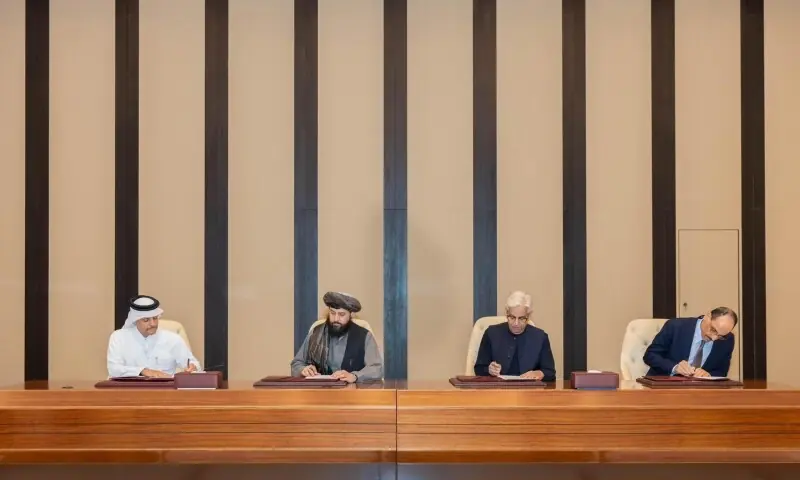
ISLAMABAD: Pakistan and Afghanistan have reached an agreement on an immediate ceasefire after high-level talks in Doha, pledging to respect each other’s sovereignty and to convene again later this month to address lingering security issues, Pakistan’s defence minister said on Sunday.
The deal, brokered with Qatari mediation, comes amid a sharp escalation in border clashes that have claimed dozens of lives on both sides in recent days, including Pakistani airstrikes on militant camps inside Afghanistan. It represents a tentative step toward de-escalation in a region long plagued by cross-border militancy and mutual accusations of harboring terrorists.
Khawaja Asif, defence minister, who led the delegation to the Qatari capital on Saturday, disclosed the agreement in a post on X. “A ceasefire agreement has been finalised,” he said. “The terrorist attacks from Afghanistan on Pakistan’s soil will cease immediately. Both neighbouring countries will respect each other’s territory.”
Asif added that delegations from the two countries would meet again in Istanbul on Oct. 25 to discuss matters in detail, expressing gratitude to the hosts and mediators. “We are sincerely grateful to both brotherly countries, Qatar and Turkiye,” Asif said.
The talks, which lasted 13 hours according to a post on the X account of PTV News citing Qatar’s Ministry of Foreign Affairs, followed a 48-hour ceasefire that was extended on Friday to facilitate the negotiations. That temporary truce had been announced by Foreign Office on Wednesday, amid ongoing hostilities.
Foreign Minister Muhammad Ishaq Dar hailed the Doha agreement as progress. “I welcome the agreement finalised late last night in Doha. It is the first step in the right direction,” Dar said in a post on X. “Deeply appreciate the constructive role played by brotherly Qatar and Turkiye.”
He expressed hope that the upcoming meeting in Istanbul would lead to “the establishment of a concrete and verifiable monitoring mechanism” to combat terrorism “emanating from Afghan soil,” stressing that “it is important to put all efforts in place to prevent any further loss of lives.”
From the Afghan side, Zabiullah Mujahid, the spokesperson for the Taliban government, confirmed the accord in a statement on Sunday. “Negotiations between representatives of the Islamic Emirate of Afghanistan and the Islamic Republic of Pakistan, held in Qatar, have concluded with the signing of a bilateral agreement,” he said. “Under the terms of the agreement, both sides reaffirm their commitment to peace, mutual respect, and the maintenance of strong and constructive neighbourly relations.”
Mujahid statement specified that “neither country will undertake any hostile actions against the other, nor will they support groups carrying out attacks against the Government of Pakistan.” Further, “Both sides will refrain from targeting each other’s security forces, civilians, or critical infrastructure,” the statement said, emphasizing a resolve to handle disputes diplomatically. “Both sides are committed to resolving issues and disputes through dialogue… a comprehensive and meaningful ceasefire has been mutually agreed upon.”
The agreement also calls for establishing “a mechanism… under the mediation of intermediary countries, to review bilateral claims and ensure the effective implementation of this agreement.”
Mujahid extended appreciation to Qatar and Turkiye for their facilitation. In a subsequent post, Mujahid clarified the clause about not supporting attacks against Pakistan, reiterating that it aligned with longstanding policy. “It has been the permanent position of the Islamic Emirate that it does not allow the use of Afghan territory against any other country,” he wrote. “It (The Islamic Emirate) does not support any attack against anyone and has always emphasised this stance.”
The PTV News post, citing Qatar’s foreign ministry, elaborated that “both countries not only agreed on an immediate ceasefire but also decided to establish a permanent mechanism for bilateral peace and stability.” It said follow-up meetings would ensure “the implementation and sustained continuity of the ceasefire,” adding that “these measures will prove beneficial in promoting security and stability in both Pakistan and Afghanistan.”
Turkiye served as a mediator in the process, hosted by Qatar. The breakthrough follows a week of intense fighting. On the night of Oct. 11, Afghan forces launched what Pakistan described as an unprovoked attack on its border posts, igniting clashes that resulted in the deaths of 23 Pakistani soldiers and more than 200 Taliban fighters and affiliated militants. Pakistan retaliated with precision strikes on militant camps in Afghanistan’s Kandahar Province and near Kabul, calling on the Taliban authorities to crack down on terrorist groups using Afghan soil as a base.
Afghanistan characterized its initial border action as retaliatory, accusing Pakistan of airstrikes on its territory the previous Thursday — an allegation Islamabad has neither confirmed nor denied. Hostilities flared again on Oct. 14, with exchanges of fire involving Afghan Taliban forces and militants from Fitna al Khawarij — a term Pakistani officials use for the banned Tehreek-i-Taliban Pakistan — at the Kurram border crossing. Pakistan responded the next day with additional strikes in Kandahar and Kabul.
Even as the temporary ceasefire was extended on Friday, Pakistan conducted further operations against hideouts of the outlawed Hafiz Gul Bahadur group in the Angoor Adda region and Afghanistan’s Urgun and Barmal Districts in Paktika Province. Those strikes followed a gun-and-bomb assault on a military installation in North Waziristan. As the Doha talks proceeded on Saturday, Pakistan’s Foreign Office issued a statement reaffirming that the country “did not seek escalation” but urged Afghan authorities “to honour their commitments to the international community and address Pakistan’s legitimate security concerns by taking verifiable action against terrorist entities.” “Pakistan appreciates the mediation efforts of Qatar and hopes these discussions contribute to peace and stability in the region,” the foreign office said.
Ties between Islamabad and Kabul have been fraught since 2023, with Pakistan repeatedly voicing alarm over militants launching cross-border attacks from Afghan territory. The situation worsened after the TTP ended its ceasefire with Pakistan in November 2022, leading to increased violence in the provinces of Khyber Pakhtunkhwa and Balochistan.
Copyright © 2021 Independent Pakistan | All rights reserved