By Staff Reporter
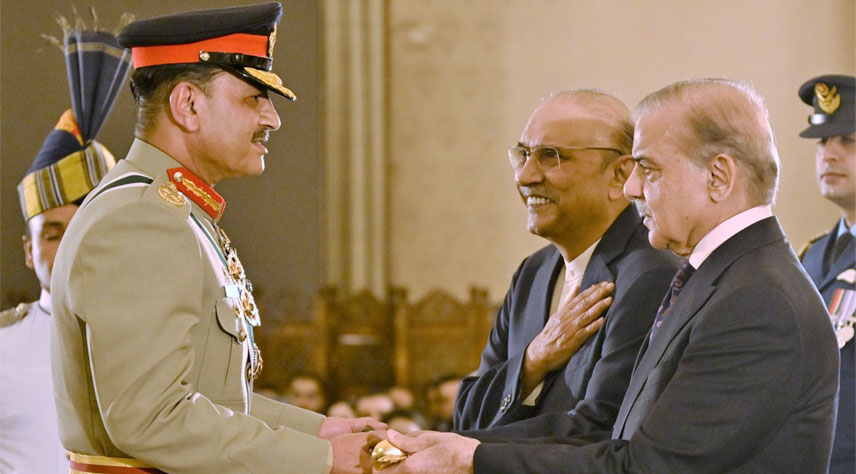
ISLAMABAD: President Asif Ali Zardari on Thursday signed off on the summary to appoint Chief of the Army Staff Field Marshal Asim Munir as the country’s first chief of defence forces, a newly created post that consolidates military authority and extends the army chief’s tenure amid a sweeping reorganisation of the country’s armed forces command structure.
The move, announced in a statement from the presidency, said Zardari also signed off on the two-year extension in the tenure of Air Chief Marshal Zaheer Ahmed Babar Sidhu and extended his best wishes to the two for their successful tenures.
The chief of defence forces position, created under the 27th Constitutional Amendment, will replace the now-abolished office of the Joint Chiefs of Staff Committee chairman, which formally ended on November 27. It would be a dual-hatted position combined with the office of the army chief.
Field Marshal Munir’s appointment to both positions is set for a five-year term, effectively recommencing his tenure as army chief from the date of notification and extending it until November 2030. “On issuance of notification of the first appointment of the Chief of the Army Staff concurrently the Chief of the Defense Forces under this sub-section, the existing tenure of the incumbent Chief of the Army Staff shall be deemed to have recommenced from the date of such notification,” states the amended Army Act, which allows for the possibility of an additional five-year extension.
Earlier in the evening, Prime Minister Shehbaz Sharif sent a summary to President Zardari recommending the appointment of Field Marshal Munir as chief of defence forces. The prime minister today approved the summary for the appointment of Field Marshal Munir “as the chief of army staff and the chief of defence forces,” and then referred it to the President House, said a press release by the Prime Minister’s Office.F ield Marshal Munir’s appointment for both roles is for a period of five years, the statement added.
Prime Minister Sharif also approved a two-year extension in the tenure of Air Chief Marshal Sidhu, which will take effect upon the completion of his current five-year tenure in March 2026, the Prime Minister’s Office added. Air Chief Marshal Sidhu was appointed as the chief of the air staff in March 2021 and had been granted a one-year extension in 2024.
The restructuring, enacted last month, vests the chief of defence forces with oversight of joint operations, multi-domain planning and inter-service integration, effectively making the position the commander not only of the army but also of the air force and navy. It also grants lifetime immunity from criminal prosecution to the field marshal and the president.
Officials and observers had anticipated the notification to align with the abolition of the Joint Chiefs post on Nov. 27, coinciding with the retirement of Gen. Sahir Shamshad Mirza. The delay sparked speculation of tensions between the civilian government and the military, but Defense Minister Khawaja Asif dismissed such talk last week, asserting that the appointment would proceed “in due course of time” after Sharif’s return from a trip to Britain.
In an informal conversation with journalists at the Aiwan-e-Sadr in Islamabad on Thursday, shortly after the summary was forwarded, Field Marshal Munir struck an optimistic note. “Everything is fine; it’s all in front of you. Things are moving towards improvement, and Pakistan will now soar to greater heights from here,” he said.
The government rapidly pushed the 27th Amendment through parliament last month, but the notification setback complicated the transition to the restructured higher-defence framework, which military planners had hoped would be seamless .A pending decision is the appointment of the commander of the National Strategic Command, a new four-star position created to assume the nuclear manager role previously exercised by the Joint Chiefs of Staff Committee chairman.
Officials believe this appointment will be made only after the chief of defence forces notification is issued. The National Strategic Command commander will be appointed by the prime minister on the recommendation of the chief of the army staff “concurrently the chief of defence forces,” as per the now-amended Article 243 of the Constitution.
Meanwhile, the National Command Authority Act, which pertains to the command and control of strategic assets, still requires amendment to reflect the abolition of the Joint Chiefs of Staff Committee chairman and the emergence of the chief of defence forces and National Strategic Command commander under Article 243.The changes are expected to be complex, particularly regarding the placement of the new posts relative to the Pakistan Air Force and Pakistan Navy chiefs and whether the air force and navy heads will retain representation in the National Command Authority once their strategic commands are subsumed under a unified National Strategic Command commander.
Field Marshal Munir, appointed army chief in November 2022, will now serve a total of eight years in the role under the new framework, a significant consolidation of power in a country where the military has long played a dominant role in politics and security affairs. The amendments reflect ongoing efforts to streamline military hierarchy, but they have raised questions about the balance between civilian oversight and armed forces autonomy.
Copyright © 2021 Independent Pakistan | All rights reserved