By Staff Reporter
ISLAMABAD: Pakistan and Saudi Arabia have completed ratification of the Makkah Joint Defence Agreement, the Foreign Office said on Friday, leaving Turkey as the only signatory still working through its approval process.
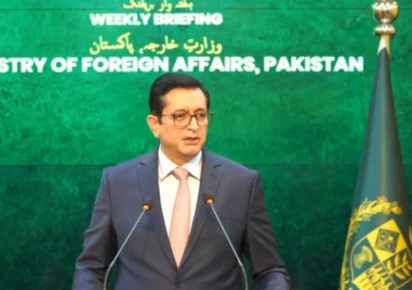
Sajjad Haider Khan, the ministry’s spokesperson, told his weekly press briefing in Islamabad that Ankara was following the procedures required by its own legal framework. “Each country follows its own constitutional and legal procedures for the approval and ratification of international agreements,” he said.
Turkey’s process is now before parliament. President Recep Tayyip Erdogan submitted the agreement to lawmakers on Tuesday, and it must go through the foreign affairs committee, chaired by the former foreign minister Mevlut Cavusoglu, before reaching a plenary vote. Reuters reported that committee debate could begin as early as Friday.
The pact was signed in Makkah on 7 August by Shehbaz Sharif, the Pakistani prime minister, Saudi Crown Prince Mohammed bin Salman and Erdogan, and allows each state to treat an attack on one as an attack on all. It builds on a mutual defence agreement that Pakistan and Saudi Arabia signed in September 2025.
Asked whether the text contained undisclosed provisions, particularly given Pakistan’s separate defence arrangement with Riyadh, Khan said the agreement ran to 16 articles. “There are no hidden provisions; the agreement is explicit and clear in its provisions and articles,” he said. Pakistan, he added, endorsed the version made public through the Turkish parliament.
That published text reportedly bars members from withdrawing for the first 10 years after it takes effect. It also creates a Strategic Political and Defence Committee of foreign ministers, defence ministers and chiefs of general staff, supported by a secretariat based in Saudi Arabia.
Khan said ratification and operationalisation were handled through that committee, whose latest meeting took place on 5 October. The session, held in Riyadh, was described as an emergency meeting. He stressed the agreement’s defensive character, saying it was consistent with the UN Charter and aimed at regional peace, security and stability. Turkey’s foreign minister, Hakan Fidan, has also said the pact is not offensive and that his country would not send troops to another state.
Kashmir, water and India
Khan was asked about an International Crisis Group report warning of renewed conflict between Pakistan and India, driven by rising militant activity in Indian-occupied Kashmir. He said Islamabad wanted all disputes settled peacefully and in line with international law.
“From Pakistan’s perspective, war is not a solution to any issue,” he said, adding that Kashmir and the Indus Waters Treaty should be addressed through dialogue.
He accepted that both issues carried a potential risk of conflict, but played down the chances of another military confrontation and said Pakistan was fully prepared to defend its sovereignty and territorial integrity. Asked whether India might stage another false-flag operation, he said that could not be ruled out. “We are prepared for all eventualities,” he said.
The two nuclear-armed neighbours fought a short but intense conflict last year. India put the 1960 water-sharing treaty in abeyance in April 2025, after the Pahalgam attack.
Khan urged the international community, including the five permanent members of the UN Security Council and bodies working in the water sector, to help uphold international law. The treaty was signed by two countries, he said, but its implications reached further, because letting an upper-riparian state misuse its provisions or weaponise water could set a precedent elsewhere.
Pakistan would not allow its share of water to be diverted from rivers meant to flow into the country, he said, recalling that the National Security Committee had warned that any diversion would be considered an “Act of War”.
Islamabad also rejected what it called “baseless and unwarranted assertions” by India’s Ministry of External Affairs about resolutions on Kashmir adopted at the 52nd session of the Organisation of Islamic Cooperation’s Council of Foreign Ministers in Baghdad. Khan said the resolutions reflected the longstanding collective position of member states, grounded in UN Security Council resolutions, and that the OIC had rejected India’s unilateral measures to alter the disputed status of the territory.
“The organisation’s continued principled support is an important reaffirmation that the Jammu and Kashmir dispute remains an internationally recognised dispute,” he said. He called India’s portrayal of the OIC position misleading and said New Delhi should respect the fundamental rights of Kashmiris and create conditions for a settlement in line with UN resolutions and the wishes of the people of Kashmir.
He also voiced grave concern over what he described as “yet another” eviction notice served on a historic mosque in New Delhi. The Race Course Mosque, he said, was a Waqf property and heritage site facing the threat of demolition under the governing Bharatiya Janata Party. “The measure exemplifies worsening Islamophobia in India,” he said, calling on the international community to take notice of the demolition of places of worship, including Muslim ones.
Washington and Tehran
Khan also responded to remarks by the US secretary of state, Marco Rubio, during a visit to India, in which Rubio referred to Pakistan as a nuclear-armed state and spoke of Washington’s interest in cooperative relations with Islamabad.
Pakistan, the spokesperson said, enjoyed strong ties with the US in trade, investment and people-to-people contacts, with more than $5bn of Pakistani exports going there. He said India often viewed Pakistan’s relationships through a “zero-sum” lens, but that New Delhi’s strategic alignment with Washington could not prevent the US from keeping its ties with Islamabad.
He declined to comment on the visit to Tehran by Field Marshal Asim Munir, who travelled with the interior minister, Mohsin Naqvi, as the US president renewed threats to resume hostilities. The question, Khan said, could be taken up on another occasion. He was also asked whether Pakistan was in contact with Washington and pursuing de-escalation. His opening statement reiterated Pakistan’s commitment to diplomatic engagement, regional coordination and the peaceful resolution of conflicts.
Local media reported that Iranian leaders told the field marshal on Tuesday that Washington must take the first steps to rebuild trust, and that no breakthrough was announced. Pakistan brokered a ceasefire in April and hosted talks that produced the Islamabad Memorandum of Understanding in June, but the process later stalled.
Istanbul talks
Ishaq Dar, the deputy prime minister and foreign minister, travelled to Istanbul on Friday for a meeting of the so-called Regional Four of Pakistan, Egypt, Turkey and Saudi Arabia, to be followed by a wider session with Britain, France and Germany. Khan said it would be the first meeting of the seven countries in that format.
Dar held separate telephone calls on 18 October with his Iranian counterpart, Abbas Araghchi, and Egypt’s Badr Abdelatty. With Abdelatty he condemned Houthi attacks on Saudi Arabia and reaffirmed support for the kingdom’s sovereignty, territorial integrity and security.
The Foreign Office said later that the four ministers repeated that condemnation and backed Saudi sovereignty, and that the wider session, which it said also included Italy, ended with agreement to keep meeting in this format. Britain’s foreign ministry had said the talks would centre on the Strait of Hormuz and the situation in Saudi Arabia. Dar also met Fidan, Abdelatty and the German foreign minister, Johann Wadephul, on the sidelines.
Khan said SAARC, the South Asian regional bloc, had been inactive for some time, and blamed India for holding it hostage since 2016, when a summit due in Islamabad did not go ahead. Countries across the region wanted it revived to improve trade, connectivity, transit and energy links, he said. Trade within the grouping accounts for less than 5 per cent of members’ overall trade, making South Asia one of the least economically integrated regions in the world. “A functional SAARC would benefit all countries in the region rather than just Pakistan,” he said.
Maldivian President Mohamed Muizzu made a state visit to Pakistan from 20 to 22 October at Sharif’s invitation, the first by a Maldivian president in 11 years and timed with the 60th anniversary of diplomatic relations. He met President Asif Ali Zardari and held talks with the prime minister, and the two sides exchanged 20 memoranda of understanding covering trade, investment, health, education, tourism, agriculture, defence, maritime security and climate change.
Zardari is on an official visit to Germany from 22 to 24 October, marking 75 years of diplomatic relations. Pakistan also held political consultations with Lithuania on 19 October and Latvia on 21 October, and the 10th round of its counterterrorism dialogue with the European Union took place in Islamabad on 22 October.
“The EU condemned recent terrorist attacks in Pakistan, expressed solidarity with affected civilians and acknowledged Pakistan’s counterterrorism efforts,” Khan said. Both sides voiced concern about terrorism emanating from Afghanistan and agreed to hold the next round in Brussels in 2027.
In Doha on 21 October, Pakistan, Qatar, Turkey and Indonesia signed the Badr Multilateral Memorandum of Understanding on defence industries, covering manufacturing, technical training, research and development, technological innovation and industrial capacity-building. Dar also attended the Shanghai Cooperation Organisation’s heads of government council in Dushanbe on 19 and 20 October.
Copyright © 2021 Independent Pakistan | All rights reserved