By Staff Reporter
ISLAMABAD: Pakistan signed a memorandum of understanding with crypto exchange Binance to explore tokenizing up to $2 billion in sovereign bonds, treasury bills and commodity reserves, a move aimed at boosting liquidity and drawing international investors amid a broader push into digital assets.
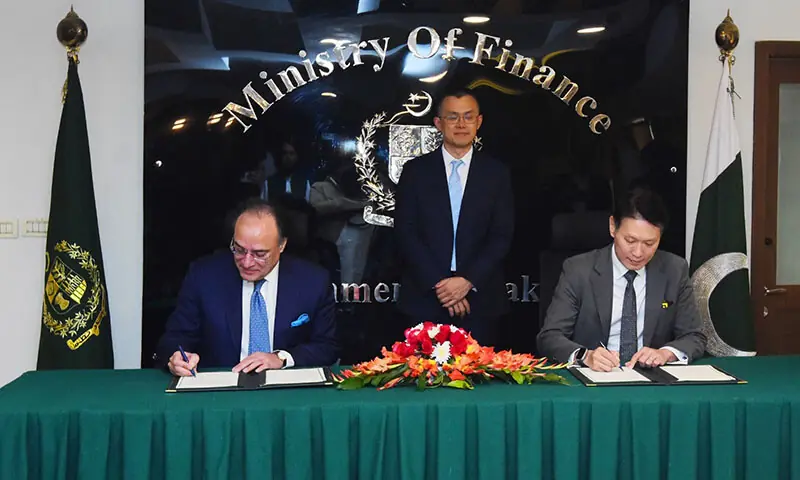
The non-binding agreement, inked by Finance Minister Muhammad Aurangzeb and Binance Co-Chief Executive Officer Richard Teng in Islamabad, sets the stage for potential collaboration on blockchain-based distribution of real-world assets like government-owned oil, gas and metals.
It could involve technical expertise, advisory support and training from Binance or its affiliates to build compliant infrastructure, according to a finance ministry statement. “This is a very strong message — not only for Pakistan, but for the entire world,” Aurangzeb said at the signing, attended by Binance founder Changpeng Zhao. “What we have signed today reflects a long-term partnership. From where we started to moving towards operationalisation, this progress could not have happened without active guidance and leadership. The next step for us is execution, and we are fully committed to delivering results with speed and quality.”
Tokenization, which creates digital representations of physical assets, is part of Pakistan’s accelerating digital-finance overhaul. The country has established the Pakistan Crypto Council and the Pakistan Virtual Assets Regulatory Authority, while drafting a formal licensing regime. A central bank digital currency pilot and a Virtual Assets Act are slated for 2025. Pakistan ranks as the world’s third-largest crypto market by retail activity, PVARA Chairman Bilal bin Saqib said earlier this week at Binance Blockchain Week in Dubai.
The deal follows a meeting in Islamabad between a Binance delegation, including Global CEO Teng, and senior Pakistani officials including Prime Minister Shehbaz Sharif and Chief of Army Staff Field Marshal Syed Asim Munir. Zhao called the pact a landmark for the nation’s tech-savvy population. “This is a great signal for the global blockchain industry and for Pakistan,” he said. “It has a very big impact on the country’s future and its technology-driven generation. This is the beginning … now we can move towards full deployment and execution. We are honoured to work with Pakistan’s leadership and are confident this collaboration will deliver positive and lasting outcomes for the economy.”
Separately, PVARA granted initial clearances to Binance and digital-asset platform HTX to register with regulators, establish local subsidiaries and prepare full exchange license applications. The approvals, issued after reviews of governance and compliance controls, allow the firms to enroll in the anti-money laundering system. The clearances launch Pakistan’s phased licensing process, with compliance determining which exchanges advance, Saqib said.
The initiative aligns with global trends, as nations like the United Arab Emirates, Japan and parts of the European Union tighten rules for crypto exchanges. In April, the Pakistan Crypto Council signed a letter of intent with US-based World Liberty Financial to explore stablecoins and other digital-asset infrastructure. Any definitive agreements under the MoU would be negotiated within six months, subject to legal and regulatory approvals, and governed by Pakistani law without exclusivity or procurement commitments, the ministry said.
Copyright © 2021 Independent Pakistan | All rights reserved