By Staff Reporter
ISLAMABAD: Prime Minister Shehbaz Sharif urged the international community on Friday to press the Afghan Taliban to rein in terrorist groups operating from Afghan soil, emphasising Islamabad’s persistent security concerns amid fragile cross-border relations.
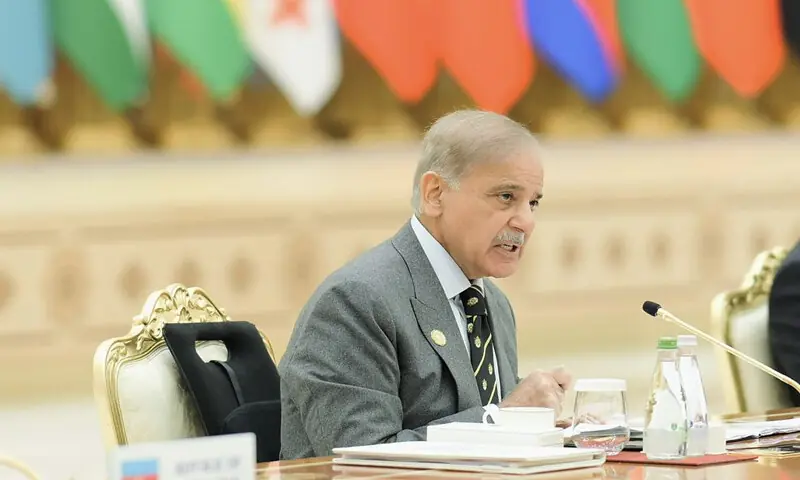
Speaking at an international forum in Ashgabat, Sharif called for the Afghan regime to fulfill its international obligations and take meaningful action against terrorism. His remarks came during a two-day visit to this Central Asian nation, where he also held bilateral talks with President Recep Tayyip Erdogan of Turkey and President Masoud Pezeshkian of Iran, stressing the need for Kabul to address Pakistan’s worries over cross-border attacks.
Pakistan has accused Afghanistan’s Taliban-led government of failing to curb cross-border militancy, including attacks by the Pakistani Taliban, allegations Kabul denies. Relations between the two neighbors have deteriorated since October, when border clashes killed dozens, prompting emergency talks in Doha, Istanbul and Saudi Arabia. While understandings were reached with regional mediation, Pakistani officials say the ceasefire remains fragile.
“We need the international community to urge the Afghan Taliban regime to fulfill its international obligation and commitments, and reigning terrorist elements, operating from its territory,” Sharif said in his address at the forum in Turkmenistan.
“In the meanwhile, we are very grateful to our brotherly countries Qatar, Turkiye, the Kingdom of Saudi Arabia, UAE and Iran for their sincere desire and efforts to achieve permanent ceasefire, which as I speak, is still very fragile.”
The forum, hosted in Turkmenistan’s capital to commemorate the United Nations’ 1995 recognition of the country’s neutral status, defined as abstention from wars, impartiality and recognition thereof, drew global leaders, including heads of state from Russia and Turkey.
Reaffirming Pakistan’s dedication to peaceful resolutions, Sharif cited the UN Security Council’s adoption in July of Resolution 2788, sponsored by Pakistan and unanimously passed, as an endorsement of that approach, calling for stronger mechanisms to settle disputes nonviolently.
Sharif also addressed the conflict in Gaza, voicing hope that peace initiatives would “ultimately protect and save the lives of innocent Palestinians, ensuring a lasting and permanent ceasefire, [and] allow the flow of critical humanitarian aid.” He pledged continued Pakistani support for “all efforts aimed at upholding the inalienable right to self-defence for the Palestinian people as well as the brave and resilient Kashmiri people.”
Linking peace to development, he highlighted the 2030 Agenda for Sustainable Development as a blueprint for a better world, with his government prioritizing socioeconomic progress, financial inclusion and integrating women and marginalized groups into the economy. On climate change, Sharif pointed to Pakistan’s push for cleaner solutions and ecosystem restoration, but warned that developing nations like his face obstacles from disasters and economic inequities. He recalled the “catastrophic impact” of recent floods, labeling climate change, poverty and inequality as “transnational threats” requiring shared responsibility, unity and equitable access to technology, “without any kind of discrimination.”
“I appeal to all of you ladies and gentlemen to let this forum serve as a genuine call to action and urgent action for a new paradigm of international relations where we move from zero-sum mindsets to purposeful cooperation. Let us invest in connectivity, not just as conduits for transportation of goods but as bridges for people, ideas and prosperity. Let us commit to [resolving] disputes peacefully through dialogue and diplomacy and reaffirm our earnest commitment to the principles of the UN Charter, and let us together chart a common course towards a future defined by peace, mutual trust and shared prosperity. For far too long, the seeds of hatred and conflict have overshadowed our world. Let the dove of peace take flight once more.”
On the sidelines, Sharif met Erdogan, reaffirming historic fraternal bonds rooted in shared values. He voiced satisfaction with high-level engagements and the upcoming 16th session of the Pakistan-Turkey Joint Ministerial Commission to implement decisions from their strategic council. Prioritizing energy, petroleum and minerals, he welcomed Turkish investments and urged timely execution of recent agreements.
The leaders discussed Pakistan’s interest in Turkish expertise for privatizing power distribution companies, agreeing to ministerial exchanges soon. They also highlighted regional connectivity via the revived Islamabad-Tehran-Istanbul rail network and exchanged views on global issues. Sharif praised Erdogan’s leadership on Gaza peace efforts and thanked Turkey for mediating with Afghanistan, insisting peace depended on addressing Pakistan’s security concerns.
In talks with Pezeshkian, the leaders noted mutual support during recent aggressions — apparently alluding to Pakistan-India tensions in May and Iran-Israel clashes in June. Building on the 22nd Pakistan-Iran Joint Economic Commission meeting, Sharif pushed for boosted trade, border markets, security and transport links. He reiterated the call for Afghanistan to act on terrorism from its soil.
Sharif held informal meetings with other leaders, including President Vladimir V. Putin of Russia, President Emomali Rahmon of Tajikistan and President Sadyr Japarov of Kyrgyzstan. Deputy Prime Minister Ishaq Dar, accompanying Sharif, met Iranian Foreign Minister Abbas Araghchi to discuss cooperation and regional matters, agreeing to deepen trade, connectivity and people-to-people ties for stability.
Copyright © 2021 Independent Pakistan | All rights reserved