By Staff Reporter
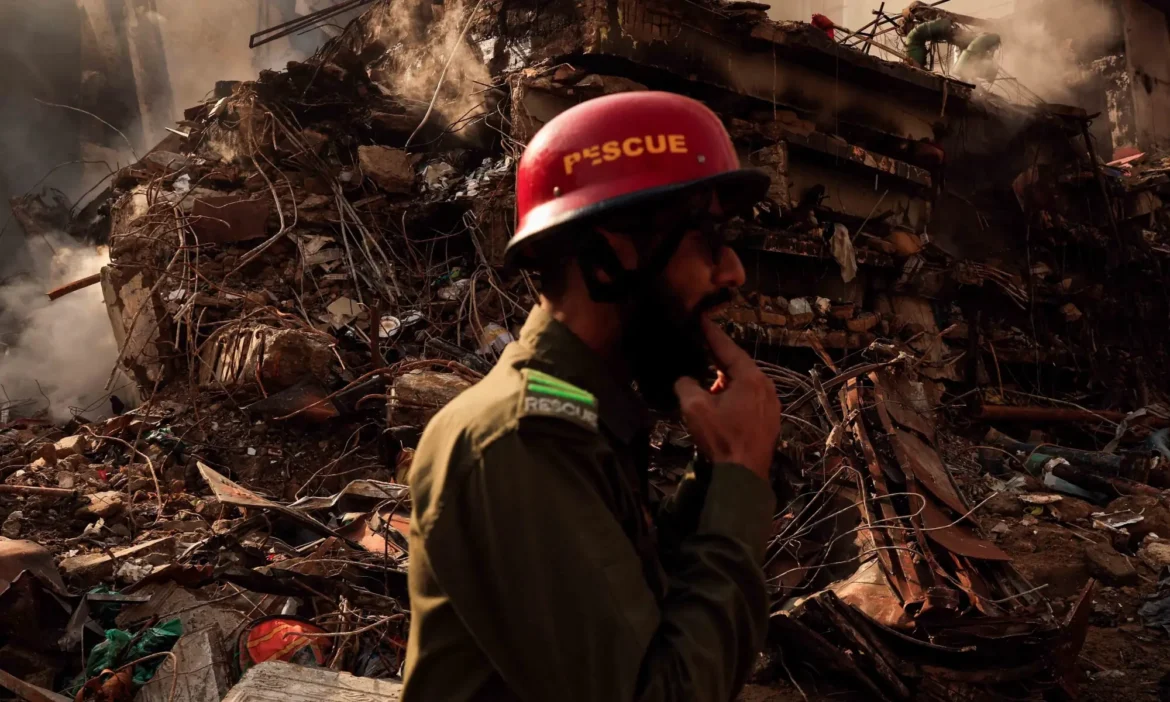
KARACHI: Rescue workers pulled 30 charred bodies from a single shop in the rubble of Gul Plaza on Wednesday, pushing the death toll from Karachi’s deadliest fire in more than a decade to at least 60, as authorities warned that dozens more people remained unaccounted for in the gutted commercial complex.
The grim discovery came from a crockery store on the mezzanine floor, where victims had barricaded themselves in a desperate bid to escape the flames that engulfed the sprawling multi-story building late Saturday. “These people locked themselves in the crockery shop to save their lives,” said Syed Asad Raza, the deputy inspector general for Karachi’s South district, speaking to reporters at the site.
Suleman, the shop’s owner, told local media that 14 bodies had been recovered from his store alone, including his cousins, employees and customers who were inside when the blaze erupted. A resident named Rasheed, who lives nearby, said the shop had extended its hours until 2 am for a wedding-season sale, far beyond its usual 10 pm closing time.
The fire, which raged for more than 24 hours before being extinguished on Sunday, only to reignite Monday amid smoldering debris, has turned a routine recovery operation into a protracted humanitarian ordeal. Parts of the ground-plus-three-story plaza, which housed over 1,200 shops across an area larger than a football field in the city’s busy Saddar district, collapsed under the intense heat, melting steel reinforcements and trapping victims beneath tons of concrete and twisted metal.
City officials described a scene of extreme peril for rescuers, with lingering smoke, high internal temperatures and unstable structures limiting access to key areas. “There’s no haste in the rescue operation as it’s an issue of human lives, and the operation is being carried out while catering to relevant technicalities,” said Javed Nabi Khoso, the deputy commissioner for Karachi South, who oversees the effort. Heavy machinery was being used cautiously to remove debris, including large chillers, to ease the load on the weakened building.
Khoso said the death toll could rise further, as many remains were fragmented and burned beyond recognition, some weighing as little as three kilograms and including mismatched limbs. “After we send them for DNA analysis, we will find out the exact number,” he said, fearing that some victims were children. Police surgeon Summaiya Syed, speaking from Civil Hospital, where remains from two shops were brought, said doctors “cannot yet confirm whether these are 21 bodies or remains of more individuals. Since this morning, only remains of bodies have been brought to the Civil Hospital.”
Authorities have collected DNA samples from 48 families to aid identification, a process that could take weeks and prolong the agony for relatives camped outside the cordoned-off site, some chanting slogans and clashing with police amid frustration over the slow pace. Khoso said 86 people were initially reported missing, with 39 later traced to the plaza; 17 recovered bodies remain unidentified, while 11 have been confirmed. He said about 50 percent of the victims were shopkeepers, and rescuers had gathered as much data as possible despite the chaos.
Rescue official Muhammad Ameen of the Edhi Foundation, Pakistan’s largest volunteer emergency service, called it “the most challenging fire” they’ve faced, with heat so intense it “melts the human body” and collapses walls, mixing remains in the debris. “In such conditions, how could anyone have survived inside.”
Karachi Commissioner Syed Hassan Naqvi, who visited the site, called the investigation “quite complex, with multiple angles under review.” Naqvi said “no single institute can be held responsible” and promised “long-term and far-reaching recommendations” to prevent future disasters. Additional Inspector General Azad Khan ruled out terrorism, saying: “So far, no evidence of terrorism has been found in the Gul Plaza incident.”
The blaze has exposed glaring safety lapses in one of Pakistan’s most crowded commercial hubs. Fire officer Zafar Khan of the Karachi Metropolitan Corporation said the building lacked emergency exits and fire extinguishers, complicating initial response efforts. “When the information was initially received of fire, three fire tenders were dispatched simultaneously; however, the scale of the blaze was large, and the road leading to the incident site was narrow,” he said. The operation was further hampered by panicked shopkeepers demanding priority for their stores.
The Sindh Building Control Authority (SBCA) said the building, constructed in 1979 with revisions in 1998 and regularization in 2003, had approval for 1,102 shops and featured two basement staircases, six from ground to first floor, five to the second and third, and 16 ground-floor exits. But Raza noted that 14 of those exits were closed during the fire.
The fallout extended to adjacent Rimpa Plaza, a 13-story complex partially damaged by falling debris and heat exposure. SBCA Director General Muzammil Halepota said three floors were affected, with two pillars weakened; repairs, including steel jacketing, were underway. The authority issued a notice declaring parts of the building unsafe, ordering immediate evacuation and supervised strengthening. “Upon inspection, the affected portion of Rimpa Plaza’s structure is unsafe and dangerous, posing a serious threat to human life and property,” the notice read, warning of legal action under the Sindh Building Control Ordinance if ignored.
In a broader crackdown, the SBCA gave builders and developers three days to fix fire safety deficiencies flagged in a January 2024 audit of Karachi buildings, which identified 266 noncompliant structures. The audit, ordered by Mayor Murtaza Wahab and conducted by the fire department and metropolitan corporation, was submitted to Chief Minister Murad Ali Shah on Jan. 19, 2026. Local Government Minister Nasir Hussain Shah said the chief minister expressed displeasure over the delay and directed fire alarm installations citywide, adding that officials were coordinating with the Association of Builders and Developers.
This kind of horror isn’t new in Karachi, a city bursting with over 20 million souls where old buildings, jammed corridors and spotty safety checks turn fires into killers. The city has seen such disasters before — the 2012 Baldia Town factory fire that claimed over 260 lives, the 2009 Bolton Market arson that razed hundreds of shops. Traders here point to outdated wiring, absent fire exits and lax inspections as chronic risks in commercial hubs.
As night settled in on Wednesday, floodlights cast a harsh glow over the mangled concrete as excavators and bucket loaders clawed through the debris, working through the darkness. Beyond the cordons, families waited — silent, exhausted, unwilling to leave — a stark reminder of the human cost in a city where commerce and peril often collide. Khoso said the structure would not be torn down until every missing person was found. “When everything is complete, the entire building will be demolished.”
Copyright © 2021 Independent Pakistan | All rights reserved