By Staff Reporter
QUETTA: Balochistan’s home minister escaped unhurt after his security convoy was ambushed by gunmen in a remote stretch of Mastung district on Friday, in an attack that came as Pakistan marked its 79th Independence Day under some of the tightest security measures seen in the restive province in years.
Mir Ziaullah Langove, the province’s minister for home and tribal affairs, was travelling from Kalat to the provincial capital, Quetta, when his convoy came under fire near Khad Kocha, a mountainous area roughly 22 kilometres from Mastung city. Police said between six and eleven people were wounded in the exchange of fire, with accounts differing on whether all of the injured were police personnel or included members of the public.
Awais Khan, in charge of the local police station, said six policemen escorting the minister were hurt but that Langove himself “remained unhurt in the attack.” A separate police official quoted by local media put the number of wounded at six, three of them police, and said the convoy was struck as it reached the Khad Kocha area. The injured were taken to hospitals in Quetta, with doctors at one facility saying two were in serious condition and had been referred onward for further treatment.
No group had claimed responsibility for the attack by Friday evening. Security forces sealed off the area and launched a search operation for the attackers.
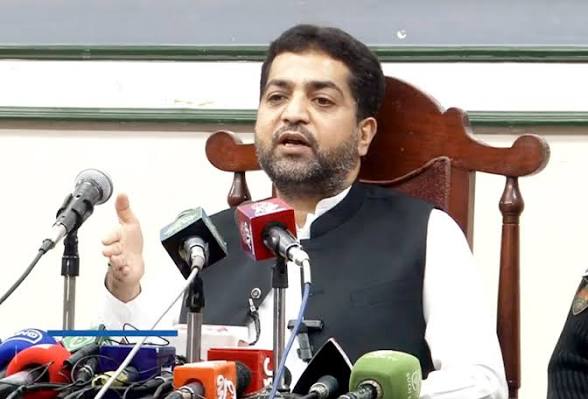
Speaking afterwards in Quetta, Langove struck a defiant tone. “I cannot be frightened by these firecrackers,” he said, insisting the attack would not weaken the government’s resolve.
Baloch separatist militants are known to maintain a strong presence around Khad Kocha, where a curfew has been in place since 23 July following a string of attacks on transporters, travellers and security personnel in the area.
Second attack in Turbat
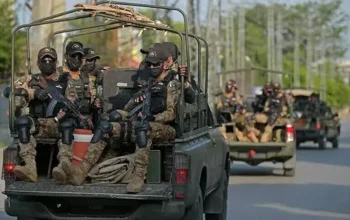
In a separate incident on Friday morning, a roadside bomb struck a security forces convoy in the centre of Turbat, hundreds of miles to the south-west. Sher Zaman, the officer in charge of Turbat police station, said the remotely detonated device had been planted on a motorbike parked near a barber’s shop and wounded five civilians who had been sitting outside at the time.
The twin attacks unfolded against a backdrop of heavily reinforced security across Balochistan, where authorities suspended mobile data services in several districts as the country marked Independence Day. The measures reflect the scale of the threat facing the province, Pakistan’s largest by area but its least developed, which borders both Iran and Afghanistan and has for years been the epicentre of a separatist insurgency.
The violence in Mastung and Turbat came just two days after the Pakistani military reported that 18 militants and three civilians had been killed, and two soldiers wounded, in a series of separate clashes across the region.
A province under strain
Friday’s ambush also came almost exactly three weeks after gunmen killed a sessions judge and his gunman in a separate attack in Mastung. According to District Police Officer Allah Bakhsh Baloch, the judge’s vehicle was fired upon in the Wali Khan area on 23 July as he travelled from Quetta to the sessions court in Mastung. An additional sessions judge and another person were critically injured in that assault.
The unrest in Balochistan mirrors a broader deterioration in security across Pakistan’s western provinces since 2021, when the Taliban returned to power in neighbouring Afghanistan. Research published by the Centre for Research and Security Studies found that Khyber Pakhtunkhwa and Balochistan together accounted for nearly 96 per cent of all violence-related deaths recorded nationwide in the second quarter of 2026. Khyber Pakhtunkhwa alone recorded 475 deaths, or just over 61 per cent of the total, while Balochistan accounted for 265 deaths, or 34 per cent. Khyber Pakhtunkhwa also saw the highest number of violent incidents, with 151 recorded, representing 57 per cent of the national total, while Balochistan followed with 94 incidents, or 35 per cent.
Separatist groups in Balochistan have long accused Islamabad of extracting the province’s natural resources — among the richest in the country — while leaving it under-developed, an allegation the federal government firmly denies, insisting it is investing in the welfare of local communities.
Langove, a member of the Balochistan Awami Party, was sworn in as the province’s home minister in March. It is his second stint in the post: he previously held the role before his appointment was declared null and void when he was formally de-notified on 21 August 2024.
Copyright © 2021 Independent Pakistan | All rights reserved