By Staff Reporter
ISLAMABAD: Accusations of election fraud and institutional meddling dominated a tense Senate session on Friday, with opposition lawmakers pushing for a parliamentary investigation into the handling of February 2024’s vote.
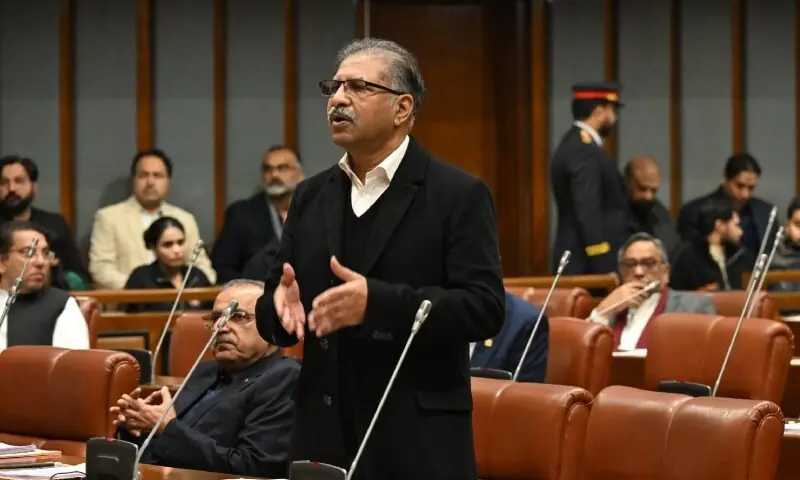
Government representatives countered by charging their critics with “economic terrorism” and recalling the opposition’s stumbles during the 2018 polls. The debate centered on a notice from Ali Zafar, the Senate leader for the Pakistan Tehreek-e-Insaf party, whose remarks prompted frequent outbursts from ruling party members. Zafar said Parliament had been pushed to the sidelines, with critical choices on the economy, security and foreign affairs handled privately instead of through legislative channels.
He expressed frustration over deals affecting the country’s long-term interests being sealed without lawmakers’ awareness, calling it an erosion of civilian control under the constitution. All members, Zafar noted, had sworn to defend that document, and he urged the Senate to step up. “Will this Senate remain a rubber stamp or will it rise to face the storm?” he asked. “Let us ensure that the law is not merely the law of the powerful but the law of the land.”
Zafar described events after the Feb. 8, 2024, elections as a deep constitutional breakdown. He said voters had delivered a straightforward outcome, only to see it undermined. “The people’s mandate was not only ignored but was systematically destroyed through violence and manipulation,” he said, adding that the move undercut democracy at its core. He referenced a 1947 address by Muhammad Ali Jinnah, Pakistan’s founder, to the first Constituent Assembly. “The authority of the government is conditional upon the will and consent of the people.” Zafar also drew from Liaquat Ali Khan, the first prime minister. “The greatest pillar of democracy is the free will of the people. The will is the foundation of the Constitution.” This wasn’t about party politics, Zafar stressed; it signaled a broader threat to the nation. Any government formed without true public support, he said, would hold neither legal standing nor ethical weight. It couldn’t handle tough calls, bring people together or guide the country through hard times. He called the current administration unstable, like a structure on shaky ground, sure to give way.
On economic matters, Zafar painted inflation as a daily hardship for citizens, not just numbers on a page. “Inflation is not a mere statistic or economic indicator,” he said. “It is a sword hanging over the head of every citizen.” Public debt, now at 80 trillion rupees, he warned, would bind future generations in dependency. “This government survives only on debt,” Zafar said. “They are not here to distribute progress, they are here to distribute misery.”
He questioned the focus on taxing those already struggling, without clear steps to expand exports, generate jobs for young people, tap into technology potential or aid small and medium businesses, which he saw as essential to the economy. “This government doesn’t have a policy or governance,” he said, “only drift, confusion, and the dark clouds of an approaching storm.”
Zafar highlighted a loss of talent, with skilled professionals leaving Pakistan due to dim prospects for fairness and opportunity. Businesses were shifting operations abroad, output was dropping and investors were pulling back. He accused officials of twisting laws for political ends. “Cases are not being filed, they are being manufactured,” Zafar said. “A court case has become a punishment itself. This is political victimization which is destroying the last remnants of public trust in the state.” These issues, he said, had spilled into foreign relations, with Pakistan stepping back from its position on Kashmir and lacking firm views on matters like Venezuela or Iran.
As global dynamics shift, Zafar called for protecting independence and involving Parliament in decisions. But progress required public confidence, which he linked to Imran Khan’s return, given widespread support for him. The PTI, Zafar said, stood ready as an option with strategies to fix the economy. He proposed a committee to examine claims of vote tampering and overreach, along with a resolution against policies that hit the poor hardest and widen divides.
Bilal Azhar Kayani, the minister of state for finance, responded by faulting the PTI’s rule from 2018 to 2022 for errors that deepened poverty and nearly caused a default. That government, he said, went through four finance ministers, first turning down an IMF deal, then taking it on bad terms and later derailing it for political reasons. As its hold weakened, Kayani said, the PTI knowingly risked collapse by weakening the IMF agreement. The new government stepped in with hard measures to restart the program, regain trust from partners and avoid default.
Even with pushback, Kayani said, they had steadied the economy and were now aiming for lasting growth and more jobs. He pointed to former PTI figures writing to the IMF to block aid as “economic terrorism.” Kayani urged the PTI to apologize for actions that brought Pakistan close to insolvency and hampered recovery.
Copyright © 2021 Independent Pakistan | All rights reserved