By Staff Reporter
ISLAMABAD: Islamabad police arrested a prominent human rights lawyer and her husband on Friday as they made their way to a court appearance, in a move that ignited immediate protests from the legal community and drew rebukes from politicians and international watchdogs who saw it as the latest sign of eroding civil liberties in the country.
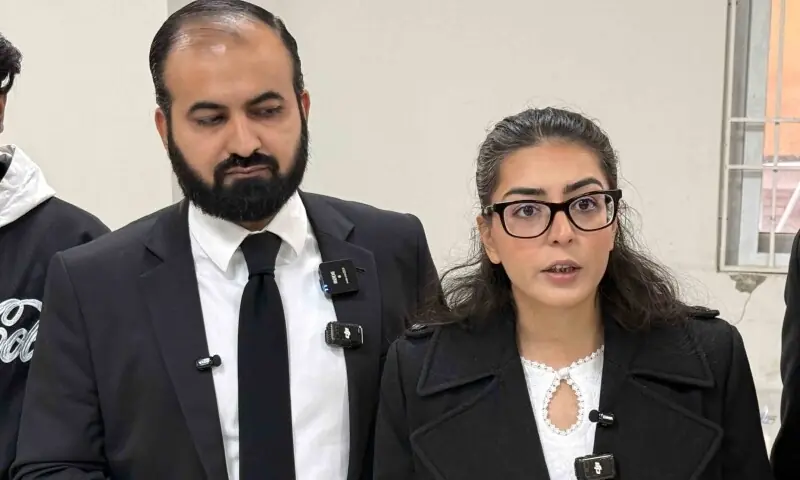
Imaan Zainab Mazari-Hazir, an activist known for taking on cases involving enforced disappearances and other abuses, and her husband, Hadi Ali Chattha, were taken into custody near a busy underpass in the capital, according to witnesses and bar association officials. Hours later, an anti-terrorism court sent them to jail on remand in a case linked to a September 2025 altercation outside the Islamabad High Court, where they are accused of protesting and assaulting the bar association’s president.
The courtroom where Anti-Terrorism Court Judge Abual Hasnat Muhammad Zulqarnain presided was under heavy security, with lawyers and reporters kept out — a detail that only heightened suspicions among the couple’s supporters that the proceedings were being shrouded in secrecy. The arrests came after days of high-stakes drama. Mazari-Hazir and Chattha had spent the previous three nights sheltering in the office of Syed Wajid Ali Gilani, the president of the Islamabad High Court Bar Association, apparently fearing imminent detention.
Bar officials said the pair tried to surrender that morning to Chief Justice Sardar Muhammad Sarfaraz Dogar in a related case over social media posts deemed controversial by authorities. But with the chief justice absent, they headed instead to the district courts in a bar association vehicle. Police, who had been positioned outside the high court for days, followed. The stop happened near the Serena Hotel, where officers blocked the car, arrested the couple and drove them to an undisclosed spot, officials said.
Speaking to reporters outside the Women Police Station later, Gilani revealed a new police report had been filed against them three days earlier. He explained that while the high court had provided some relief in one case, others were still active before Additional District and Sessions Judge Muhammad Afzal Majoka. Bar members accused police of breaking promises not to intervene, saying officers attacked lawyers on the scene, broke vehicle windows and roughly handled Mazari-Hazir. They expressed deep concern for her safety and denounced what they called law enforcement’s misconduct.
The bar association’s secretary, Manzoor Ahmed Jajja, said he’d been given explicit assurances of safe passage. In response, he resigned. “Following the arrest, I have decided to quit from the office.” In the social media case, Judge Majoka postponed the hearing because of their absence and warned that cross-examination rights could be forfeit if they didn’t show. Prosecutor Rana Usman claimed they were intentionally skipping out. Majoka gave until 3:30 p.m. Saturday to finish questioning, saying enough time had been allowed.
Earlier that week, the high court had voided Majoka’s arrest order in the social media matter and allowed four days for witness grilling, but emphasized no arrests in that case — with the caveat that missing court would end the shield.
Shireen Mazari, Mazari-Hazir’s mother and a former cabinet member, vented her fury on X, confirming the arrests and saying the pair were separated and taken to unknown places without showing any police report. “Fascism at its peak. Emasculated men in power must be so pleased with this achievement!” she wrote. She posted videos of the police pursuit and stop, alleging broken windows and violence — all to avoid further embarrassment in the social media case during cross-examination. She claimed rough treatment of the couple. By evening, she shared the court order, noting their “covert” presentation without lawyer access or the report. “Just learnt they were never even presented before the judge — kept in vehicle and taken away in the same vehicle so one could see what state they are in after violence was done on them during the arrest and maybe after arrest too. As good as a forced disappearance,” she posted.
An hour later, she lamented not knowing their location or condition, with even water, food and medicine denied. “Enforced Disappearance!” she said. In a video Mazari shared, Gilani described Thursday’s negotiations with authorities for no arrests and safe travel to court. They approached the chief justice out of caution, but no hearing occurred. On the way to sessions court, police struck near Serena Chowk, he said, smashing windows, pulling them out — including male officers grabbing Mazari-Hazir — and beating Jajja.
Gilani called on lawyers to protest at the Women Police Station and strike, threatening a revival of the 2007 movement if the “oppression” continued. “This is a very major incident for Islamabad,” he said, highlighting lawyers’ defense of the nation’s laws. The Islamabad High Court Bar Association, Islamabad Bar Association and Islamabad Bar Council all condemned the arrests in statements. The first two declared Friday strikes; the council, Saturday. The Islamabad Bar Association, after an emergency session, called it an “illegal and unconstitutional move” and demanded release. “The Islamabad Bar Association believes that every Pakistani has the right to defend themselves in the court,” it said, labeling it a human rights violation. The bar council decried police “misbehaviour, assault and torture” on Gilani and Jajja as authority abuse to intimidate lawyers. It sought unconditional freedom, an independent investigation and punishment for those involved.
Eight new Pakistan Bar Council members, including Abid Shahid Zuberi and Salman Akram Raja, urged condemnation of the “malicious persecution” and solidarity. “We are absolutely clear this brave couple is being punished solely for the sins of professionally representing victims of state oppression and speaking out against ongoing human rights abuses in Pakistan in order to set an example for others,” they stated. In parliament, leader Mahmood Khan Achakzai criticized viewpoint targeting as unconstitutional and trust-damaging. He pushed for release and a fair probe. Amnesty International called it escalation in “judicial harassment,” noting force and no due process. It demanded release and dropping charges for their work.
Copyright © 2021 Independent Pakistan | All rights reserved