By Staff Reporter
QUETTA: Pakistan accused India of orchestrating deadly militant attacks in its southwestern Balochistan province, where security forces killed 92 militants, including three suicide bombers, while repelling coordinated assaults that left 18 civilians and 15 security personnel dead, officials said on Saturday.
The assaults, which involved gunfire and explosions, targeted multiple locations including the provincial capital Quetta, the coastal city of Gwadar, and districts such as Mastung, Nushki, Dalbandin, Kharan, Panjgur, Tump and Pasni, according to the military’s Inter-Services Public Relations (ISPR) media wing.
In a statement, the ISPR said militants launched the attacks “to disrupt peace in Balochistan,” describing them as orchestrated by “Indian sponsored Fitna al Hindustan,” a term used by Pakistani authorities to refer to the separatist Balochistan Liberation Army (BLA), with intelligence reports confirming direction from leaders outside Pakistan who communicated directly with the attackers.
“Security Forces and Law Enforcement Agencies being fully alert immediately responded and successfully thwarted the evil design of terrorists,” the ISPR said. “Our valiant troops carried out engagement of terrorists with precision and after prolong, intense and daring clearance operation across Balochistan, sent ninety two terrorists including three suicide bombers to hell, ensuring security and protection of local populace.”
The military said the 18 civilians killed included women, children, elderly people and laborers in Gwadar and Kharan, while the 15 security personnel died during clearance operations and armed standoffs. The BLA claimed responsibility earlier in the day, stating it had launched “Operation Herof 2.0” with attacks in multiple locations.
The Baloch Liberation Army claimed responsibility for Saturday’s attacks, according to a statement, saying its militants targeted security forces, police and civil administration officials. The BLA said the group had launched ‘Operation Herof 2.0,’ which included a series of attacks in multiple cities of Balochistan. Saturday’s attacks follow coordinated attacks carried out by the group in August 2024 in various districts of Balochistan which killed dozens of people. The separatists accuse the central government of stealing the region’s resources to fund development elsewhere in the country. The Pakistani government denies the allegations and says it is working for the uplift of local communities in Balochistan.
Balochistan, Pakistan’s largest but least populated province, has faced a low-level insurgency by Baloch separatists seeking greater autonomy or independence, alongside Islamist militancy. It borders Afghanistan and Iran and is central to China’s Belt and Road Initiative via the China-Pakistan Economic Corridor. The banned BLA has conducted frequent attacks in Balochistan, targeting security forces and law enforcement. In August 2025, the United States designated the BLA and its Majeed Brigade as foreign terrorist organizations. Despite high militant deaths, Pakistan saw a 34 percent rise in terrorist attacks and 21 percent increase in related fatalities in 2025, per the Pak Institute for Peace Studies. Some 699 attacks occurred nationwide.
Interior Minister Mohsin Naqvi accused India of orchestrating the violence, speaking to media alongside Balochistan Chief Minister Sarfraz Bugti on Saturday night. “These were not normal terrorists. India is behind these attacks. I can tell you for sure that India planned these attacks along with these terrorists,” Naqvi said, adding that authorities would pursue those involved and their “masters behind them.” “We will expose them in the world — the face with which they meet the world and the face with which they support terrorists,” he said, describing India as the “main country” behind terrorism, providing financial support and aiding in planning and strategy.
Bugti condemned the killing of women and children from a Baloch family hailing from Khuzdar in Gwadar’s labor colony and lauded the response by law enforcement and security personnel. “The terrorists’ morale was declining. To raise morale, they executed this attack but the lethality was very low,” Bugti said. “The rebuttal by security forces was superb.”
The ISPR statement noted that the attacks were carried out “at the behest of their foreign masters,” aiming to disrupt local lives and development in Balochistan. It added that sanitization operations continued, with perpetrators, facilitators and abettors to be brought to justice. The military also reported that 41 terrorists were killed in Panjgur and Harnai on Jan. 30, bringing the total militants killed in ongoing operations to 133.
Information Minister Attaullah Tarar described the attacks as “a desperate move” by terrorists as security forces neared neutralizing them. “This was a desperate move by the terrorists. Our security forces are close to defeating the fighters of Fitna-al-Hindustan and Fitna-al-Khawarij,” Tarar said in an interview with a local television channel, adding that forces were alert and not taken by surprise. “It is the resolve of the state of Pakistan that it will not rest until terrorism is eliminated from the country.
“Defence Minister Khawaja Asif said the attacks were “terrorism being run under foreign patronage, whose targets are both Pakistan and the people of Balochistan” and not a struggle for rights. “These elements neither tolerate development nor peace. That is why they target labourers, travellers, and ordinary citizens, want to destroy development projects and employment opportunities, and conspire against projects like the China-Pakistan Economic Corridor,” Asif said in a post on X.
He added that terrorist groups recruited young people via social media and received funding through organized criminal networks, a drug-fueled economy, extortion and smuggling. “The state is resolute. The morale of our law enforcement agencies is high, and we will bring the terrorists, their facilitators, and the foreign handlers to their logical end,” Asif said.
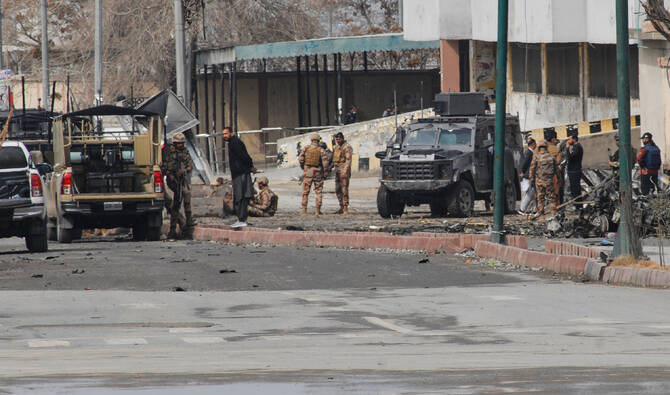
Bugti visited a bomb blast site in Quetta, receiving a briefing from Balochistan Inspector General Muhammad Tahir, according to a statement from the CM House. “The timely response against terrorist elements is commendable,” Bugti said, hailing actions by police and the Counter-Terrorism Department (CTD). “Anti-state elements will not be forgiven under any circumstances. There will be no compromise on peace in Balochistan.”
An emergency was imposed in government hospitals on directives from Health Minister Bakht Muhammad Kakar and Health Secretary Mujeebur Rehman, with additional doctors deployed and operating theaters on alert.
Separately, police reported finding suspected explosives on a railway track in Balochistan’s Nasirabad district. “An anti-tank mine and explosive material were found on the railway line near Rabi Pul,” Nasirabad Senior Superintendent of Police Asadullah Nasir said in a statement. “A suspected IED (improvised explosive device) was neutralized as the police, FC and Special Branch took timely action.” The items included half a kilogram of explosive material, petrol and an iron rod, which were passed to the Counter-Terrorism Department for probe. Railway tracks are often targeted by militants, with the Jaffar Express attacked multiple times in the past year. Most recently, on Monday night, a blast on the track linking Sindh to Balochistan derailed four bogies of the Quetta-bound Jaffar Express from Peshawar and damaged the line. The Jaffar Express also escaped attacks in Nasirabad in October and November last year, with similar attempts in Kachhi and Sindh’s Shikarpur district during those months. Pakistan Railways suspended train service from Balochistan to other parts of the country for a day, following Saturday’s attacks. “Quetta-Peshawar bound Jaffar Express, and Quetta-Chaman passenger trains have been canceled due to the prevailing security situation in Balochistan,” Muhammad Kashif, the railways controller in Quetta division, told Arab News.
President Asif Ali Zardari praised the army and law enforcement agencies for their expertise in blocking “infiltration attempts by Fitna-al-Hindustan terrorists at multiple locations.” In a statement, he paid tribute to the “security personnel and innocent civilians who embraced martyrdom during the actions” and prayed for them. “Our commitment is not to make any compromise on Balochistan’s peace, civilians’ protection, and national unity,” Zardari said. He said the state would pursue operations against “enemy elements operating under external backing and their facilitators with full force and unity.”
Prime Minister Shehbaz Sharif commended the security forces for foiling attempts by Fitna-al-Hindustan to disrupt peace in Balochistan, according to state-run APP. The prime minister highlighted the competence and bravery of the forces in repelling “coordinated attacks at 12 locations across Quetta, Noshki, Dalbandin, Pasni and Gwadar.” Sharif also praised the elimination of 88 leading terrorists, allegedly backed by India, in intelligence-based operations over the past 48 hours, calling it a key success against terrorism. Reaffirming his commitment, Sharif said the fight against terrorism would persist until its eradication.
Copyright © 2021 Independent Pakistan | All rights reserved