By Staff Reporter
ISLAMABAD: The United States on Sunday condemned a wave of militant attacks in Pakistan’s southwestern Balochistan province that killed dozens of security personnel and civilians, calling the violence an assault by a US-designated foreign terrorist organisation and pledging continued support for Islamabad’s counter-terrorism efforts.
US Charge d’Affaires Natalie Baker described the attacks, claimed by the Balochistan Liberation Army (BLA), as acts of terrorist violence against security forces and civilians, extending condolences to the victims and their families. “The United States strongly condemns January 31 attacks and acts of terrorist violence against security personnel and civilians in Balochistan, claimed by the Balochistan Liberation Army, a US-designated Foreign Terrorist Organisation,” Baker said in a post on X. “The Pakistani people deserve to live free from violence and fear. The United States remains a steadfast partner of Pakistan in its efforts to ensure peace and stability. We stand in solidarity with Pakistan during this difficult time.”
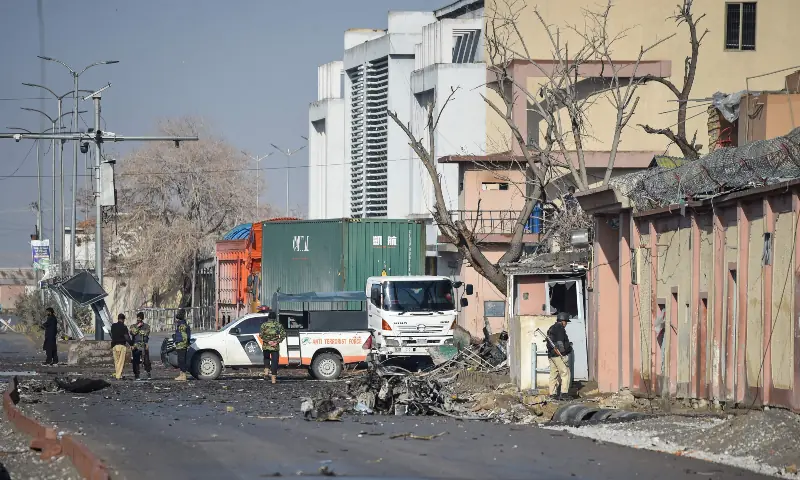
The statement followed coordinated assaults by militants on Saturday across multiple districts in Balochistan, including Quetta, Mastung, Nushki, Dalbandin, Kharan, Panjgur, Tump, Gwadar and Pasni, which Pakistan’s military said were aimed at disrupting peace in the resource-rich province.
Pakistan’s Inter-Services Public Relations (ISPR), the military’s media wing, said security forces killed 92 militants, including three suicide bombers, in operations to repel the attacks. It added that 15 personnel were killed during clearance operations and armed confrontations, while 18 civilians, including women and children, died in assaults targeting laborer families in Gwadar and Kharan. The ISPR also reported that forces had killed an additional 41 militants on Friday in separate operations in Panjgur and Harnai, raising the total militant deaths over two days to 133.
Pakistan has labeled Balochistan-based terrorist groups as “Fitna-al-Hindustan” to underscore what it alleges is India’s role in fomenting terrorism and instability in the country. Interior Minister Mohsin Naqvi, who visited Quetta to assess the situation after a bomb blast in the provincial capital, blamed India for orchestrating the attacks. “The authorities would go after every single one of those involved and the masters behind them,” Naqvi said.
The attacks prompted condemnations from several countries, including Britain, Saudi Arabia, Qatar and Turkey, all expressing solidarity with Pakistan. “Our thoughts are with the families of those who lost their lives and all those affected. We stand with Pakistan in rejecting terrorism and in our shared commitment to peace and security,” the British High Commission in Islamabad said in a statement on X.
Saudi Arabia’s foreign ministry, in a statement cited by Ambassador Nawaf bin Said Al-Malki, strongly condemned the attacks by separatist elements, rejecting all forms of terrorism and extremism. It conveyed condolences to the families of the deceased and wished a speedy recovery to the injured, reaffirming support for Pakistan’s stability and security efforts.
Turkey’s foreign ministry condemned the violence and offered prayers for the soldiers killed, while Qatar’s foreign ministry reiterated its rejection of violence, terrorism and criminal acts regardless of motives, and wished recovery for the injured.
The BLA, a proscribed group that has frequently targeted security forces and law enforcement in Balochistan, was designated by the United States as a foreign terrorist organization in August 2025, along with its Majeed Brigade squad. Balochistan, which shares borders with Iran and Afghanistan, has endured a long-running separatist insurgency involving attacks on security personnel, infrastructure and civilians, amid intensified Pakistani counter-militancy operations. Despite significant militant casualties, Pakistan experienced a marked rise in violence in 2025, with terrorist attacks increasing by 34% and related fatalities rising by 21% year-on-year, according to data from the Islamabad-based Pak Institute for Peace Studies. The BLA emerged as a primary perpetrator of such violence in 2024.
In the aftermath, train services from Quetta to other parts of Balochistan remained suspended for a second day on Sunday, Pakistan Railways officials said. The Peshawar-bound Jaffar Express and a passenger train to Chaman did not depart. Dera Ghazi Khan Deputy Commissioner Usman Khalid said all routes from Punjab to Balochistan were closed, including the Fort Munro Highway and the Taunsa-Musa Khel Road. Traffic was halted at border points such as Buwata and Sakhi Sarwar, preventing travel to Balochistan via the district.
The incidents coincided with warnings at the United Nations about the spillover of terrorist threats from Afghanistan, where Pakistan has attributed much of its recent surge in militancy to cross-border infiltration since the Taliban’s return to power in August 2021.
Chinese Ambassador to the UN Sun Lei, addressing a briefing on the Counter-Terrorism Early Warning Network for Central Asia on Friday, highlighted the impact of cross-border terrorism on the region, citing recent attacks in Syria, Afghanistan and Pakistan as cause for vigilance. “We need to strengthen engagement and cooperation with Afghanistan to prevent it from once again becoming a safe haven for terrorist organisations, and to jointly prevent and address the return of foreign terrorist fighters,” Sun said.
A day earlier, UN Secretary-General Antonio Guterres expressed concern over terrorist groups operating from Afghan soil, particularly the Tehreek-e-Taliban Pakistan (TTP), and frustration with the Taliban’s lack of progress on inclusivity, human rights and regional security. “We are particularly concerned about what has happened with the Pakistani Taliban and the support they might receive,” Guterres said, noting some progress on drug trafficking but lamenting stagnation elsewhere. Pakistan has repeatedly called on the international community to urge Kabul to curb militants using Afghan territory to launch attacks, linking regional stability to Afghanistan’s security.
Copyright © 2021 Independent Pakistan | All rights reserved