By Staff Reporter
PESHAWAR: The northwestern Khyber Pakhtunkhwa province on Thursday called for close consultation and coordination with the federal government and all political parties to ensure the success of a comprehensive counter-terrorism policy, as it seeks to tackle a surge in militant attacks.
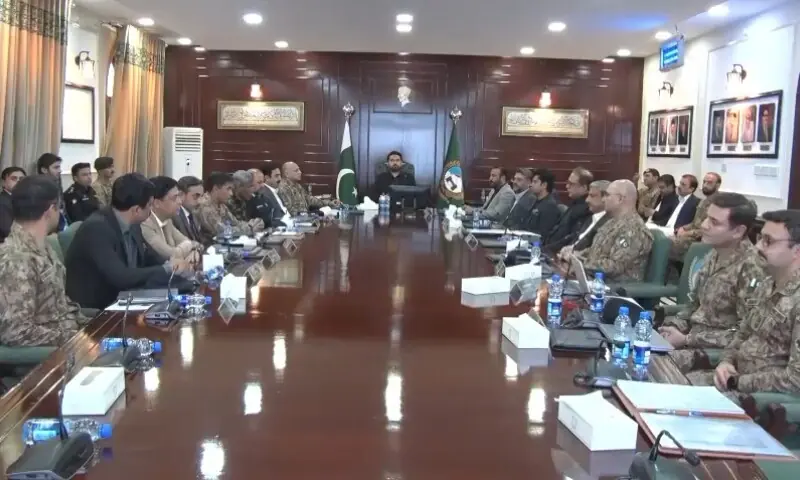
Chief Minister Sohail Afridi chaired his first meeting of the provincial apex committee since taking office, with the panel discussing the general rise in terrorism incidents in the province and an action plan to eradicate what the state terms “Fitna-al-Khawarij” – a reference to militants from the banned Tehreek-i-Taliban Pakistan (TTP) – and establish complete peace and stability, according to a statement from the chief minister’s office.
The committee agreed that “joint consultation, mutual cooperation, and practical coordination between all political parties, public representatives, and the federal government is essential for the success of a comprehensive counter-terrorism policy,” the statement said.
The meeting, attended by provincial ministers, the Peshawar corps commander, the chief secretary, the provincial inspector general, and senior civil, military and law enforcement officials, came amid ongoing tensions between the provincial and federal governments over counter-terrorism strategies.
The apex committee firmly resolved that the Khyber Pakhtunkhwa government would utilise all its resources, including the armed forces, police, counter-terrorism department and other institutions, to combat terrorism and would not hesitate to make any sacrifices, the release added. It expressed hope that a long-term strategy would identify all causes of terrorism and eliminate them, thereby restoring public confidence so that the government and the public could work together for the country’s progress. “The KP government’s agenda is that only good governance and public interest can unite the nation against terrorism.”
Under this agenda, the committee decided that in the first phase, areas affected by terrorism would be converted into model good governance districts, with all government resources utilised to compensate for lacks in development, social services and economic growth in those areas. The panel also announced a special package to provide security, communication, health, education, employment, basic amenities and other services in these areas under an organised programme.
The forum decided that the government would ensure complete care, rehabilitation, and the provision of basic needs for the welfare of people affected in areas where temporary relocation took place for sustainable stability, so that this temporary difficulty could form the base for peace, development and prosperity in the future, the statement said. “Their dignified return is a top priority for the [KP] government.”
The federal and Khyber Pakhtunkhwa governments have recently traded barbs over who authorised the evacuation process after hundreds of residents in the Tirah valley vacated their homes ahead of a planned military action against terrorists.
Speaking during the meeting, Chief Minister Afridi stressed that the provincial government “will not make any compromise on peace” in the province. He asserted that the “civil government, authorities, armed forces, and other law enforcement agencies (LEAs) are on the same page for law and order and will continue their joint efforts”. Afridi reiterated that the fight against terrorism was a “collective one and can only be won through joint efforts”.
The statement follows a meeting days earlier between Afridi and Prime Minister Shehbaz Sharif, where the two discussed issues related to the province’s finances and counterterrorism. On counter-terrorism, Sharif termed the Khyber Pakhtunkhwa government’s cooperation in establishing peace in the province as “unavoidable”. “There is a need to improve the provincial government’s efforts to establish law and order,” he said, urging the provincial government to strengthen its departments to combat terrorism.
The Pakistan Tehreek-e-Insaf (PTI)-led Khyber Pakhtunkhwa government and Pakistan Muslim League-Nawaz’ s federal government have mostly been at odds over counter-terrorism policies in the province, particularly military operations, with the provincial side objecting to “decisions taken behind closed doors”. Afridi has repeatedly called for a “policy shift” and urged the inclusion of the provincial government in counter-terrorism policy-making. The debate on the right approach to establish law and order comes on the heels of heightened militancy.
According to the Annual Security Report 2025 from the Centre for Research and Security Studies (CRSS), Khyber Pakhtunkhwa recorded a significant surge in violence last year as “fatalities rose from 1,620 in 2024 to 2,331 in 2025”. This marked an “absolute increase of 711 deaths, accounting for over 82 per cent of the net national rise and marking almost a 44pc year-on-year surge in violence in the province”.
Copyright © 2021 Independent Pakistan | All rights reserved