By Staff Reporter
ISLAMABAD: Pakistan has been extended a formal invitation to the inaugural gathering of Donald Trump’s “Board of Peace” – a US-led initiative billed as a bulwark against global conflict but widely derided as a sidestep around the United Nations – with diplomats in Islamabad signalling a probable attendance at the Washington summit scheduled for 19 February.
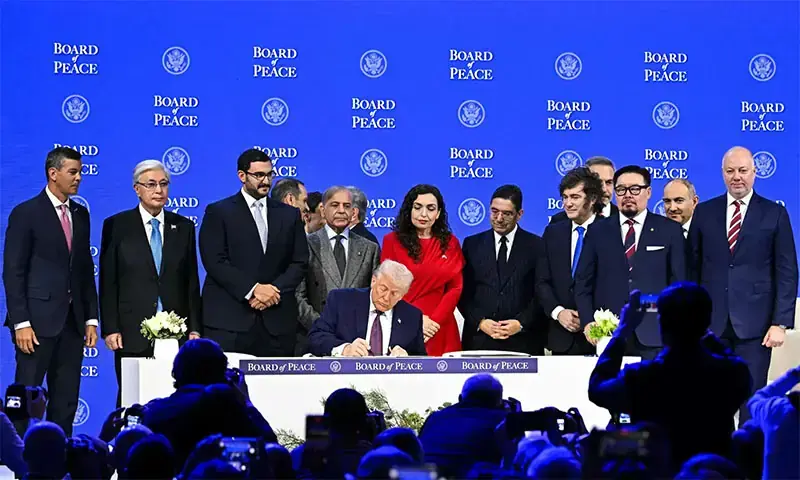
The move, confirmed by sources close to the foreign ministry and also reported by Dawn newspaper, shows Pakistan’s delicate navigation of international fault lines on the Israel-Palestine question. As one of 14 founding members that inked the board’s charter on the fringes of the World Economic Forum in Davos on 22 January, Islamabad finds itself drawn into an enterprise that Trump launched with fanfare late last month, even as the fragile ceasefire it helped broker in Gaza teeters on the brink of collapse.
The gathering, to be hosted at the United States Institute of Peace in the capital, is slated to hammer out the board’s bones: its organisational scaffolding, core remit and administrative nerve centre. “This will be a key meeting aimed at giving a shape and structure to the board,” one senior diplomatic figure told the Dawn newspaper, speaking on condition of anonymity to navigate the sensitivities at play. Pressed on whether Pakistan might yet be sounded out for contributions to a mooted international stabilisation force in the battered enclave, the source demurred: such talk was “premature”. “That would come later. First, we have to give shape to the board, form a structure, set up a secretariat and define its direction.”
A second official insisted it remained “still too early” for any substantive haggling over boots on the ground. The reticence speaks volumes about the tightrope Pakistan treads: a steadfast advocate for Palestinian self-determination since the days of its own partition-born birth pangs, yet pragmatic enough to keep a seat at tables that might, however improbably, nudge the needle towards resolution. Conceived by Trump in September 2025 as a centrepiece of his Middle East recalibration, the Board of Peace (BoP) as it has already spawned in acronym form – was rubber-stamped into existence last month, with the US government assuming the role of its custodial keeper. Trump has anointed his eponymous Donald J. Trump Institute of Peace in Washington as the outfit’s nerve centre, a choice that has only amplified the scepticism swirling around the project.
According to an Axios report drawing on a US official and envoys from four charter signatories, the White House envisions the debut session incorporating a fundraising strand aimed at bankrolling Gaza’s rubble-strewn reconstruction – though these blueprints are, by all accounts, embryonic and prone to flux. The timing could scarcely be more charged. Israeli prime minister Benjamin Netanyahu is due to huddle with Trump at the White House a day prior, on 18 February, in what aides on both sides frame as a stocktake on the ceasefire’s wobbly footing.
That truce, forged in October under a Trump-orchestrated blueprint that Israel and Hamas grudgingly endorsed, has since exacted a grim toll: more than 550 Palestinians and four Israeli soldiers lost to sporadic clashes that have shredded any illusion of stability. Zoom out, and the canvas darkens further. Israel’s military campaign in Gaza, which erupted in October 2023, has claimed over 71,000 Palestinian lives, uprooted every last soul in the territory and unleashed a humanitarian cataclysm of biblical proportions – acute famine gnawing at the edges, hospitals reduced to charnel houses, and aid convoys routinely repelled or ransacked. A chorus of human rights bodies, academics and a United Nations inquiry have levelled the stark charge of genocide against the onslaught, a claim Jerusalem rebuts with vehement denials, casting it as a necessary excoriation of Hamas’s entrenched terror networks.
It was against this blood-soaked backdrop that the UN security council, in a mid-November resolution, greenlit the Board of Peace – alongside willing partner states – to midwife an international stabilisation force into Gaza, contingent on the ceasefire holding. Yet Trump’s original blueprint for the territory, unveiled in the dying embers of last year, cast the board in a more imperial hue: not merely a steward of post-truce security, but a provisional overlord of governance, with designs later ballooned to encompass the world’s sundry flashpoints from Ukraine to the South China Sea.
Trump, who will personally helm the board, has trumpeted it as a nimble antidote to the UN’s sclerotic bureaucracy – a “peace machine”, in his words, unencumbered by veto-wielding holdouts. But the pitch has landed like a lead balloon among legions of analysts, who discern in it less a salve for war’s wounds than a Trojan horse for American hegemony. “This isn’t diplomacy; it’s dominion,” warned one veteran Middle East scholar last month, fretting that the board’s writ could erode the multilateral sinews that have, however imperfectly, underwritten global order since 1945.
The roster of adherents tells its own tale. While a phalanx of Washington’s Gulf and Levantine clients – from Saudi Arabia to Jordan – have affixed their signatures, the roster conspicuously lacks the usual suspects from Europe and beyond. Britain, France, Germany and their transatlantic kin have demurred, their reticence a quiet indictment of both the board’s opaque architecture and its presumptuous sweep. No Palestinian voice graces its councils either, a glaring lacuna that has only fanned the embers of outrage among rights campaigners, who liken the endeavour to a neocolonial carve-up.
For Pakistan, then, the summons to Washington is less a clarion call to arms than a calculated foray into the fray. Long the standard-bearer for the Palestinian cause in Muslim-majority corridors – its foreign policy playbook etched with invocations of equitable partition and the inalienable right to statehood – Islamabad has been at pains to insinuate itself into Gaza’s diplomatic orbit without bestowing imprimatur on any schema that smacks of extraterritorial fiat. Attendance at the summit, sources stress, betokens no blanket buy-in to the board’s grander pretensions. Rather, it affords a perch from which to monitor, and perhaps modulate, the currents that could yet chart the enclave’s fate – all while husbanding reservations on the nettlesome knots of sovereignty, redress for atrocities past and any whiff of martial entanglement.
In the corridors of the foreign ministry in Islamabad, the mood is one of vigilant opportunism. Officials murmur of leveraging the platform to amplify calls for accountability – for the architects of Gaza’s devastation to face the bar of international justice – even as they steel for the board’s inexorable pivot from blueprint to boots-on-the-ground reality. Pakistan’s envoy to the UN, in a recent address, reiterated the republic’s fealty to the two-state paradigm, the sine qua non of any durable peace. Islamabad’s gambit – to engage without endorsing, to influence without implicating – will be tested in the crucible of compromise.
Copyright © 2021 Independent Pakistan | All rights reserved