By Staff Reporter’
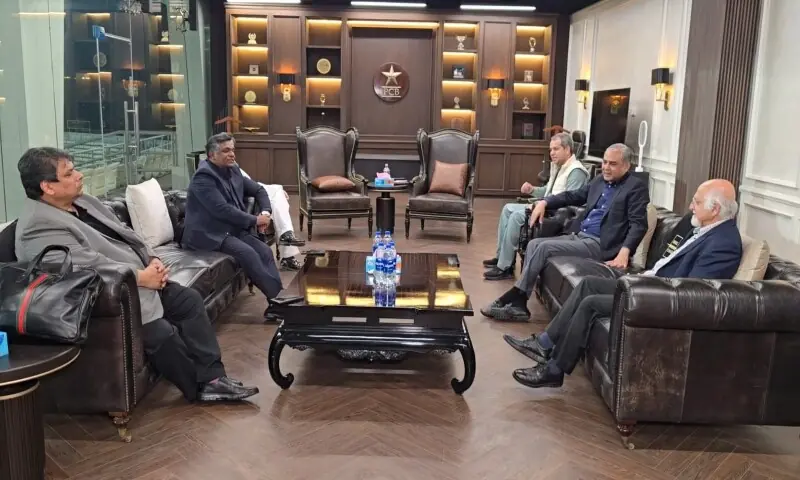
LAHORE: Top officials from the International Cricket Council (ICC) and Pakistan Cricket Board (PCB) huddled in Lahore on Sunday for high-stakes discussions over Pakistan’s government-mandated boycott of its T20 World Cup clash with India, a move that threatens to upend the tournament’s marquee fixture and expose deep fissures in global cricket governance.
The closed-door meeting at Gaddafi Stadium brought together PCB Chairman Mohsin Naqvi and ICC Deputy Chairman Imran Khawaja, with Bangladesh Cricket Board (BCB) President Aminul Islam joining the talks as a key stakeholder in the escalating row.
Sources close to the discussions indicated that any formal announcement on the outcome would likely follow clearance from the Pakistani government, a sign of how deeply political weight bearing down on the cricket diplomacy in South Asia.
Khawaja, a veteran Australian administrator tasked with navigating the crisis, touched down in Lahore earlier in the day and was met at Allama Iqbal International Airport by Amir Mir,Naqvi’s right-hand man on communications. The PCB confirmed the arrival in a brief post on X, saying it as a routine engagement amid the tournament’s early stages.
Islam, whose board’s ouster from the event ignited the chain reaction, had arrived a day earlier and received a warm welcome from Salman Naseer, chief executive of the Pakistan Super League and another Naqvi confidant. In a PCB statement, Naqvi and Islam were said to have swapped perspectives on the “ongoing crisis” during a preliminary sit-down, with the BCB chief extending thanks for Pakistan’s vocal support in Dhaka’s standoff with the ICC.
The Lahore meeting caps a frenetic week of shuttle diplomacy that has cast a long shadow over the 20-team ICC Men’s T20 World Cup, which kicked off on Saturday amid fanfare in Colombo and other venues across Sri Lanka and India. Pakistan scraped a narrow victory over the Netherlands in its opener, but the real drama swirls around its scheduled Group A encounter with India on Feb. 15 at Colombo’s R. Premadasa Stadium – a fixture so commercially electric it routinely pumps hundreds of millions of dollars into the sport’s coffers.
It all boiled over in January, when Bangladesh’s pace spearhead Mustafizur Rahman was unceremoniously axed from the Indian Premier League’s Kolkata Knight Riders squad – a $1 million acquisition – on orders from the Board of Control for Cricket in India (BCCI). No official rationale was proffered, but the timing fed into wider strains across the border, prompted Dhaka to cry foul over perceived discrimination. The BCB then asked the ICC to shift its World Cup games out of India over security issues, but the request fell on deaf ears.
With the Feb. 7 start date looming, the global body deemed schedule tweaks unfeasible and slotted in Scotland as a last-minute replacement – a call that drew howls of protest from Bangladesh and its lone ally on the ICC board, Pakistan. Islamabad’s riposte was swift. Prime Minister Shehbaz Sharif’s administration greenlit the Green Shirts’ participation in the rest of the tournament but barred the Feb. 15 showdown, saying it as a stand of solidarity against the ICC’s “biased decision” toward Bangladesh. “The government of Pakistan wanted to show solidarity with Bangladesh. Therefore, as a protest, the national team was restricted from playing its match with India,” officials said.
Prime Minister Sharif said the boycott was needed to call out the unfair treatment of Bangladesh. The BCB’s Islam thanked Pakistan for its stance during his meeting with Naqvi, the PCB said. PCB Chairman Naqvi has called the ICC’s approach to Bangladesh’s concerns “double standards” and an “injustice.” The board wants any fix for the boycott to include steps for Bangladesh. Sources suggest Islam’s input could bridge toward a “mutually acceptable resolution,” as the ICC urged, safeguarding “all stakeholders
The ICC, in its sole public salvo last Sunday, struck a measured tone. “The position of selective participation is difficult to reconcile with the fundamental premise of a global sporting event where all qualified teams are expected to compete on equal terms per the event schedule,” it said in a statement. The body voiced hopes that the PCB would weigh “the significant and long-term implications for cricket in its own country,” warning of ripples across the “global cricket ecosystem, which it is itself a member and beneficiary of.”
Islamabad’s stand carries steep costs. Forfeiting the match would dock Pakistan two points and kneecap its net run rate in a group also featuring Ireland and Namibia, dimming semifinal hopes. Captain Salman Agha, speaking ahead of the Netherlands win, flagged the contingency. Any potential India rematch in the knockouts would loop back to government consultations.
Commercially, the stakes dwarf the on-field arithmetic. India-Pakistan T20s are cricket’s golden goose, with a single billing pegged at around $500 million when stacking broadcast rights, sponsorship surges, ticket windfalls and ancillary boosts. Ad slots during such games fetch $30,000-$48,000 for 10 seconds – premiums that eclipse even India’s knockout clashes against other heavyweights. The broadcaster alone stands to miss out on roughly $36 million in spot revenue, per industry estimates.
The boycott’s fallout has rippled beyond the boards. Sri Lanka Cricket, co-hosts to the Colombo leg, implored the PCB to backpedal, citing a double whammy of lost gate receipts and a setback to the island’s tourism rebound from its 2022 economic implosion. Back-channel overtures, reportedly greenlit by the ICC, have buzzed quietly. ESPNcricinfo detailed on Saturday how the global body sought clarification on the PCB’s invocation of a force majeure clause under the Members Participation Agreement, laying out thresholds for legitimate non-participation alongside the sporting, financial and regulatory blowback.
The PCB has parried with equal vigor. Spokesman Mir torched Indian journalist Vikrant Gupta’s claim of Islamabad initiating dialogue, branding it “fiction” peddled by “sections of Indian media.” “I categorically reject the claim by Indian sports journalist Vikrant Gupta that PCB approached the ICC,” Mir said in a statement. “As usual, sections of Indian media are busy circulating fiction. A little patience and time will clearly show who actually went knocking and who didn’t.”
Lurking beneath the brinkmanship are broader fault lines in cricket’s power geometry. Pakistan has levelled accusations of BCCI puppeteering at the ICC, whose chairmanship rests with Jay Shah, son of India’s home minister Amit Shah. Defence Minister Khawaja Asif said this week the ICC, under Shah, is “hostage” to “Indian political interests”. “Time for a new setup,” Asif said. India’s heft is undeniable. It bankrolls the lion’s share of cricket’s war chest, funnelling nearly 39% of the ICC’s projected $1.15 billion annual revenue from 2024-2027 via the IPL alone. That gives the BCCI strong sway.
The Feb. 15 game is a week away. Both teams won their first matches on Saturday. The talks in Lahore are the latest effort to find common ground before the deadline.
Copyright © 2021 Independent Pakistan | All rights reserved