By Staff Reporter
ISLAMABAD: Developers have demolished the remains of a 16th-century Mughal-era building in Pakistan’s capital, just days after razing a nearby World War I memorial, as part of a push to build a private housing society, despite repeated appeals from heritage officials to protect the sites.
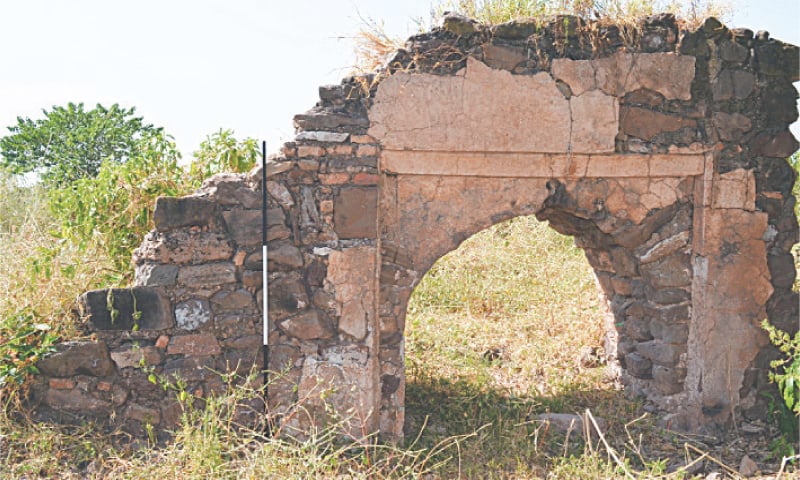
The Mughal structure, located about 200 metres from the British-era obelisk in Rehara village, was possibly built during the reign of Emperor Akbar and stood as the oldest historical ruin in the region, according to the Department of Archaeology and Museums (DOAM).
A DOAM official said the building’s above-ground arch and remaining structure – including an 8-by-4.5-metre main chamber with 1.5-metre-thick walls made of limestone and sandstone blocks – had been entirely wiped out, requiring what should have been careful excavation. A departmental team visiting the site found the remnants, visible in earlier photographs, had been completely erased.
The demolitions cleared space for Margalla Enclave, a joint venture between the Capital Development Authority (CDA) and the Defence Housing Authority (DHA) Islamabad-Rawalpindi. The project spans over 10,000 kanals in Zone-IV, near Chak Shahzad and Jinnah Avenue.
DOAM has claimed it wrote repeatedly to the CDA since 2020, seeking records on the war memorial and other sites, including the Rehara structure, to enable formal protection. “The CDA has not once responded to the numerous letters DOAM has written in the last six years,” said an official from the Ministry of National Heritage and Culture. CDA spokesperson Shahid Kiyani, when contacted by a local newspaper, initially sought time to prepare a response but did not answer further queries or provide comment.
Several DOAM officials declined to comment on the record, but a senior official, speaking on condition of anonymity, said a report on the destruction had been sent to the Prime Minister’s Office a couple of days ago. In a shift, DOAM has said the World War I memorial was not protected under the Antiquities Act 1975, meaning no no-objection certificate (NOC) was required for its demolition. Earlier, the department had claimed it did not permit the CDA to tear down the monuments.
The memorial, erected by the British Empire after 1914 to honour local soldiers from villages like Rehara who fought in the Great War, had stood on a 40-foot-high mound along Kuri Road until last Sunday. By Tuesday, DOAM officials reported the mound flattened and the obelisk dismantled, with photographs showing scattered blocks in levelled earth.
Developers had approached DOAM six months ago, requesting an NOC to relocate the memorial to a roundabout about 100 metres away, arguing it would ensure visibility and accessibility. “The roundabout may be named after the World War I memorial, thereby perpetuating its legacy and significance,” the CDA stated in a letter to DOAM. DOAM rejected the proposal, insisting the memorial must first be protected and added to Islamabad’s list of historical monuments, which required documentation from the CDA. The department had also sought records on the nearby Mughal-era Rehara mosque to safeguard it.
Although located in Islamabad Capital Territory, efforts to bring the memorial under formal protection faltered due to lack of finances and legal prerequisites, DOAM said. “Nevertheless, the monument possesses cultural and historical significance. In line with internationally recognised best practices for commemorative and historical structures, DOAM was consulted and provided advisory guidance to let first protect the monument under the Antiquities Act 1975, but it was not done,” the department stated earlier.
It added that any handling should be done with care, dignity and conservation sensitivity, suggesting it be re-erected at the original site “with grace and dignity as it was erected for the same village of Rehara”. The incidents have caused embarrassment for Minister for National Heritage and Culture Aurangzeb Khan Khichi, particularly as UNESCO representatives were visiting Pakistan when news of the memorial’s demolition emerged. A full report has been sent to the minister for further action, the senior ministry official said.
Copyright © 2021 Independent Pakistan | All rights reserved