By Staff Reporter
ISLAMABAD: For the second time in a week, doctors recommended that Imran Khan, Pakistan’s jailed former prime minister, undergo a cardiac imaging test to check for blocked arteries. For the second time, it did not happen — and now his party is accusing the government of deliberately steering him away from the one hospital equipped to perform it.
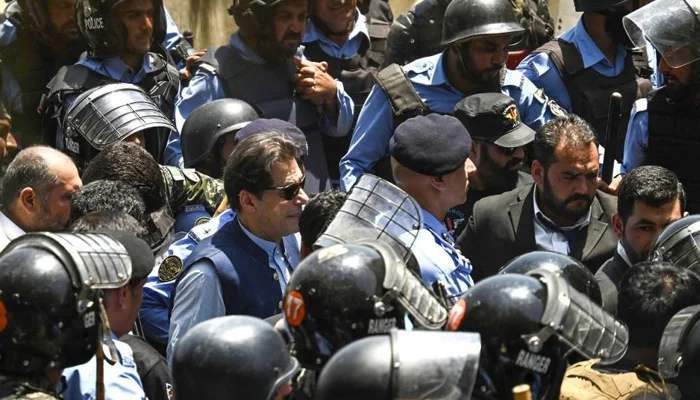
Khan, the founder of the opposition Pakistan Tehreek-e-Insaf party, was taken from Adiala jail to the Pakistan Institute of Medical Sciences before dawn Friday for an eye procedure and a round of diagnostic tests. During that visit, physicians recommended a CT coronary angiography, a scan used to detect arterial blockages and gauge the risk of a heart attack. Hospital staff told the medical team the equipment needed to perform it was not available, according to accounts relayed to Dawn, the Pakistani newspaper that first reported the episode. Khan was returned to prison without the test.
It was the second time in three weeks that a recommendation for the same procedure had gone unfulfilled. A Pims cardiologist first urged the scan on Aug. 1, citing fluctuating blood pressure, heart palpitations, headaches, and restlessness — symptoms the doctor linked to the 72-year-old’s age and his prolonged confinement in isolation. A government-appointed medical board examined Khan again on Aug. 10 and, according to PTI, likewise found the test necessary.
The explanation offered by hospital officials has drawn skepticism from doctors interviewed by Dawn newspaper, who said the equipment required for the procedure has been sitting in the radiology department for years. A 128-slice CT scanner capable of performing coronary angiography has been operational at Pims since March 2022, according to physicians familiar with the equipment. One senior doctor said Khan should have simply been referred from cardiology to radiology to complete the scan — a routine handoff that did not occur.
The distinction matters clinically. Conventional angiography, which is available at the hospital’s Cardiac Centre, requires threading a catheter through a blood vessel to the heart. CT angiography is noninvasive, performed instead with a CT scanner, and does not involve puncturing a vein. Officials said hospital staff who cited equipment unavailability may have been referring to the cardiac catheterization lab, not the radiology department’s CT unit.
Prime Minister Shehbaz Sharif responded Saturday by ordering an inquiry, to be led by the secretary of the establishment division, to determine what went wrong and hold those responsible to account.
The episode has reopened another dispute over where Khan should be receiving care at all. The Supreme Court ruled Aug. 18 that the government had two days to move him to Shifa International Hospital, a private facility in Islamabad, for evaluation by a multidisciplinary medical board. A three-judge bench led by Justice Shahid Waheed also ordered that Khan’s personal physician, Dr. Faisal Sultan, along with Dr. Uzma Khan, be present for the examination, and barred his family, party members, and lawyers from discussing his condition publicly before the next hearing.
The government pushed back and the prosecutors filed a plea the following day arguing the transfer order was discriminatory and violated prison regulations, and the court sent that petition back Thursday, citing deficiencies in how the accompanying affidavit and paperwork had been prepared.
By Thursday night, security had been mobilized in and around Shifa International, and preparations appeared underway for Khan’s arrival in keeping with the court’s directive. Instead, he was taken to Pims — the government’s own facility — and returned to Adiala jail the same morning.
Information Minister Attaullah Tarar attributed the last-minute change to security concerns, writing on social media that PTI supporters had gathered near Shifa International in a way that complicated plans to bring Khan there. He said Khan was examined that night by a team that included an ophthalmologist, a cardiologist, and a general physician, all operating under heightened security between Aug. 20 and 21. The Pims administration later said two specialists from Shifa International had taken part in the eye assessment, while its own physicians conducted the remaining exams, with findings from both incorporated into the overall evaluation.
For PTI, the explanation has done little to quiet suspicion. In a written statement to Dawn newspaper on Sunday, party Information Secretary Sheikh Waqas Akram said the substitution of Pims for Shifa International — combined with the missed scan — points to something more deliberate than a scheduling mishap.
“A former prime minister was taken to a government hospital in the middle of the night, assessed by doctors who recommended an essential cardiac investigation, and then returned to the Adiala jail without the test being conducted,” Akram said. “This cannot be dismissed as an isolated administrative lapse; it reflects a deeply troubling pattern.”
Akram questioned why Khan was taken anywhere other than Shifa International, given that the court had specifically named that hospital and its equipment was, by all accounts, in working order. “When the necessary facilities were available at Shifa International, deliberately taking Imran Khan to a hospital where the required facilities for the procedure were not available raises a grave and unavoidable question,” he said. “Was the decision made in advance to prevent the CTA from being conducted?”
He was equally unsparing about the prime minister’s inquiry, calling it an implicit acknowledgment that something had gone badly wrong. “Why the medically recommended test was not conducted in the first instance,” he said, “why coordination between the cardiology and radiology departments had failed, and why Imran Khan was not taken to Shifa International despite the availability of the required facilities there” were all questions the government still owed the public.
Akram called for the scan to be performed immediately at Shifa International under the oversight of independent specialists and Khan’s own physicians, and demanded that his complete medical records be released to his family, personal doctors, and legal team without further delay. He also pressed for full compliance with the Supreme Court’s Aug. 18 order and an independent inquiry into why Khan was diverted to Pims in the first place.
“Imran Khan’s heart health cannot be subjected to political calculations, administrative excuses or further delay,” Akram said, adding that the government “will bear full responsibility for any further deterioration in his condition.”
The dispute over Khan’s medical care has simmered since late January, when the party first disclosed that he had developed right central retinal vein occlusion, an eye condition that has required repeated trips to Pims for treatment. It escalated again Thursday, when the government filed a second review petition challenging the Supreme Court’s transfer order — this time through the Islamabad chief commissioner’s office, which argued the ruling infringed on its constitutional authority.
Copyright © 2021 Independent Pakistan | All rights reserved