By Staff Reporter
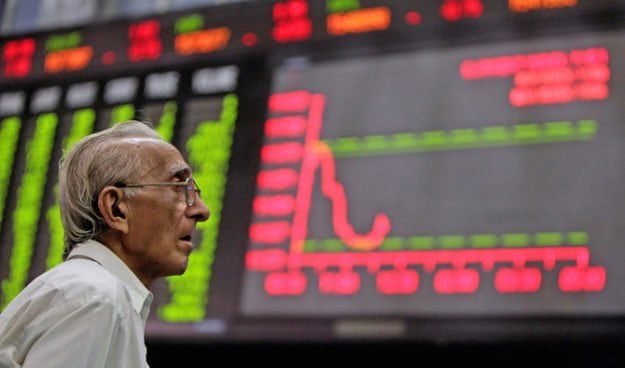
KARACHI: Pakistan’s benchmark stock index suffered its steepest one-day point drop in months on Monday, as persistent foreign outflows and a fresh wave of political jitters sent investors scurrying for the exits.
The KSE-100 Index closed at 174,453.93, down 5,149.80 points, or 2.87%, from Friday’s finish at 179,603.73. That marked the gauge’s third-largest daily decline on a point basis, according to Al-Habib Capital Markets Ltd., a unit of Bank AL Habib Ltd.
Trading opened on the back foot and never really recovered. The index quickly breached 179,000, then accelerated lower in the afternoon session, dipping below 176,000 before hitting an intraday low of 173,574.26. A late, half-hearted rebound failed to stick, leaving the close well off the session high of 179,969.22. Volumes on the benchmark were a robust 378.7 million shares, valued at 37.4 billion rupees.
Foreign selling was the clear culprit, brokers said. Topline Securities Pvt. Ltd. pointed to data from the previous session showing net outflows as the main driver of the rout. “Escalating political noise further dampened investor confidence, intensifying the bearish momentum,” the Karachi-based brokerage added in a note. That sentiment was echoed across the street. “The market remained under pressure due to persistent foreign selling and corporate earnings that failed to justify elevated valuations,” said Huzaifa Riaz, director at Mayari Securities Pvt. Ltd. “Ongoing domestic political developments further dampened sentiment, keeping investors cautious and adding to the weakness.”
Waqas Ghani, head of research at JS Global Capital Ltd., zeroed in on domestic fund flows. “The sharp sell-off in the KSE-100 today has largely been driven by massive redemptions, with heavy selling pressure from a few large mutual funds acting as the primary trigger,” he said. Saad Hanif, head of research at Ismail Iqbal Securities Ltd., kept it simple: foreign selling.
The heaviest blows came from the index heavyweights. Fauji Fertiliser Co., United Bank Ltd., Engro Holdings Ltd., Habib Bank Ltd. and Bank AL Habib Ltd. were the biggest drags, together wiping out 1,680 points from the KSE-100, Topline said. Among the most active names, power utility K-Electric Ltd. led the volume charts with 63.8 million shares changing hands, falling 4.91% to 8.13 rupees. Worldcall Telecom Ltd. was close behind, down 6.13% to 1.53 rupees on 62.2 million shares. Bank of Punjab slid 8.55% to 33.25 rupees, with 56.2 million shares traded.
The session’s biggest gainers were a handful of smaller names: Trust Securities & Brokerage Ltd. jumped 19.90% to 2.29 rupees, 786 Investments Ltd. climbed 10.03% to 17.88 rupees and Tariq Corp. Ltd.’s preference shares rose 10.01% to 16.93 rupees. On the downside, LSE Capital Ltd.’s rights issue plunged 22.61% to 1.78 rupees, Gulistan Spinning Mills Ltd. dropped 12.09% to 11.58 rupees and Kohinoor Industries Ltd. fell 10.01% to 50.27 rupees. By the end of the day, 487 stocks had traded. Just 65 advanced, 378 declined and 44 were unchanged.
The selling came on top of a bruising week. The KSE-100 shed 4,525.85 points, or 2.5%, last week, closing at 179,603.73 as political uncertainty and worsening security in Balochistan overshadowed stronger-than-expected macroeconomic data and healthy foreign inflows. Bears have now dominated for two straight weeks.
Analysts flagged a cocktail of domestic pressures. Ahsan Mehanti, managing director and chief executive at Arif Habib Commodities Ltd., cited the looming impact of a super tax on high-earning companies, rising inflation forecasts and the potential fallout from a US-India trade deal on Pakistani exports. “Political noise, uncertainty over the outcome of IMF talks and concerns for the fiscal impact of aligning SOE losses played a catalyst role in bearish activity at PSX,” he said.
Finance Minister Muhammad Aurangzeb sought to steady nerves, telling reporters on Monday that the government was pressing ahead with privatization of more state-owned enterprises. Still, the broader backdrop remains fraught. Looking ahead, the market faces a quieter stretch as Ramadan gets underway this week, with shorter trading hours likely to curb participation. Corporate earnings season could yet provide a lift if results beat expectations, while fresh trade and current-account figures will be scrutinized for signs of stability.
On the macro front, remittances climbed 15% year-on-year to $3.5 billion in January, though they slipped 4% from December. Automobile sales rebounded to about 23,000 units for the month, data from the Pakistan Automotive Manufacturers Association showed. MSCI’s latest quarterly review, released Friday, triggered some portfolio rebalancing after several Pakistani stocks were added or removed from its indexes. The rupee managed a modest gain against the dollar in the interbank market, closing at 279.61.
Copyright © 2021 Independent Pakistan | All rights reserved