By Staff Reporter
ISLAMABAD: Pakistan carried out airstrikes on seven terrorist camps in Afghanistan early on Sunday, killing more than 80 militants in retaliation for a series of suicide bombings that have claimed the lives of soldiers and civilians during the Muslim holy month of Ramadan, a security official said.
The precision operations, based on intelligence, targeted hideouts linked to the Tehreek-i-Taliban Pakistan, which the government refers to as Fitna al Khawarij, and the Islamic State-Khorasan Province in the Afghan provinces of Nangarhar, Paktika and Khost, the official said. “Last night, Pakistan’s intelligence-based air strikes destroyed seven centers of Fitna Al-Khawarij TTP in three provinces of Nangarhar, Paktika and Khost, in which more than eighty Khawarij (TTP militants) have been confirmed killed, while more are expected.”
Sources said an explosion targeted a militant hideout in Paktika’s Barmal area, with jet aircraft destroying infrastructure. Subsequent airstrikes hit Khogyani district in Nangarhar, followed by attacks in Ghani Khel, Behsud and Argoon areas.
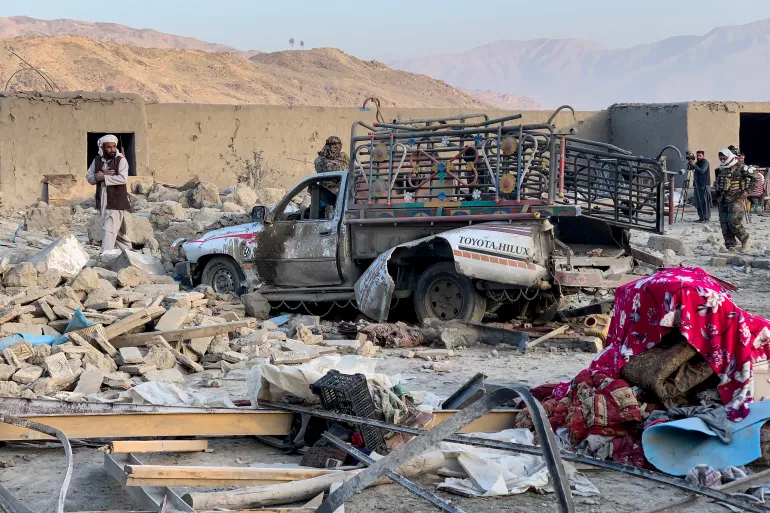
Afghan Taliban spokesman Zabihullah Mujahid accused Pakistani forces of violating Afghan territory and killing civilians in the assault. “Pakistani special military circles have once again trespassed into Afghan territory,” Mujahid said in a post on X. “Last night, they bombed our civilian compatriots in Nangarhar and Paktika provinces, martyring and wounding dozens of people, including women and children.”
The Taliban regime described the strikes as a violation of its sovereignty and said an “appropriate and measured response will be taken at a suitable time”. A Taliban spokesperson also claimed the attacks had killed and injured dozens of people, but Pakistani authorities termed such claims a “false and malicious narrative designed to create cover for terrorist sanctuaries”. They maintained that TTP terrorists routinely blended into civilian areas and used non-combatants as human shields, adding that Pakistan’s operational planning accounted for this, and forces took measures to reduce or eliminate any collateral damage.
They described the actions as a “limited, proportionate response to an ongoing terror wave”, which saw mass casualty attacks inflicted on Pakistani civilians and security forces. Photos on social media from Nangarhar’s Bihsud district – one of the locations Afghan authorities claim were targeted by Pakistan – showed people using a bulldozer to clear the rubble of a destroyed building, which was being guarded by Taliban fighters.
Afghanistan’s foreign ministry said it had summoned Pakistan’s charge d’affaires to Afghanistan Ubaid-ur-Rehman Nizamani and lodged protest through a formal démarche in response to the Pakistani military strikes. “IEA-MoFA (The Islamic Emirate of Afghanistan’s Ministry of Foreign Affairs) vehemently condemns the violation of Afghanistan’s airspace and the targeting of civilians, describing it as a flagrant breach of Afghanistan’s territorial integrity & a provocative action,” it said in a statement. “The Pakistani side was also categorically informed that safeguarding Afghanistan’s territorial integrity is the religious responsibility of the Islamic Emirate of Afghanistan; henceforth, the responsibility for any adverse consequences of such actions will rest with the opposing side.”
The strikes came in response to attacks, including a vehicle-borne suicide bombing at a joint security post in Bajaur district on Feb. 16, which killed 11 soldiers and a young girl while injuring seven others, including women and children, after damaging a nearby residential building. Investigators identified the Bajaur bomber as Amad, also known as Qari Abdullah or Abu Zar, a member of the Afghan Taliban’s special forces from Balkh province. The TTP claimed responsibility for that assault.
Another attack unfolded on Saturday in Bannu district of Khyber Pakhtunkhwa province, where security forces conducting an intelligence-based operation gunned down five terrorists but lost a lieutenant colonel and a sepoy when militants rammed an explosive-laden vehicle into their convoy. The military identified the fallen officers as Lt. Col. Shahzada Gul Faraz, 43, of Mansehra district, praised for his frontline leadership, and Sepoy Karamat Shah, 28, of Peshawar district. The operation thwarted a potential strike on civilians or law enforcement in Bannu city.
The Pakistani military’s media arm, the Inter-Services Public Relations, emphasised that the terrorists were operating from Afghan soil, violating the sanctity of Ramadan. “Pakistan will not exercise any restraint, and operations would continue against the perpetrators of this heinous and cowardly act for justified retribution against Khawarij, irrespective of their location,” the ISPR stated.
Pakistan’s Ministry of Information and Broadcasting, in a post on the social media platform X, asserted that the country holds conclusive evidence tying the bombings — which also included one at an Imam Bargah mosque in Islamabad and prior incidents in Bajaur and Bannu — to directives from Afghanistan-based leadership and handlers. Responsibilities were claimed by TTP elements tied to Fitna al Khawarij and their affiliates, along with ISKP. “Pakistan has always strived for maintaining peace and stability in the region, but at the same time, the safety and security of our citizens remains our top priority,” the ministry’s statement said, framing the strikes as a retributive measure carried out with precision and accuracy.
Despite repeated appeals to the Afghan Taliban regime to dismantle terrorist sanctuaries and prevent the use of Afghan territory by groups targeting Pakistan, Islamabad says no substantive steps have been taken. The ministry reiterated expectations that the interim Afghan government fulfil its obligations, and called on the international community to press Kabul to honour commitments under the 2020 Doha Agreement barring the use of Afghan soil for attacks on other nations — actions deemed essential for regional and global security.
The cross-border action exacerbates already strained ties between Islamabad and Kabul, which have deteriorated since the Afghan Taliban seized power in 2021. Pakistan has reported a surge in militant violence, particularly in Khyber Pakhtunkhwa and Balochistan provinces bordering Afghanistan, attributing it to groups like the TTP finding safe haven across the frontier — a charge Kabul rejects.
In a Jan. 6 briefing, ISPR Director General Lt. Gen. Ahmed Sharif Chaudhry disclosed that Pakistani forces executed 75,175 intelligence-based operations nationwide in 2025, with 14,658 in Khyber Pakhtunkhwa, 58,778 in Balochistan and 1,739 elsewhere. The year saw 5,397 terrorist incidents, predominantly 3,811 in Khyber Pakhtunkhwa and 1,557 in Balochistan, leading to the elimination of 2,597 terrorists. He highlighted 10 major attacks on civilians and soft targets, all linked to militants from Afghanistan.
Tensions flared last October when Afghan Taliban and militants allegedly launched unprovoked attacks on Pakistani border posts, sparking clashes that killed over 200 Taliban and affiliated fighters while martyring 23 Pakistani soldiers. Pakistan responded with precision strikes deep inside Afghanistan, including in Kandahar province and Kabul, though multiple talks failed to yield a ceasefire amid Kabul’s reluctance to curb terrorist outfits. In November, Mujahid claimed Pakistani bombings in Khost, Kunar and Paktika provinces coincided with a suicide attack on the Federal Constabulary headquarters that killed three personnel and injured 12.
Minister for Parliamentary Affairs Dr. Tariq Fazal Chaudhry, in an X post Sunday, hailed the latest strikes as a message to conspirators against Pakistan. “Those who weave conspiracies against Pakistan have once again received a clear message that this land is not weak; it has been strengthened by the blood of martyrs,” he wrote. “The timely and effective action of the Pakistan Air Force on the hideouts of the Fitna al Khawarij, who were nurtured under Indian patronage in Afghanistan, is actually the revenge of those innocent lives that were thrown into the fire of terrorism. This was not just an operation, it was the answer to the tears of every mother who sacrificed her son for the homeland, it was the defence of the dreams of every child who wants a safe Pakistan.”
Just days earlier, on Feb. 19, Defence Minister Khawaja Asif warned that military options remained open for strikes inside Afghanistan if cross-border attacks persisted, stressing Islamabad’s readiness absent credible peace assurances from Kabul. The escalating confrontations risk further instability along the volatile 1,600-mile border, where accusations of proxy involvement — including claims of Indian backing for militants — have long complicated relations. Officials in Islamabad maintain that many attacks, like the Feb. 17 Bajaur incident that martyred 11 security personnel while forces killed 12 militants, are orchestrated by Indian proxies operating from Afghanistan.
The airstrikes represent one of the most overt military actions by Pakistan against targets in Afghanistan in recent months, showing the deepening rift between the two neighbors since the Taliban seized power in Kabul following the withdrawal of U.S. and NATO forces. The latest flare-up risks further destabilizing the porous 1,600-mile border known as the Durand Line, a colonial-era demarcation that neither side fully recognizes and which has long been a flash point for conflict. Cross-border skirmishes, refugee flows and smuggling have compounded tensions, with both governments trading blame for the persistence of militancy in the region.
Copyright © 2021 Independent Pakistan | All rights reserved