By Staff Reporter
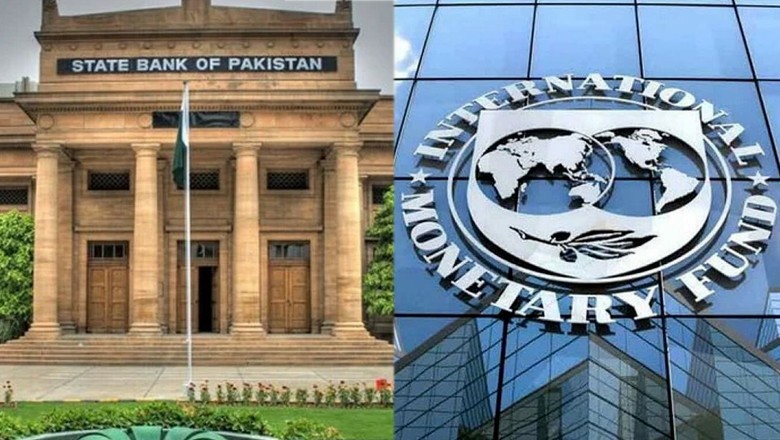
KARACHI: An International Monetary Fund staff mission led by Iva Petrova began technical-level discussions with the State Bank of Pakistan in Karachi on Wednesday, opening the third review of the country’s $7 billion Extended Fund Facility and the second review of its $1.1 billion Resilience and Sustainability Facility.
The team will remain in the port city through the end of the week before shifting to policy-level talks with federal and provincial governments starting Monday. Those sessions are expected to open with the usual round-up meeting with Finance Minister Muhammad Aurangzeb.
Aurangzeb told reporters after a parliamentary committee session that the government is well positioned for a successful review. He highlighted steady progress on collections by the Federal Board of Revenue, which will come under close examination during the talks. On external financing, the minister said there is “absolutely no issue” with the rollover of the United Arab Emirates’ $2 billion deposit held at the central bank. Both sides remain in constant contact, he added. The deposit, which normally rolls over annually, expired more than two months ago and has since been extended on a short-term basis.
Deputy Prime Minister and Foreign Minister Ishaq Dar struck a similar note, saying talks with the UAE government are ongoing and the funds will be “automatically rolled over.” Pakistan continues to rely on annual rollovers of safe deposits from the UAE, Saudi Arabia and China. The $12.5 billion in such funding forms a critical chunk of the country’s external financing needs under the EFF.
The almost two-week mission, set to conclude around March 11, will carry extra significance this time. Teams will assess program performance for the six months through Dec. 31, 2025, while also laying groundwork for the next federal budget, including broad contours and provincial contributions. Discussions are expected to drill into provincial finances, agriculture income tax collection, governance challenges and an action plan to address weaknesses in procurement and accountability institutions that have led to trillions of rupees in economic losses.
Program performance through the end of last year was largely on track. Most quantitative performance criteria were met, though revenue fell short of targets. Authorities expect the gap to narrow following a recent Federal Constitutional Court ruling on the super tax that favored the government. The sides will also review macroeconomic indicators for the third quarter now under way. The power sector will face particular scrutiny after months of shifting policies on industrial tariffs and residential fixed charges, even though circular debt remains within the agreed range.
Pakistan has lagged on some indicative targets and structural benchmarks, areas that could shape implementation going forward. On the technical front, the central bank is on track to meet nearly all of the seven quantitative performance indicators. Net international reserves are likely to have come in slightly below the $7 billion benchmark for September 2025 and under the $6.5 billion target for December. Net domestic assets stood around Rs12.5 trillion to Rs13.5 trillion, comfortably below the ceiling targets of Rs14.9 trillion to Rs15.1 trillion for those periods.
A successful completion of the review would unlock about $1 billion under the EFF and another $200 million under the RSF by the end of April. An IMF spokesperson said last week that policy steps under the EFF “helped stabilise the economy and rebuild confidence.”
Prime Minister Shehbaz Sharif, speaking at the Pakistan Governance Forum 2026 in Islamabad on Wednesday, signaled plans to cut direct taxes in the upcoming budget to ease the burden on businesses and spur growth. “I feel that in this upcoming budget, God willing, in the next few months, we will need to reduce direct taxes across the board so that business investors get some relief and they know that their capital is not being eaten up by taxes,” he said.
Sharif added that indirect taxes collected from consumers must flow properly into the national exchequer. “You collect indirect taxes from the consumer, but if you take that indirect tax from the consumer and put it in your pocket, then how is that any different from exploiting the larger public?” he asked. The prime minister acknowledged operating under IMF conditionalities but described many of the required reforms as necessary to strengthen the economy’s foundations. He called on provinces to support the federal “Uraan Pakistan” initiative aimed at accelerating growth, exports and governance.
The current IMF visit follows the release of $1.2 billion in mid-December after the previous review, completed in early October. Sources familiar with the schedule said the SBP will also brief the IMF team on anti-money laundering and counter-terrorism financing efforts.
Copyright © 2021 Independent Pakistan | All rights reserved