By Staff Reporter
ISLAMABAD: Imran Khan, the jailed former prime minister, was poised to be moved from his prison cell to a private hospital in Islamabad, in what supporters cast as the first real breakthrough in a three-year standoff over his health and treatment behind bars.
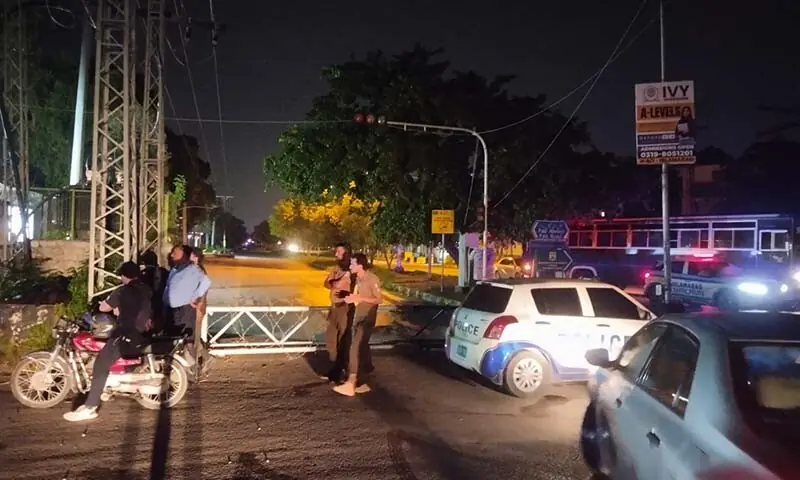
Police officers massed outside Shifa International Hospital through the day, sealing off surrounding roads and clearing parked cars, as the authorities raced to meet a court-imposed deadline that expired at midnight. Islamabad’s police chief, Syed Ali Nasir Rizvi, toured the hospital in person to inspect security preparations, according to sources briefed on the operation.
Khan, 73, has not left Adiala jail in Rawalpindi since his imprisonment in August 2023, when he was convicted of concealing the proceeds of state gifts he was entitled to buy at a discount but instead sold for profit — the so-called Toshakhana case. He is separately serving a 14-year sentence over what has become known as the Al-Qadir Trust affair, in which he and his wife were found to have accepted land and cash worth an estimated £190m in exchange for planning favours for a property tycoon. Khan and his party, Pakistan Tehreek-e-Insaf (PTI), have always maintained the cases were engineered by the military establishment to remove him from politics after his ousting in a no-confidence vote in April 2022.
The prospect of his transfer follows an order handed down by the s
Supreme Court on Tuesday, in which a three-judge bench directed jail authorities to move Khan to Shifa International Hospital within 48 hours for medical assessment and treatment, with the former prime minister to remain there until a further hearing on 16 September. The panel, led by Justice Shahid Waheed and sitting alongside Justices Naeem Akhtar Afghan and Ishtiaq Ibrahim, said the court could not turn away from its duty to protect the health and dignity of a person in state custody.
“A prisoner does not, by reason of his incarceration, cease to be entitled to humane treatment and necessary medical care,” the judges wrote in their order, adding that the ruling was an interim measure that would stand until the case was heard again.
The order came after weeks of pressure from Khan’s family and legal team, who told the court he had been left in near-total isolation and had suffered a serious decline in his eyesight, later diagnosed as central retinal vein occlusion, a condition affecting blood flow to the retina. His allies say the condition first became apparent in January and has since worsened under prison medical care.
The government moved quickly to resist the ruling. A day after the order was issued, lawyers acting for Islamabad’s chief commissioner filed a petition asking the supreme court to review and set aside its own decision, arguing that the direction to transfer Khan to a private hospital was “discriminatory” and had been made “in excess of jurisdiction”. That petition was rejected on procedural grounds by the court’s registrar’s office, which cited incomplete paperwork, though officials indicated it could be refiled once the deficiencies were addressed.
By Thursday evening, with the government’s challenge stalled, preparations for the transfer were reported to be complete. A police convoy, including officers from the traffic and elite units, had arrived at Adiala jail, while a dedicated team from the Islamabad police and capital administration was assembled to escort Khan to the hospital. PTI’s chairman, Barrister Gohar Khan, was formally notified of the arrangements, party sources said.
Should Khan be admitted for treatment, the relevant ward or floor of the hospital will be declared a sub-jail by Islamabad’s chief commissioner, with staff from Adiala jail deployed alongside police and paramilitary Rangers personnel to maintain security. Officials cautioned that the exact timing of the move had yet to be finalised and that contingency plans were in place in case complications arose.
Family access after months of silence
The order followed a rare moment of access for Khan’s family. On Tuesday, his sister Noreen Niazi was allowed to see him for the first time this year, meeting him in the jail’s conference room, where she updated him on the court’s ruling. She left without commenting to waiting reporters, pressing a finger to her lips when asked for a response. She was accompanied to the jail by her sisters, Aleema Khan and Dr Uzma Khan, both of whom have played leading roles in the family’s campaign for his release and treatment.
Dr Uzma Khan, a physician, was the last family member to see him before Tuesday, visiting in December. She said afterwards that his physical health was broadly stable but that he was enduring what she called “mental torture” from prolonged isolation. Before that, his sister Noreen had last seen him in November.
The hearing on Tuesday was attended by all three sisters, as well as Sohail Afridi, the chief minister of Khyber Pakhtunkhwa, the north-western province PTI continues to govern.
Political stakes
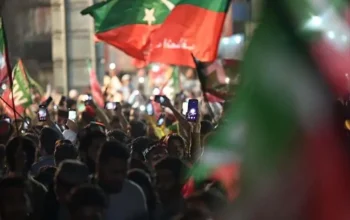
The transfer, if it proceeds as expected, would mark a significant, if provisional, victory for a party that has spent more than three years locked out of access to its founder and struggling to mount an effective legal challenge to his continued detention. PTI’s information secretary, Sheikh Waqas Akram, urged supporters to stay away from the hospital rather than gather outside it, saying the party understood the “sentiments” of those “eager to catch a glimpse of their leader” but did not want crowds to complicate his treatment.
The party’s secretary-general, Salman Akram Raja, moved to dampen speculation that Khan might ultimately be allowed to recuperate at his home in Bani Gala on the outskirts of Islamabad rather than return to prison. He said it was too early to draw that conclusion, though he noted that any building could in principle be designated a sub-jail if a medical board determined that sending Khan back to Adiala would harm his health. “These are all possible options,” he said, adding that the decision would ultimately rest with the medical panel overseeing his care.
Government and opposition figures have traded accusations over responsibility for the state of Khan’s health, with PTI claiming officials have obstructed access to his personal doctors and delayed proper treatment, and the government rejecting the charge. It has consistently maintained that Khan has received appropriate medical attention in custody, pointing to dozens of consultations carried out by prison-appointed specialists over the past three years.
Speaking from London, Khan’s close ally Zulfi Bukhari said the former prime minister had no wish to confront the military leadership were he to be freed. “If Imran Khan was released tomorrow, hypothetically, he wouldn’t do anything that would effectively damage the country,” Bukhari said, describing him as “magnanimous” in his approach to the army and its chief, Field Marshal Asim Munir. “That doesn’t mean you go loggerheads with the establishment, with the military leader,” he added. “You control your own hurt. You curb your own pain. You swallow it for the betterment of your country.”
Bukhari described the supreme court’s order as a “new ray of hope” but acknowledged that senior figures in the party, many of whom have gone into hiding amid a sustained crackdown on PTI since 2023, had not spoken directly to Khan in eight months. He suggested some might now begin to re-emerge. “You’ll probably see a lot of leadership come out of hiding,” he said. “Even if you don’t see them, you’ll see them mobilising.”
Khan’s family in Britain, including his sons Kasim and Sulaiman, who were raised in the UK by their mother, Jemima Goldsmith, following her divorce from Khan, have repeatedly appealed for greater access to their father and voiced alarm over his deteriorating eyesight.
Copyright © 2021 Independent Pakistan | All rights reserved