By Staff Reporter
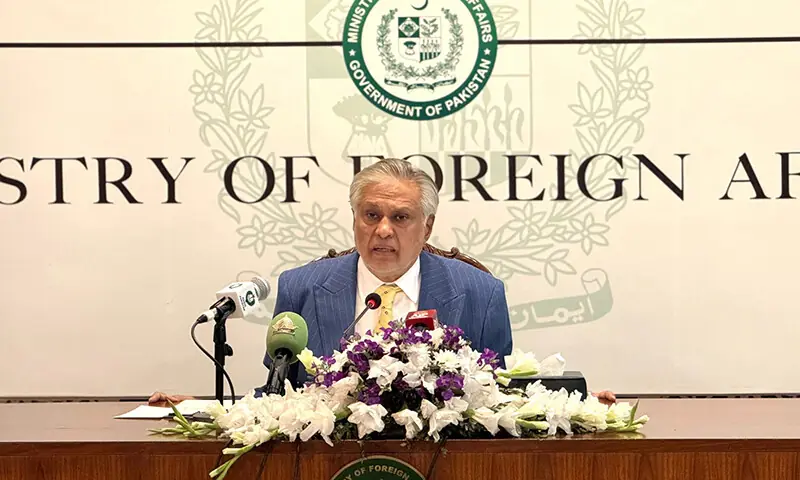
ISLAMABAD: Pakistan is engaged in intensive diplomatic efforts to calm the crisis in the Middle East after US and Israeli strikes on Iran killed supreme leader Ayatollah Ali Khamenei, the country’s foreign minister and deputy prime minister, Ishaq Dar, said on Monday.
Speaking at a press briefing in Islamabad, Dar described the situation as “significantly heightened tensions in an already volatile and fragile environment” and said Pakistan was “making full diplomatic efforts and requesting all parties to de-escalate”. The comments came as Iran carried out retaliatory strikes on US bases in Gulf countries, including Saudi Arabia, Bahrain, Jordan, Kuwait, Qatar, the United Arab Emirates and Oman.
Dar acknowledged that Tehran had framed its actions as self-defence but said Pakistan “regretted and condemned” the attacks on the Gulf states. “We can’t have double standards,” he added. “There was no justification.” Dar told reporters that the escalation had erupted at a moment when diplomatic channels appeared to be making progress. He pointed to prime minister Shehbaz Sharif’s recent visit to Austria and discussions with the International Atomic Energy Agency, which he said had produced “positive” feedback. Serious developments had nevertheless “engulfed almost all countries”, he said, just as efforts were under way for a “peaceful and negotiable solution”.
A high-level meeting chaired by Sharif on Sunday had reviewed both the Middle East crisis and the situation on Pakistan’s border with Afghanistan. Dar stressed that Pakistan’s position remained “clear and persistent”: all countries must respect the UN charter, international law, sovereignty, territorial integrity and international humanitarian law.
He voiced particular concern over the targeting of a head of state. “We are concerned over the violation of norms as well as international law … that the heads of state and the government … have been targeted,” he said. Pakistan had always insisted that “the door to dialogue and diplomacy must not be closed”.
Dar revealed that he had spoken last week to Iran’s foreign minister, Abbas Aragchi, conveying Pakistan’s condemnation of the attacks and calling for “restraint and dialogue”. Aragchi had responded positively, Dar said, “but on the ground, things were not settling down”.
Pakistan’s permanent representative at the United Nations had repeated the condemnation during an emergency UN security council meeting on the Middle East, the minister added. He himself had held conversations with foreign ministers of several countries, none of whom, he said, disagreed that “dialogue and diplomacy are the only way forward”. Pakistan stood “in full solidarity with all our brotherly countries” and was urging “maximum restraint”, Dar said.
The message had been delivered at every level, including by Sharif and army chief Field Marshal Asim Munir in their own contacts. He noted that the prime minister had personally called the leaders of the affected Gulf states to express regret and appeal for calm. Developments in the past 72 hours were “really very, very worrisome”, Dar said. Pakistan was calling for “an immediate halt to escalation through the urgent resumption of diplomacy” and stood ready to help achieve “a peaceful, negotiated resolution”.
Dar then turned to Pakistan’s western neighbour, declaring that Islamabad still wanted “good relations with all its neighbours” but had been left with no alternative but to act against terrorist groups operating from Afghan soil. He said he had visited Afghanistan three times and in every engagement had demanded that Kabul stop its territory being used by the Balochistan Liberation Army, Tehreek-i-Taliban Pakistan (TTP), the Majeed Brigade and other proscribed organisations.
After “serious violations” in October 2025, when Pakistani soldiers were being killed every week, and a string of high-profile attacks inside Pakistan — including the Islamabad court bombing, coordinated assaults across Balochistan and a suicide bombing at an imambargah on 6 February — Islamabad had first tried dialogue. Talks held in Qatar and Turkey with the Afghan Taliban had produced “nothing, nil”, Dar said. Intelligence showed that recent attacks in Bajaur and Bannu had been orchestrated by TTP leaders based in Afghanistan.
On 21 February Pakistan carried out selective strikes on seven terrorist camps. When those failed to stop the threat, and after what Dar called “unwarranted and provocative actions by the Afghan Taliban regime on the night of February 26” involving 53 locations across 15 sectors in Khyber Pakhtunkhwa — actions he described as “horrifying and totally lunatic” — Pakistan launched Operation Ghazab lil-Haq.
The operation, Dar insisted, was conducted “in self-defence” and consisted of “precise and targeted operations” against TTP and IS-KP camps and hideouts. Initial aerial strikes hit 22 locations in Kabul, Kandahar, Paktia, Nangarhar, Khost and Paktika — all military targets chosen on the basis of intelligence. In total, 37 locations were struck, he said.
Dar emphasised that the actions were “proportionate, minimum and measured” and had been planned “with careful planning in order to make sure that only the terrorist camps and hideouts are hit and civilian populations should not be targeted”. Pakistan had “the capacity, the will, the kinetic capability” to deal with the threat, he added, but had shown “extreme restraint” until now. The operation had been forced on Islamabad by “repeated terrorist attacks by Fitna Al Khawarij and Fitna Al Hindustan emanating from Afghan soil”.
Copyright © 2021 Independent Pakistan | All rights reserved