By Staff Reporter
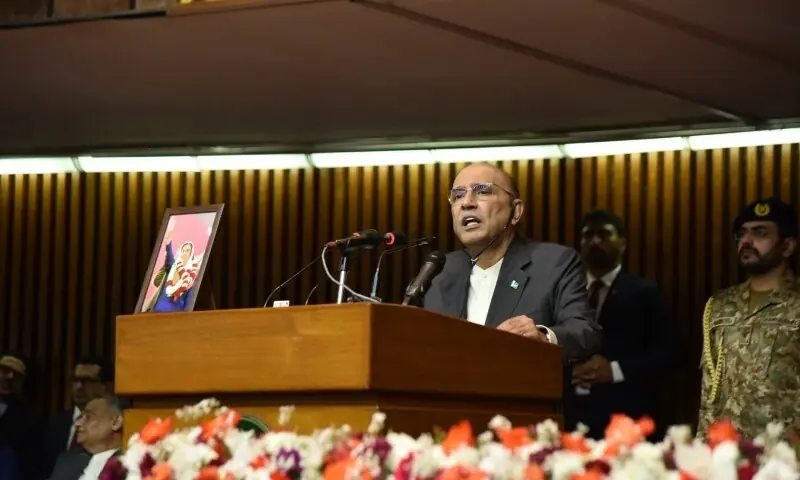
ISLAMABAD: President Asif Ali Zardari has issued a pointed warning to India and Afghanistan that any further aggression would meet with decisive force, telling potential adversaries to “prepare for another humiliating defeat” while insisting that Pakistan had so far revealed “only a fraction of our capabilities”.
Delivering his ninth address to a joint sitting of parliament at the start of the new parliamentary year, Zardari spoke against a backdrop of sustained disruption from opposition lawmakers who chanted “Go Zardari, go” and “Khan ko reha karo” – “free Imran Khan” – and at one stage gathered directly in front of the speaker’s dais.
The session, co-chaired by Senate chairman Syed Yousuf Raza Gilani and National Assembly speaker Sardar Ayaz Sadiq, was attended by prime minister Shehbaz Sharif, Zardari’s son and PPP chairman Bilawal Bhutto-Zardari, his daughter and MNA Aseefa Bhutto-Zardari, Punjab chief minister Maryam Nawaz, Balochistan chief minister Sarfraz Bugti and several provincial governors. First lady Aseefa Bhutto Zardari watched from the galleries alongside diplomats.
Zardari began by describing the occasion as his “singular privilege”, framing the address as a reminder of the continuity of Pakistan’s democratic system and the responsibilities borne by its elected representatives. He paid tribute to the country’s founder, Mohammad Ali Jinnah, and the 1973 constitution, recalling how, during his previous term as president, he had unilaterally returned presidential powers to parliament through the 18th amendment. “Today, the presidency stands as a symbol of unity … a bridge between federating units and a guardian of constitutional law,” he said.
The bulk of the speech, however, focused on the security challenges of the past 10 months, which he described as having tested the nation in “profound and complex ways”. Zardari praised the armed forces for their response to what he called “unprovoked attacks on both our borders one after the other”. Referring to the confrontation with India, he said Pakistani forces had turned an attack on the motherland into a “strategic victory” through “professionalism and discipline”.
On the western border, he said, security forces had acted decisively on the night of 26 February against a “long line of attacks” ramped up by the Taliban regime. “The political leadership stood united; the people stood resolute,” he said, expressing gratitude to the army, air force, navy, Rangers, Frontier Corps, police and intelligence agencies. The sacrifices of soldiers and law-enforcement personnel, he added, could not be reduced to statistics. “We only see their actions on the media with pride. We don’t really see their blood and sweat and tears.”
The president said 2025 had marked a turning point defined by these military successes. Turning to Kashmir, Zardari declared that “nobody in South Asia would be free or safe until the Kashmiris won their freedom”. He noted that Indian leaders had spoken of preparing for another war. “As a life-long advocate for peace, I would not recommend it,” he said. “At the same time, I will also say that any aggressor should prepare for another humiliating defeat; make no mistake, we are ready for you.”
Pakistan, he continued, was a “responsible nuclear state” that understood the weight of that responsibility but would defend itself when required. “Our conduct reflects maturity, confidence and clarity of purpose.”
On Afghanistan, Zardari said that when India attempted last week to “amplify proxy operations” through Afghan territory, the Taliban regime had witnessed Pakistan’s response once pushed past its red line. Despite exhaustive diplomatic efforts, he said, Islamabad had eventually exercised its right under Article 51 of the UN charter. “We have let both India and Afghanistan see a fraction of our capabilities.”
He cited a recent UN Security Council monitoring team report that described terrorist groups in Afghanistan as an “extra-regional threat”, warning that other countries could suffer catastrophic attacks if the problem was ignored. The Afghan de facto regime, he added, had failed to honour promises made in Doha and continued to provide sanctuaries to groups including al-Qaida, the Tehreek-i-Taliban Pakistan (TTP), the Balochistan Liberation Army (BLA) and their affiliates. “Let me be clear: the soil of Pakistan is sacred. We will not allow any entity – domestic or foreign – to use neighbouring territory to destabilise our peace,” Zardari said. He urged the Afghan Taliban to dismantle the terror groups “that survive on conflict and its war economy” and stop allowing Afghanistan to be used as a battlefield for another country’s ambitions. Pakistan, he insisted, had always treated the Afghan people as “kith and kin” and never walked away from dialogue.
The president expressed deep concern over the Middle East, condemning the war waged on Iran while negotiations were under way and reaffirming support for its sovereignty and territorial integrity. He condoled the martyrdom of Supreme Leader Ayatollah Khamenei. At the same time he condemned subsequent Iranian attacks on Saudi Arabia, the United Arab Emirates, Bahrain, Jordan, Kuwait and Qatar. “The sooner stability returns to the region, the sooner the world can go back to the business of rebuilding lives and fractured trust,” he said, calling for maximum restraint, respect for international law and negotiated solutions.
On water, Zardari accused India of “hydro-terrorism” by placing the Indus Waters Treaty in abeyance and manipulating river flows. “Rivers symbolise life,” he said. “International law does not permit the unilateral blockage of water.” Pakistan would defend its water rights “with unity, resolve, strength and legal clarity”, he added.
Domestically, the president stressed the importance of federal harmony and provincial autonomy. He called for the Council of Common Interests to function effectively and said he looked forward to a just National Finance Commission award. Balochistan, he said, deserved special attention; while insurgencies fuelled by foreign proxies were being dismantled, genuine social and economic grievances must be addressed so that the province’s people became “full partners in Pakistan’s progress”.
Zardari commended the government for rescuing the economy from near-collapse in spring 2022 and restoring stability in key indicators. He acknowledged the hardship endured by salaried workers, pensioners, labourers and small traders, and said the next phase must deliver inclusive growth, jobs and direct relief. Structural reforms, widening the tax base, embracing technology and innovation, and above all tackling high energy costs were essential, he argued. Climate-resilient agriculture and a shift towards clean energy were strategic imperatives.
Copyright © 2021 Independent Pakistan | All rights reserved