By Staff reporter
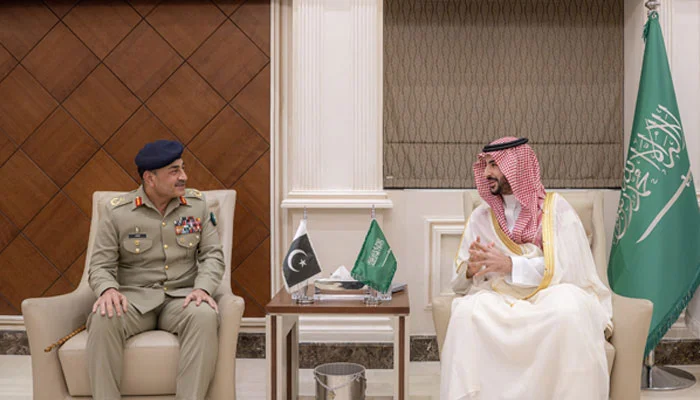
ISLAMABAD: Pakistan’s chief of defence forces and army staff chief, Field Marshal Asim Munir, met on Saturday with Saudi Defence Minister Prince Khalid bin Salman to address the kingdom’s mounting security concerns over repeated Iranian drone and missile attacks, officials from both sides said.
The closed-door talks in Riyadh focused on the “gravity of the security situation” created by the Iranian strikes and on practical steps to stop them under the Strategic Mutual Defense Agreement the two countries signed last September, according to a statement from military’s media wing Inter-Services Public Relations. That pact, signed in Riyadh by Prime Minister Shehbaz Sharif and Saudi Crown Prince Mohammed bin Salman, stipulates that an attack on either nation will be considered an attack on both.
The two sides “emphasised that unprovoked aggression undermined efforts for regional security and stability and foreclosed options for the peaceful settlement of disputes,” the military statement said. They expressed hope that “brotherly country Iran would manifest prudence and sagacity to avoid any miscalculation and strengthen the hands of friendly countries seeking peaceful settlement of the crisis.”
Prince Khalid struck a similar tone in posts on X, both before and after the meeting. He wrote that the discussions covered “Iranian attacks on the Kingdom and the measures needed to halt them” within the framework of the joint defence agreement. “We stressed that such actions undermine regional security and stability and expressed hope that the Iranian side will exercise wisdom and avoid miscalculation.”
The meeting was attended on the Saudi side by Chief of General Staff Gen. Fayyadh bin Hamed Al-Ruwaili and the defence minister’s adviser for intelligence, Hisham bin Abdulaziz bin Saif. The Pakistani delegation included Brig. Muhammad Javed Tariq.
The discussions came against the backdrop of a rapidly escalating Middle East conflict. The United States and Israel launched a large-scale military campaign against Iran on Feb. 28. In response, Tehran has fired drones and missiles at US and Israeli assets across the Gulf, as well as at sites inside Saudi Arabia and other Gulf states.
The Saudi Defence Ministry said Saturday that several drones targeting the Shayba oil field in the Empty Quarter had been shot down. Earlier in the week, a drone struck the US Embassy compound in Riyadh, sparking a minor fire but causing no injuries. The Iranian actions have also disrupted energy shipping through the Strait of Hormuz, threatening global oil supplies and the economies of Gulf states.
Pakistan and Saudi Arabia have long maintained deep ties rooted in military cooperation, economic assistance and shared Islamic heritage. Riyadh has been a major provider of financial aid and oil to Islamabad for decades. The Saturday meeting builds on earlier Pakistani diplomatic efforts. On Tuesday, Deputy Prime Minister and Foreign Minister Ishaq Dar told the Senate that Pakistan had used its influence to help deter heavier Iranian strikes on Saudi Arabia.
He said he had raised the Iran issue directly with US Secretary of State Marco Rubio in a bilateral meeting. “I had a bilateral meeting with Secretary Rubio — I took up the issue of Iran — Iran agreed not to produce nuclear weapons — Pakistan wanted that the matter be resolved through dialogue and Iran’s response was positive,” Dar said. Despite those positive signals, he added, Iran was attacked anyway.
Dar said Pakistani officials had repeatedly advised their Iranian counterparts to pursue diplomacy. “In meetings with Iranian officials, Pakistan advised Iran to resolve the matter with diplomacy and dialogue,” he told lawmakers. He also appeared to suggest that Iran’s own attacks on Gulf installations housing US military bases had complicated potential Arab support for Tehran. “Iran is a sovereign country, our brother, our friend, very dear to us — but they took a decision — I don’t want to get into that controversy,” Dar said. “I think if a counterattack had not taken place on those countries, we would have made them stand with us, and we would be having a joint voice.”
Dar noted that Pakistan had reminded Iran of the new defence agreement with Saudi Arabia and claimed that Islamabad was the only country to quickly condemn the initial US-Israeli strikes on Iran — a position Tehran appreciated. He added that Pakistan had formally asked Saudi Arabia for an alternative oil supply route through the port of Yanbu after the closure of the Strait of Hormuz.
Separately on Saturday, Saudi Interior Minister Prince Abdulaziz bin Saud bin Naif received a telephone call from Pakistan’s Interior Minister Mohsin Naqvi. Naqvi condemned the Iranian attacks and reaffirmed Islamabad’s “full cooperation and solidarity” in protecting Saudi security and stability, according to the Saudi Press Agency. The exchanges underscore the delicate balancing act Pakistan is attempting in a region where it maintains close ties with both Saudi Arabia and Iran. The military-to-military channel between Islamabad and Riyadh appears to be the most active track at the moment, reflecting the depth of the defence relationship forged over decades and formalised last year.
Copyright © 2021 Independent Pakistan | All rights reserved