By Staff Reporter
ISLAMABAD: The deputy prime minister and foreign minister said on Tuesday that dialogue and diplomacy are the only realistic way out of the widening Middle East conflict, a stance the government has repeated since US and Israeli strikes on Iran began more than two weeks ago.
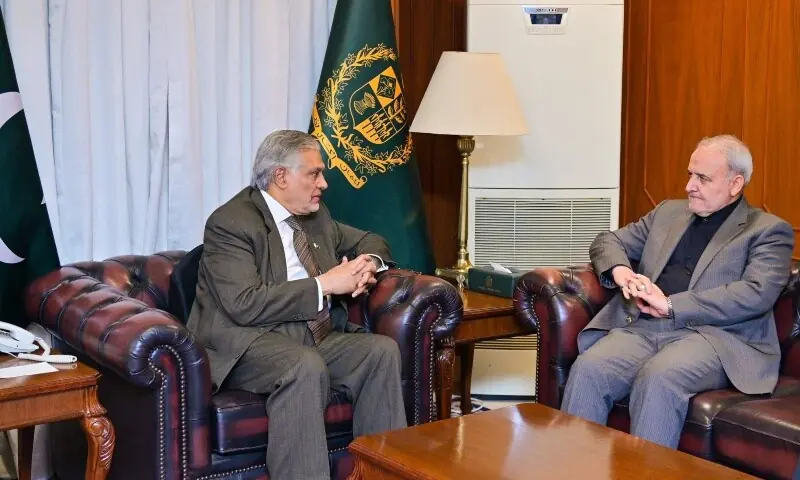
Ishaq Dar made the point during a meeting with Iran’s ambassador to Pakistan, Reza Amiri Moghaddam, the Foreign Office said. The envoy thanked Pakistan for the “strong moral support” its people have extended to Iran in a time of aggression from the United States and Israel. Dar offered condolences for the lives lost and voiced hope for a swift resolution. “He underscored that dialogue and diplomacy remain the only viable path to resolving issues and achieving lasting peace and stability in the region,” the Foreign Office said in a statement posted on X.
The message arrived as the fighting — triggered by U.S.-Israeli strikes on Feb. 28 and met with Iranian retaliation against American targets in Gulf countries — continues to ripple across the region. Pakistani officials have described their country’s role as that of a “bridge builder,” a position that has required careful navigation between close ties to Iran, Washington and Saudi Arabia, with which Islamabad maintains a mutual defense pact.
On Monday, Iran’s foreign minister, Abbas Araghchi, publicly thanked Pakistan in an Urdu post on X. “On this blessed, divine, and spiritual day and hour, I extend my heartfelt gratitude to the government and people of Pakistan for their strong expression of solidarity and support with the people and government of the Islamic Republic of Iran in the face of the aggression by America and the Zionist regime,” he wrote.
Prime Minister Shehbaz Sharif and Dar have spent the past two weeks on the phone with leaders across the region, repeatedly pressing for de-escalation. Earlier this month Sharif spoke with Iranian President Masoud Pezeshkian to quietly sound out possibilities for a ceasefire. He also flew to Saudi Arabia for a brief visit, holding a restricted meeting with Crown Prince Mohammed bin Salman in which he pledged Pakistan’s full solidarity and agreed to work together on regional stability.
At the same time, Pakistan has focused on keeping its own economic lifelines intact. Muhammad Mudassir Tipu, Pakistan’s ambassador to Iran, said Tuesday that Tehran continues to grant full facilitation for Pakistani trade and transit traffic despite the hostilities. Land borders remain open and operating smoothly, he said, with green channels at crossing points moving goods quickly in both directions. “I am extremely grateful to the Government of the Islamic Republic of Iran for extending full facilitation to Pakistan’s trade to Iran — as well as transit trade through Iran — during challenging times,” Tipu wrote on X. “Pakistan is also extending the best possible cooperation to Tehran to ensure that our trade remains unaffected by ongoing developments. The issues of congestion are also being addressed through mutual efforts.”
The embassy has stayed in constant touch with officials and private traders on both sides to clear bottlenecks immediately, he added. Ship-tracking data offered a glimpse of how some commerce is still getting through. Over the weekend a Pakistan-bound oil tanker operated by the Pakistan National Shipping Corporation became the first non-Iranian cargo vessel to transit the Strait of Hormuz while actively broadcasting its AIS signal, according to MarineTraffic data cited by the provider Kpler. Iran has attacked several ships in the Gulf since the war began, effectively disrupting the narrow waterway that normally carries about one-fifth of the world’s crude oil and liquefied natural gas and sending global energy prices higher. Pakistan depends heavily on imported crude and refined fuels from Gulf producers routed through the strait. The passage of the Karachi suggested that at least some countries have been able to negotiate safe passage for their vessels.
The fighting has also triggered a large-scale effort to bring Pakistanis home. Balochistan Chief Minister Sarfraz Bugti said Tuesday that 5,615 Pakistani nationals have returned through the province’s border crossings since Feb. 28. Before the strikes began, officials estimated that roughly 35,000 Pakistanis — including students, religious pilgrims and workers — were living in Iran. Air travel has been disrupted and military activity has intensified along Iran’s southern coast, turning ports such as Bandar Abbas near the strait into flashpoints.
In addition, 2,117 Iranian drivers and 431 other foreigners have crossed into Pakistan. Bugti said district administrations in Gwadar and Chagai have provided special facilities and assistance to all arrivals. “The Balochistan government is fully prepared and proactive to ensure the convenience, safety and comfort of the passengers at both the border crossing points,” he wrote on X.
Separately on Tuesday, Dar chaired a high-level meeting to review the rapidly changing regional picture. The Foreign Ministry said he took stock of efforts by Pakistan’s missions across the region and directed all concerned departments to stay fully engaged, maintain close coordination and give top priority to the safety and support of Pakistani nationals.
Copyright © 2021 Independent Pakistan | All rights reserved