By Staff Reporter
ISLAMABAD: Pakistan’s oil marketing companies are running into foreign-exchange bottlenecks as soaring international crude and product prices, coupled with higher insurance, import premiums and freight costs triggered by the US-Israel conflict with Iran and the blockade of the Strait of Hormuz, more than double the financing required for cargoes.
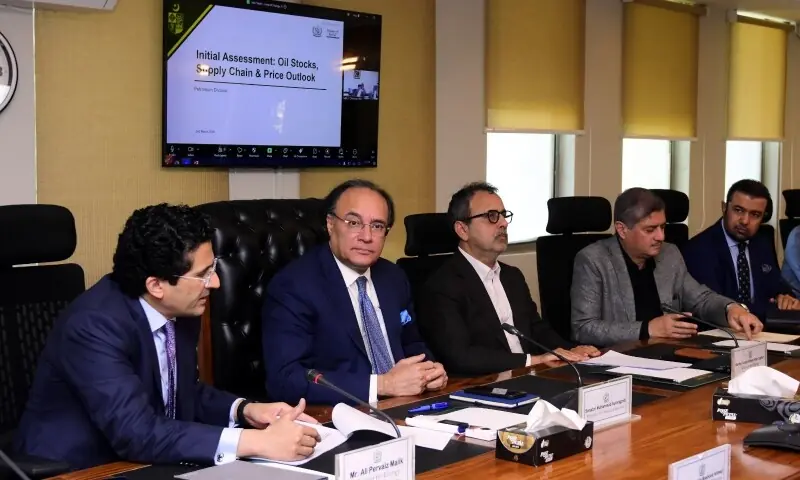
The constraints were formally flagged at Wednesday’s meeting of the special cabinet committee monitoring petroleum prices, chaired by Finance Minister Muhammad Aurangzeb. Industry executives, led by state-owned Pakistan State Oil, told the panel that credit limits extended to oil marketing companies in Pakistani rupees have stayed frozen since they were calibrated for global petrol prices around $70 a barrel and diesel near $90. Those benchmarks have since climbed beyond $132 and $190 respectively. The import premium alone has jumped above $20 a barrel from less than $5-6, while longer-haul voyages have inflated insurance and freight charges further.
Commercial banks have consequently declined to provide full foreign-exchange cover for the enlarged import requirements. The companies urged Aurangzeb’s committee and the State Bank of Pakistan to raise the limits immediately or put in place alternative arrangements to keep cargoes moving.
An official statement issued after the meeting acknowledged the pressure. “Rising international prices have significantly increased the landed cost of imports, resulting in larger transaction sizes and placing pressure on existing financing arrangements,” it said. The committee discussed “operational challenges arising from the increased size of letters of credit (LCs)” and called for tighter coordination between banks and importers “to ensure continuity of fuel imports.”
Aurangzeb directed officials to take the issue up urgently with the State Bank and the Pakistan Banks’ Association. Options under consideration include temporary enhancements to credit lines and consortium-based financing where single-bank limits prove insufficient. State Bank Governor assured the panel that prudential-limit issues would be reviewed on priority and encouraged lenders to adopt a flexible stance “to accommodate higher transaction volumes in view of prevailing market conditions.”
Despite the financing squeeze, domestic stocks have strengthened in recent days. Preliminary industry data showed petrol inventories covering more than 29 days of demand, diesel 26 days and crude 14 days, with Saudi Aramco committed to delivering two additional cargoes by mid-April. The Petroleum Division’s formal briefing to the committee put diesel cover at approximately 24 days and described petrol levels as comfortable, supported by ongoing imports and steady refinery runs.
One crude cargo has already arrived and is under discharge at Karachi; a second vessel is expected within hours. Further shipments remain in transit, and import programmes for March and April are being finalised to bolster reserves. Refinery throughput is forecast to rise as the fresh barrels are processed.
The committee was briefed that global petroleum markets remain “exceptionally tight, with recent increases observed in both benchmark prices and cargo premiums.” Members noted that “prevailing market conditions reflect supply-side uncertainties linked to regional developments, with premiums for upcoming cargoes expected to remain elevated in the near term.”
Pakistan has already adjusted domestic prices to reflect the surge. From March 7 the government raised petrol and high-speed diesel by Rs55 a litre. In Sunday’s weekly review it left motor fuels unchanged but lifted kerosene by Rs40 a litre.
The meeting also reviewed demand trends. Offtake has risen in recent weeks, prompting the committee to order provincial administrations and regulators to step up inspections and crack down on speculative hoarding. With Eid holidays and the harvesting season approaching, oil marketing companies were told to keep depots fully operational; the government said no supply disruptions are anticipated.
Separately, Prime Minister Shehbaz Sharif instructed Pakistan Railways on Wednesday to accelerate upgrades to its freight infrastructure so more goods can move by rail and reduce road-fuel consumption. Freight volumes are projected to grow 21% this year, officials told him, aided by a new digital Freight Management System, electronic weighing bridges and rolling-stock tracking.
Aurangzeb told the committee the government’s overriding priority is “uninterrupted availability of petroleum products across the country while minimising the burden on the public.” He noted that proactive planning and coordination have so far kept domestic supply stable even as international markets exhibit “volatility and upward price pressures.” March import requirements are fully covered, the panel was told, with current planning providing visibility through mid-April. Work is also under way on a digital dashboard to give real-time visibility of stocks and supply chains, and on expanding government-to-government supply deals to diversify sources.The finance minister ordered the committee to maintain daily monitoring of global prices, domestic inventories and logistics so policy can respond in real time.
Copyright © 2021 Independent Pakistan | All rights reserved