By Staff Reporter
KARACHI: Fresh excavations at Mohenjo-daro, one of the largest and most enigmatic cities of the ancient Indus Valley Civilisation, have confirmed an earlier chapter of organised urban life there than scholars had previously established, Pakistani authorities said on Sunday.
New radiocarbon dates and artefacts recovered during fieldwork in 2025-26 show that a substantial settlement and massive mudbrick fortifications existed at the site during the Kot Diji Phase, roughly 3300 to 2600 B.C., the Sindh Directorate General of Antiquities and Archaeology said. The findings reshape understanding of how this meticulously planned metropolis evolved from its earliest days.
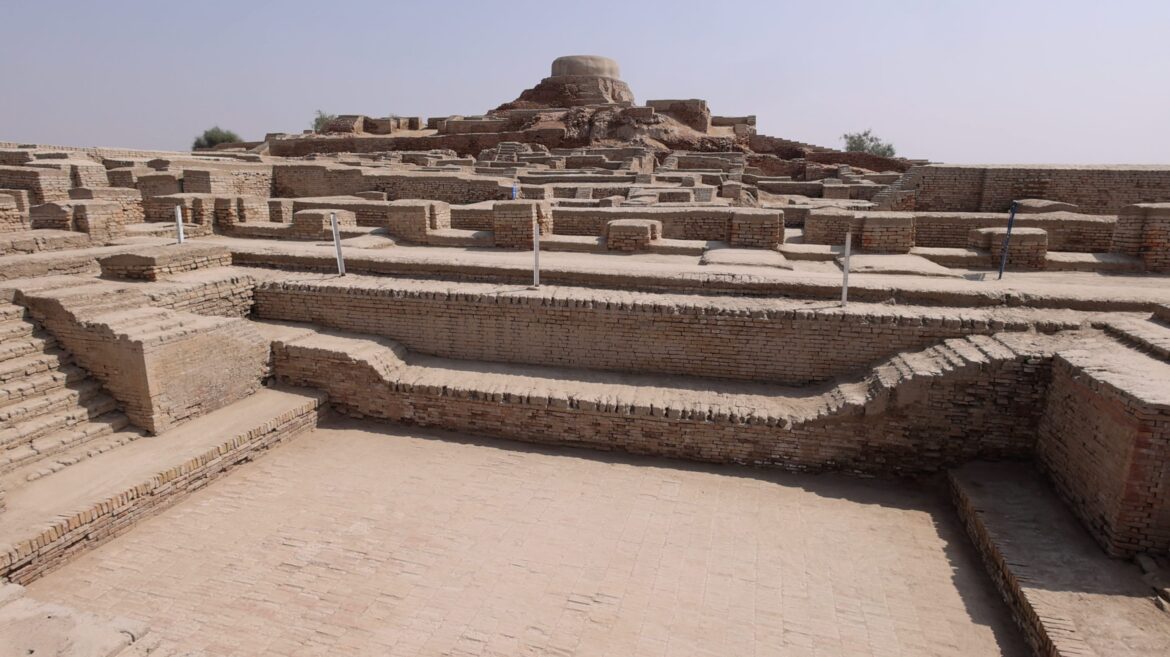
Mohenjo-daro, a UNESCO World Heritage site that sprawls across more than 620 acres on the banks of the Indus River in Sindh province’s Larkana district, ranked among the preeminent urban centers of its era. At its height, the city may have been home to as many as 40,000 people, its grid of baked-brick houses, covered drainage systems and public buildings rivalling those of contemporary centres in ancient Egypt and Mesopotamia. The site was abandoned around 1900 B.C., for reasons that remain the subject of scholarly debate.
The latest campaign was conducted by a joint mission of the Directorate General of Antiquities and Archaeology and the Sindh Exploration and Adventure Society, known as SEAS Pakistan. Pakistani archaeologists Asma Ibrahim and Ali Lashari led the work in collaboration with Jonathan Mark Kenoyer of the University of Wisconsin-Madison and teams of scholars and students from universities across Sindh and the United States. The excavations, carried out under the National Fund for Mohenjo-daro after a long hiatus, focused on the open plain west of the prominent Stupa Mound.
There, researchers reopened and meticulously redocumented a trench first dug in 1950 by the British archaeologist Sir Mortimer Wheeler. Wheeler had uncovered a massive mudbrick perimeter wall surrounding the western citadel, but interpreted it as a simple revetment built to protect the city from flooding. The new investigations established that the structure was far more complex — built in multiple phases atop even earlier occupation layers — and yielded five new radiocarbon dates.
“Pottery and carbon samples from the lowest levels of the first wall indicate that this initial structure was constructed at the end of the Early Harappan or Kot Diji Phase, around 2700-2600 BCE, approximately 100 years before the beginning of the Harappan Phase,” the directorate said in a statement.
Although the deepest deposits now lie below the water table, the team was able to reach and sample the critical construction layers.
Deeper coring beneath the wall recovered Kot Dijian-style pottery, evidence of a substantial Early Harappan occupation that predated the fortifications themselves. The chronology aligns closely with findings at the related site of Harappa in Punjab province, where an early city wall and Kot Dijian settlement have been dated to roughly 2800-2600 B.C.
Analysis of pottery and carbon samples from the middle and upper levels confirmed that later phases of the wall were expanded and maintained throughout the mature Harappan Period, beginning around 2600 B.C. and continuing at least until 2200 B.C. — and possibly longer. Future work will aim to trace the wall’s full circuit around the Stupa Mound, locate any gateways and clarify how the structure functioned within the city’s overall layout and eventual decline.
A Technical Consultative Committee for Mohenjo-daro described the project as “a step forward” in understanding the evolution of the ancient city’s urban fabric and the society that built it.
The site itself was first systematically explored in 1921-22. Subsequent campaigns by archaeologists, including R.D. Banerji, John Marshall and Ernest Mackay uncovered thousands of artefacts, among them 4,348 coins recovered between 1922 and 1931 that were later transferred to museums across what was then undivided India.
Ongoing conservation and research at Mohenjo-daro have continued to yield discoveries. In 2023, a preservation effort led by the Directorate General of Antiquities and Archaeology uncovered hundreds of copper coins from the Kushan era, dating from the second through fifth centuries A.D., in the vicinity of Divinity Street near the Stupa. The coins, fused together by centuries of heat and corrosion and weighing roughly 5.5 kilograms, were found clustered in what appeared to be a single deposit, making an immediate count difficult, said Shaikh Javed Ali Sindhi, a research scholar who took part in that work.
The latest findings from the city wall add significant new depth to the story of one of the world’s earliest planned urban societies, offering fresh insight into how Mohenjo-daro grew from its formative phases into a metropolis whose influence still resonates more than 4,000 years later.
Copyright © 2021 Independent Pakistan | All rights reserved