By Staff Reporter
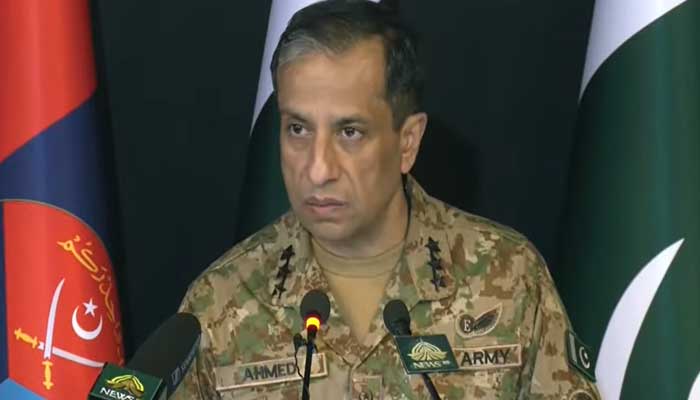
ISLAMABAD: Pakistan has warned the Houthis that an attack on Saudi Arabia will draw a collective military response, with its army spokesman declaring that Islamabad is already providing “whatever support is needed” to defend the kingdom.
Lieutenant General Ahmed Sharif Chaudhry, director general of Inter-Services Public Relations, said in an interview with Independent Arabia, aired on Sunday, that if deterrence failed it would be “re-established by all means” available to Pakistan, Saudi Arabia and Turkey.
It is the latest in a run of increasingly firm public pledges from the nuclear-armed country. Last month the general said Pakistan would go “to any extent” to protect the kingdom. Three weeks ago he confirmed that Pakistani forces were already stationed there, and he said they had been for decades.
The warning follows weeks of Houthi missile and drone strikes that have pulled Saudi Arabia deeper into the regional war. Saudi authorities say at least 12 people were killed and more than 300 wounded when a missile hit Riyadh’s King Khalid International Airport on 10 October. The Houthis say they are retaliating for Saudi strikes on airports in Sanaa and Hodeidah. On Monday, civil defence officials said a Houthi projectile struck a residential area of Najran, injuring six people.
Defensive, but with a warning
Lt Gen Chaudhry offered no detail on what Pakistan is providing, saying no alliance publishes such information because of “operational confidentiality”. He was blunt about the stakes, however. The security of Makkah and Madinah, he said, was “non-negotiable”, and there could be no “ifs and buts”.
Anger at the Houthi attacks, he said, ran “from a young boy and girl up to our political and military leadership”. He asked why anyone “in his right mind” would threaten the holy places. The Houthis have denied targeting Makkah, after Saudi Arabia said last month that it had shot down a drone approaching the city.
He was equally firm that the Makkah Joint Defence Agreement, signed by the three states on 7 August, had “no offensive intent”. Invoking Article 51 of the UN Charter, he said anyone who waged war on any member “directly or indirectly” would face a collective response.
Asked whether the Houthis would heed such a message, he compared them with Pakistan’s own militant enemy, the Tehreek-e-Taliban Pakistan. Such groups, he said, “don’t behave like states”, but they responded to clear communication. “There is no hesitation in our communication to them,” he said.
Talking to Tehran
The general’s tone toward Iran, which backs the Houthis, was markedly softer. A Saudi deputy foreign minister has linked the two, but Lt Gen Chaudhry said Pakistan had spent months engaging all sides, Iran included, “with the singular intent of restraint”. Defence Minister Khawaja Asif has said separately that Islamabad raised the Houthi attacks with Tehran.
He rejected reports that the pact was aimed at Iran or Israel. It was “not country-specific”, he said, though any actor threatening regional stability “automatically interacts” with its deterrence.
The conflict, he said, followed a “sinusoidal” pattern. It subsides, then “the agent of chaos” drives it up again. “We need to stop attacking each other,” he said. If diplomacy failed, he added, the alliance’s deterrence “will definitely come into play, as it is coming into play”.
Asked about US-Iran hostilities after the American midterm elections, he said: “The concern of escalation is always there.”
An alliance taking shape
The pact was first activated on 5 October, when the three countries met in Riyadh. They agreed to deploy forces rapidly to the kingdom and appointed a retired Pakistani general, Nauman Mahmood, as secretary general. Turkey’s foreign minister, Hakan Fidan, has said Ankara is assessing how it can help. Prime Minister Shehbaz Sharif has called the attacks on the holy cities a “red line”, while saying he hopes for a settlement without further fighting.
The general said the alliance now has a secretariat and a committee of foreign and defence ministers and service chiefs, and that its speed of development was “phenomenal”. He said it was open to other states, but that membership was for the three founders to decide. He gave no commitment on reports that Egypt and Syria were interested. He dismissed critics as people with “a problem with this alliance”.
Asked about direct military help for Yemen’s government, he said he did not know whether any request had been received, but that one would be considered.
Copyright © 2021 Independent Pakistan | All rights reserved