By Staff Reporter
ISLAMABAD: The country observed its annual Pakistan Day on Monday with the patriotic fervor that has long defined the holiday, but this year’s ceremonies were deliberately modest, stripped of the usual military parade and large-scale pageantry in line with government austerity measures imposed because of the global oil crisis.
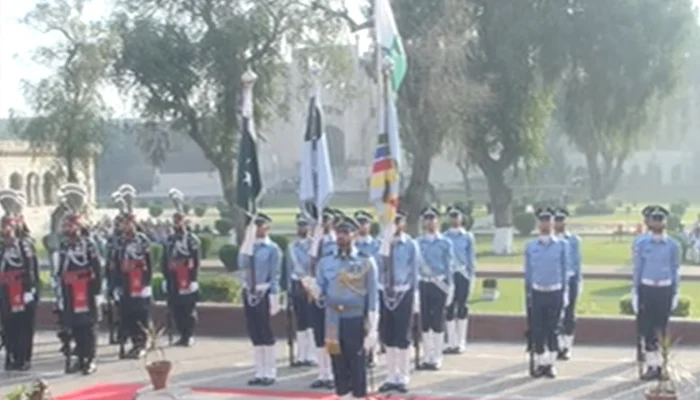
The day commemorates the passage on March 23, 1940, of the Lahore Resolution by the All-India Muslim League, the pivotal demand for a separate Muslim homeland that set the country on the path to independence. Eighty-six years later, the occasion was marked across the country with 21-gun salutes in federal and provincial capitals, flag-hoisting ceremonies at government buildings and military installations, and a dignified change-of-guard at the mausoleum of Allama Iqbal in Lahore, where a contingent from the Pakistan Air Force assumed ceremonial duties.
The restrained tone reflected decisions announced last week by the government to scale back non-essential spending and public events in response to the economic pressures triggered by the US-Israel war on Iran, which has disrupted oil supplies and sent energy prices soaring worldwide. Officials said the measures were necessary to safeguard the national economy at a time when Pakistan, like many developing nations, is feeling the pinch of higher fuel costs and reduced export revenues.
President Asif Ali Zardari and Prime Minister Shehbaz Sharif used their separate messages to strike notes of both reflection and resolve. Zardari described the day as a reminder that “unity and solidarity are essential to transform national resolve into reality.” He paid tribute to the sacrifices of the nation’s founders and recalled how, despite the immense challenges of the early years after independence, Pakistan had built strong institutions, achieved nuclear capability and successfully confronted terrorism through collective effort.
The president pointed to recent military operations — including what he called Marka-e-Haq, Operation Bunyan-um-Marsoos and Operation Ghazab-lil-Haq — as evidence that Pakistan had responded decisively to aggression and would continue to do so. He vowed that no group, including those he labeled Fitna al-Khawarij, would be allowed to use Pakistani soil for attacks on other countries, and he reaffirmed the military’s determination to eliminate terrorism in all its forms. Zardari also turned to unfinished business from the 1947 partition, describing the situation in Indian Illegally Occupied Jammu and Kashmir as an “unfinished agenda” and calling on the international community to ensure the Kashmiri people’s right to self-determination. He urged global action to halt atrocities against Palestinians and pressed for diplomatic solutions to tensions across West Asia.
Prime Minister Sharif, in his message, highlighted signs of economic stabilization despite the external shocks, citing declining inflation and growing investor confidence. He portrayed March 23 as a historic milestone that united the Muslims of the subcontinent and led, within just seven years, to the creation of Pakistan under the leadership of Quaid-i-Azam Muhammad Ali Jinnah. Sharif praised the armed forces for their “professionalism and sacrifices,” saying recent operations had demonstrated the country’s “impregnable defence and unshakable resolve.”
Chief of Defence Forces and Chief of Army Staff Field Marshal Asim Munir, Chief of Naval Staff Admiral Naveed Ashraf and Chief of Air Staff Air Chief Marshal Zaheer Ahmed Baber Sidhu extended their congratulations to the nation on the 86th anniversary of the Lahore Resolution. “March 23rd 1940 stands out as a defining moment in our history as the day that crystallised our collective vision and set the course for the creation of an independent homeland,” a statement issued by military’s media wing the Inter-Services Public Relations said. “Rooted in faith, guided by hope, and strengthened by resilience, this day epitomises the unwavering resolve of the people of Pakistan.”
The armed forces pledged to remain “united and unwavering” in eradicating terrorism and extremism, working alongside the public and law-enforcement agencies. They reaffirmed their commitment to strengthening democratic institutions, safeguarding national sovereignty and maintaining internal security “against all forms of aggression and terrorism.” Pakistan, the statement added, would continue to act as a responsible member of the international community, advocating peace and stability.
The decision to forgo the traditional Pakistan Day parade — normally a centerpiece of the celebrations, featuring marching troops, fighter-jet flyovers and displays of military hardware — was taken explicitly because of the oil crisis. Government officials said the savings would help cushion the impact of higher energy import bills on an economy still recovering from earlier shocks.
Copyright © 2021 Independent Pakistan | All rights reserved