By Staff Reporter
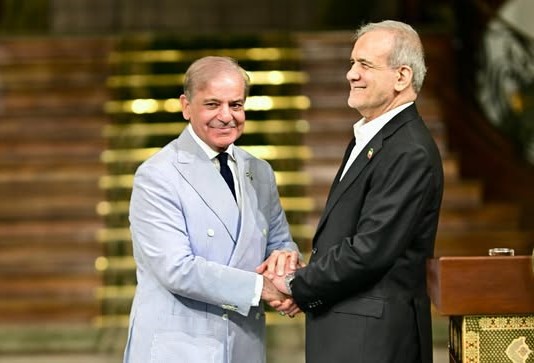
ISLAMABAD: Prime Minister Shehbaz Sharif on Monday pressed Iranian President Masoud Pezeshkian for an immediate collective effort to de-escalate the widening Middle East conflict, warning that the fourth week of war had created a “grave situation” requiring urgent dialogue among neighbours and renewed unity across the Muslim world.
The telephone conversation came as Iranian missiles and drones continued to strike targets across the Gulf and as President Donald Trump announced he had ordered a five-day postponement of threatened US strikes on Iranian power plants and energy infrastructure — a move that briefly sent oil prices tumbling before they settled around $101.80 a barrel.
According to a statement from Sharif’s office, the prime minister conveyed “serious concern” over the “dangerous ongoing hostilities in the Gulf region” and underscored “the urgent need to work collectively for de-escalation and a return to dialogue and diplomacy amongst all the neighbouring countries to settle their differences.”
He also stressed “the critical importance of unity in the ranks of the ummah, that is required more than ever before.” Sharif assured Pezeshkian that Pakistan would continue to play a “constructive role” in facilitating peace, sharing details of Islamabad’s own diplomatic outreach. As a “neighbouring brotherly country,” he conveyed Pakistan’s solidarity with “the brave Iranian people” and offered condolences for lives lost, praying for the recovery and safety of the injured and displaced.
The two leaders also exchanged Eid al-Fitr and Nowruz greetings, with Pezeshkian warmly reciprocating and sending best wishes to the people of Pakistan, the statement said. The call unfolded against a backdrop of relentless escalation since the war began Feb. 28, when the United States and Israel launched coordinated strikes on Iran that also resulted in the assassination of Supreme Leader Ayatollah Ali Khamenei. More than 2,000 people have been killed so far, according to regional tallies. The fighting has upended global markets, driven up fuel costs, accelerated inflation fears and strained the Western defense alliance.
Iran has fired barrages of missiles and carried out drone attacks on Gulf countries including Saudi Arabia, the United Arab Emirates, Oman, Kuwait and Bahrain. Tehran has accepted responsibility for some retaliatory strikes on US bases and assets while denying involvement in others, further straining ties with its Gulf neighbours. In recent days, Iran has explicitly threatened to target energy and water systems in the Gulf if Washington follows through on its threat to hit Iranian power plants. The US warning was tied to Tehran’s refusal to fully reopen the strategic Strait of Hormuz, a chokepoint for roughly one-fifth of global oil trade.
On Saturday, Trump had given Iran a 48-hour deadline to open the waterway or face destruction of its power plants. Later Monday, Trump said in a Truth Social post written in capital letters that the United States and Iran had held “VERY GOOD AND PRODUCTIVE” conversations over the previous two days aimed at a “COMPLETE AND TOTAL RESOLUTION OF HOSTILITIES IN THE MIDDLE EAST.” He claimed he had instructed the Pentagon to postpone any strikes on Iranian power plants and energy infrastructure for five days pending the outcome of the talks.
Speaking to Fox Business Network, Trump added that Iran “wanted badly to make a deal,” which he suggested could be reached within days. The White House did not respond to media questions about the content of the discussions, who took part or where they occurred. Iranian state media, including the Mehr news agency citing the foreign ministry, flatly denied that any negotiations were underway, describing Trump’s statements as an attempt to lower energy prices. A source briefed on Israel’s planning told Reuters that Washington had kept Jerusalem informed and that Israel was expected to follow the US lead in suspending targeting of Iranian power plants and energy sites.
The announcement sent the Brent crude benchmark down as much as 13 percent before it recovered somewhat. US stock futures reversed earlier losses to rise about 1.3 percent. The threat of strikes on electricity grids had raised particular alarm across the Gulf, where power consumption per capita is roughly five times higher than in Iran. Electricity is essential for desalination plants that supply virtually all drinking water in Bahrain and Qatar, more than 80 percent in the UAE and half in Saudi Arabia.
Fatih Birol, executive director of the International Energy Agency, described the unfolding energy crisis as worse than the 1970s oil shocks and Russia’s 2022 invasion of Ukraine combined. Iran’s Defense Council had earlier warned that it would cut all Gulf shipping routes by laying sea mines if Trump carried out his threat, state media reported. Iran’s Revolutionary Guards separately vowed retaliation against Israeli power plants and those supplying US bases across the Gulf.
Even as Trump spoke of a pause, Israeli forces continued operations. Early Monday the Israeli military launched a fresh wave of strikes on infrastructure in Tehran, Iranian news agencies reported. Six people were killed and 43 injured in strikes on residential buildings in the western city of Khorramabad, while a separate attack on the southern city of Bushehr hit the local meteorological organization and killed the head of meteorology for Bushehr’s airport. The Iranian Red Crescent released video showing rescue workers pulling a person on a stretcher from an affluent northern Tehran building whose facade had been largely destroyed. Across the Gulf, Saudi Arabia’s defense ministry said two ballistic missiles fired toward Riyadh had been intercepted or landed in uninhabited areas.
Copyright © 2021 Independent Pakistan | All rights reserved