By Staff Reporter
ISLAMABAD: Pakistan and China on Tuesday jointly proposed a five-point initiative to restore peace and stability in the Gulf and the wider Middle East, calling for an immediate cessation of hostilities in the US-Israeli war on Iran, the prompt launch of peace talks and the protection of civilian infrastructure and vital shipping lanes.
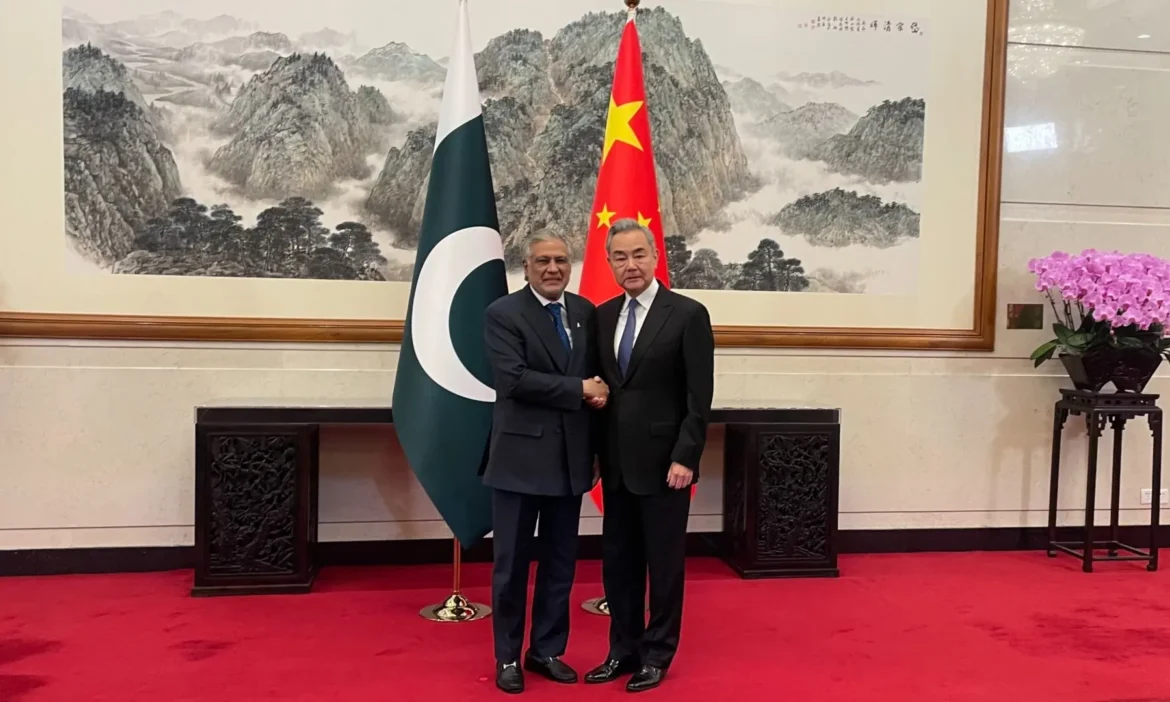
The plan emerged after Pakistan’s deputy prime minister and foreign minister, Ishaq Dar, made a one-day visit to Beijing at the invitation of his Chinese counterpart, Wang Yi. The two diplomats met at the Diaoyutai State Guest House for what Pakistani officials described as “in-depth discussions on regional developments,” part of a continuing effort by Islamabad to position itself as a mediator between Washington and Tehran even as the conflict shows few signs of abating.
In a joint statement released after the talks, the two countries — described by both sides as “all-weather” strategic partners — stressed that “dialogue and diplomacy is the only viable option to resolve conflicts.” They urged all parties to refrain from the use or threat of force during any negotiations and to safeguard the sovereignty, territorial integrity, national independence and security of Iran and the Gulf states.
The five-point initiative, laid out in detail by Pakistan’s Foreign Office begins with a demand for “the immediate cessation of hostilities and utmost efforts to prevent the conflict from spreading,” while insisting that humanitarian assistance be allowed to reach all war-affected areas without delay. It calls for peace talks to begin “as soon as possible.”
The plan further demands strict adherence to international humanitarian law. “The principle of protecting civilians in military conflict should be observed,” the statement said. “China and Pakistan call on parties to the conflict to immediately stop attacks on civilians and nonmilitary targets, and fully adhere to International Humanitarian Law, and stop attacking important infrastructure, including energy, desalination and power facilities, and peaceful nuclear infrastructure, such as nuclear power plants.”
On the economic front, the two nations focused on the Strait of Hormuz, the narrow waterway through which roughly one-fifth of the world’s oil normally flows. “The Strait of Hormuz, together with its adjacent waters, is an important global shipping route for goods and energy,” the statement noted. “China and Pakistan call on the parties to protect the security of ships and crew members stranded in the Strait of Hormuz, allow the early and safe passage of civilian and commercial ships, and restore normal passage through the Strait as soon as possible.”
The proposal also urges a return to multilateral diplomacy. Beijing and Islamabad called for “efforts to practice true multilateralism, to jointly strengthen the primacy of the United Nations, and to support the conclusion of an agreement for establishing a comprehensive peace framework and realising lasting peace based on the purposes and principles of the UN Charter and international law.”
The language reflected China’s careful calibration of its role in the crisis. Beijing has ties to Tehran and remains the largest buyer of Iranian oil, yet it has avoided deeper entanglement. While it condemned the initial U.S. and Israeli strikes, Chinese diplomacy has focused on cease-fire appeals and ensuring safe passage for its own tankers through the strait.
For Pakistan, the Beijing trip represented the latest step in a concerted diplomatic campaign. Over the past week, Prime Minister Shehbaz Sharif and army chief Syed Asim Munir have maintained direct lines to President Donald Trump and Iranian President Masoud Pezeshkian, while Pakistani intermediaries have relayed messages between the two adversaries. On Sunday, Islamabad hosted foreign ministers from Saudi Arabia, Turkey and Egypt for nearly two hours of talks aimed at forging a regional path to de-escalation. Though the United States and Iran were not at the table, Dar has publicly floated Pakistan as a potential venue for direct U.S.-Iran negotiations in the coming days.
Tehran’s ambassador to Islamabad, Reza Amiri Moghadam, welcomed the effort, praising Pakistan’s “proactive diplomatic initiatives based on goodwill” to halt the “U.S.-Israeli aggression” and restore regional stability. Analysts said Pakistan’s sudden prominence as an intermediary reflects both opportunity and necessity. After years of relative marginalization in Washington under previous administrations, the government and military leadership see a chance to reassert the country’s credentials as a diplomatic player in the Muslim world and a dependable partner for Gulf monarchies and the United States.
Yet the risks are immediate and domestic. Pakistan shares a 900-kilometer border with Iran, and officials fear that prolonged fighting could spill into the already volatile Balochistan province, which is battling a low-level insurgency. The country is also home to the world’s largest Shia Muslim population outside Iran, and sectarian tensions have already claimed dozens of lives in protests that erupted after the first US and Israeli strikes on Tehran. A newly signed defense pact with Saudi Arabia adds another layer of risk; any Gulf escalation against Iranian missile and drone attacks could pull Islamabad into the fray against its will.
The joint proposal came amid sharply divergent public signals from the warring parties. Trump claimed this week that negotiations with Iran were going “extremely well,” while Tehran insisted no direct talks were occurring. In a fresh warning, President Trump said that if a cease-fire is not reached “shortly” and the strait is not reopened, the United States would intensify its campaign, potentially striking Iran’s Kharg Island oil export terminal and even desalination plants.
Chinese Foreign Ministry spokeswoman Mao Ning had previewed the Beijing meeting by saying the two sides would “strengthen strategic communication and coordination on the Iran situation and … make new efforts toward advocating for peace.” Wang Yi had told Dar in a telephone call last week that initiating talks would be “no easy task” but was essential to restoring normal navigation through the strait. He has repeatedly endorsed Pakistan’s mediation efforts.
Copyright © 2021 Independent Pakistan | All rights reserved