By Staff Reporter
ISLAMABAD: China said Tuesday it would strengthen strategic coordination with Pakistan over the Iran crisis, as the deputy prime minister Ishaq Dar arrived in the Chinese capital for a one-day visit aimed at advancing diplomatic efforts to end the month-old war between the United States, Israel and Iran.
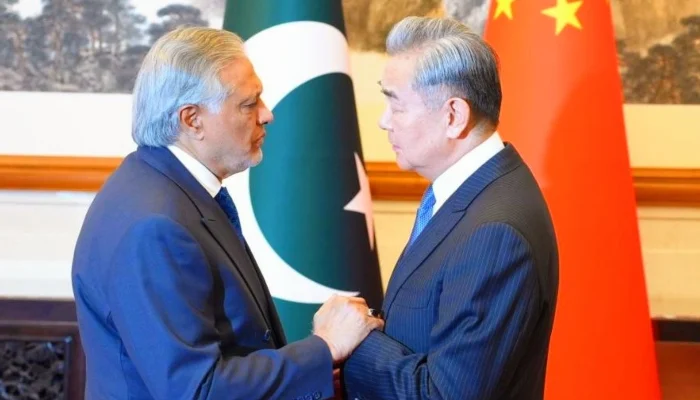
Dar, who also holds the foreign minister portfolio, landed in Beijing in the late afternoon at the invitation of Chinese Foreign Minister Wang Yi. He was greeted on arrival by China’s Special Envoy for Afghan Affairs Yue Xiaoyong and Pakistan’s Ambassador to China, Khalil Hashmi, according to Pakistan’s Foreign Office. Hours later, Wang received him at the Diaoyutai State Guest House for bilateral talks.
The meetings are expected to focus on developing a framework and guiding principles for prospective direct dialogue between Iran and the United States. Both sides will also review the full range of bilateral ties and discuss regional and global issues of mutual interest.
Chinese Foreign Ministry spokeswoman Mao Ning, speaking at a regular news briefing, described the two countries as “all-weather” strategic partners and said the foreign ministers would “strengthen strategic communication and coordination on the Iran situation and … make new efforts toward advocating for peace.”
The visit comes as Pakistan has thrust itself to the center of international mediation efforts. Over the weekend, Islamabad hosted a quadrilateral meeting of foreign ministers from Pakistan, Saudi Arabia, Türkiye and Egypt that lasted roughly 100 minutes. The participants called for immediate de-escalation, an end to the fighting and the creation of conditions for structured negotiations between Washington and Tehran.
In a televised address after the gathering, Dar publicly hinted that Pakistan could host direct US-Iran talks in the coming days. Pakistani officials have confirmed that indirect exchanges between the two sides — through carefully structured message relays rather than face-to-face contact — are continuing.
Dar’s trip to Beijing is his second official visit this year. It follows two recent telephone conversations with Wang. During the most recent call last week, Wang told Dar that initiating peace talks “is no easy task” but would be “conducive to restoring normal navigation through the Strait of Hormuz.” He also conveyed China’s support for Pakistan’s role as a mediator. In an earlier conversation on March 10, Wang commended Pakistan’s “constructive role” in promoting de-escalation and stability in the Middle East.
Pakistan’s Foreign Office noted that Dar proceeded with the journey despite medical advice to rest after suffering a hairline shoulder fracture on Monday, a decision it said underscored the importance Islamabad attaches to its relationship with Beijing.
Iran’s ambassador to Pakistan, Reza Amiri Moghadam, welcomed Islamabad’s efforts in unusually warm terms. “Iran welcomes Pakistan’s proactive diplomatic initiatives based on goodwill to restore peace and [bring] lasting stability to the region,” he said in a statement that also praised “the initiative and goodwill and good office by the friendly & brotherly country of Pakistan to stop the US-Israeli aggression against Iran and restore peace and stability to the region.”
China, which maintains close ties with Iran, has repeatedly called for a ceasefire and urged restraint by all parties. Beijing has positioned itself as a potential guarantor in any future agreement, a role that appears to have been discussed in advance of Dar’s visit. Washington-based scholar Vali Nasr noted that Iran has sought credible guarantees in any potential deal with the United States, with indications that Dar was exploring Beijing’s willingness to play that role.
The conflict, which began Feb. 28, has already had significant economic repercussions. Iran has effectively blockaded oil and gas shipments through the Strait of Hormuz — a critical chokepoint for global energy trade — causing price spikes and supply disruptions worldwide.
On Monday, The Wall Street Journal reported that President Donald Trump had told aides he is willing to end the US military campaign against Iran even if the strait remains largely closed, leaving the complex task of reopening it for a later date.
Pakistan and China share one of the world’s most enduring strategic partnerships, underpinned by close defence, security and economic cooperation. Beijing has pledged more than $65 billion in investments under the China-Pakistan Economic Corridor, a flagship project of its Belt and Road Initiative. The two countries also maintain regular consultations on other regional flashpoints, including Afghanistan, where China has previously engaged in mediation.
In an earlier statement, Pakistan’s Foreign Office described the partnership as an “all-weather strategic cooperative partnership” characterized by “close coordination and regular consultations” on regional and international issues. Officials in both capitals have signaled that Tuesday’s talks will build on that foundation to address not only the immediate Iran crisis but also longer-term stability in the wider Middle East and beyond.
Copyright © 2021 Independent Pakistan | All rights reserved