By Staff Reporter
ISLAMABAD: The Foreign Office said on Monday that diplomatic efforts to end the fighting between the United States, Israel and Iran remain “ongoing,” but it refused to confirm or deny reports that Islamabad has quietly assembled a detailed framework aimed at halting the conflict.
The measured statement came as Reuters reported that Pakistan had drafted a proposal and exchanged it overnight with both Washington and Tehran, citing a source familiar with the discussions. The plan envisions an immediate cease-fire, the reopening of the Strait of Hormuz and a 15- to 20-day window to negotiate a broader settlement tentatively dubbed the “Islamabad Accord,” according to the report. It would include a regional framework for securing the strait and culminate in in-person talks hosted in Pakistan’s capital.
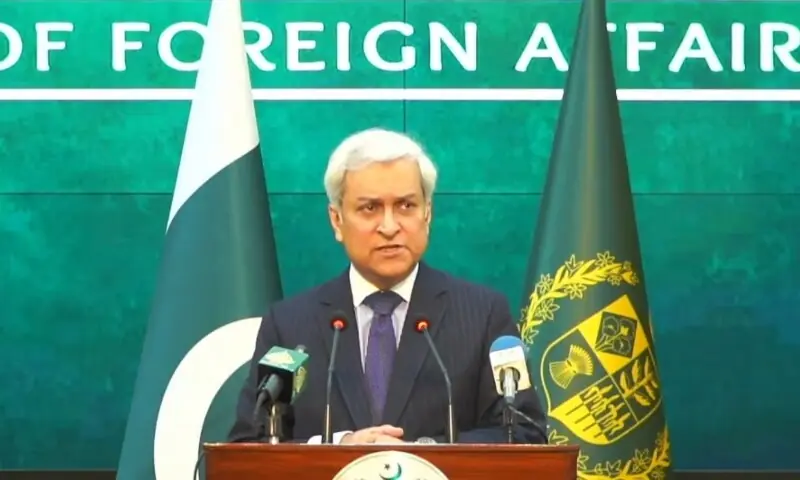
Foreign Office spokesman Tahir Andrabi, responding to questions from journalists, declined to address specifics. “There have been several reports of a 45-day ceasefire offer, or 15-point exchange. We do not comment on these individual, specific incidents,” he said. “Our position remains that the peace process is ongoing.”
The Pakistani comments followed an earlier Axios report on Sunday that the United States, Iran and regional mediators were discussing a potential 45-day cease-fire as the first phase of a two-stage agreement that could lead to a permanent end to the war. That account, based on US, Israeli and regional sources, described active but delicate negotiations.
Iran, for its part, signaled that it had already formulated its own positions and demands in response to the latest proposals funneled through intermediaries. Foreign Ministry spokesman Esmaeil Baghaei told reporters in Tehran that negotiations were “incompatible with ultimatums and threats to commit war crimes.” He said earlier US demands, including what he described as a 15-point plan, had been rejected as “excessive.” “Iran does not hesitate to clearly express what it considers its legitimate demands,” Baghaei said, “and doing so should not be interpreted as a sign of compromise, but rather as a reflection of its confidence in defending its positions.”
Pakistan has cast itself as a potential facilitator in the crisis, drawing on its longstanding ties to Washington and its functional working relationship with Tehran. On Saturday, Iranian Foreign Minister Abbas Araghchi underscored that Tehran had “never refused to go to Islamabad” for any peace talks Pakistan might host.
The latest diplomatic maneuvering unfolds against a backdrop of sharply escalating hostilities that have placed the Strait of Hormuz — the narrow waterway through which roughly one-fifth of global oil trade passes — at the center of the conflict. Iranian forces have effectively blocked shipping through the strait and carried out strikes on economic targets in Gulf countries that Tehran says are supporting the US-Israeli effort. Energy markets have grown increasingly volatile, with traders monitoring any sign that the waterway could be reopened or further constricted.
President Donald Trump has repeatedly injected urgency — and threats — into the talks. In an expletive-laden post on Truth Social on Sunday, he warned Iran that the United States would target its power plants and bridges if Tehran did not reopen the strait. Later that day, Trump posted a new, one-word deadline: “Tuesday, 8:00 P.M. Eastern Time!” He elaborated in an interview with The Wall Street Journal: “If they don’t do something by Tuesday evening, they won’t have any power plants and they won’t have any bridges standing.” In a separate conversation with Fox News, Trump said he believed a deal remained possible in the near term. “I think there is a good chance tomorrow, they are negotiating now,” he said. But he added a stark caveat: “If they don’t make a deal and fast, I’m considering blowing everything up and taking over the oil.”
Iran denounced the statements as “clear evidence of intent to commit war crime” and called on the international community to intervene. A Reuters source said an Iranian official had confirmed that Tehran received Pakistan’s proposal for an immediate ceasefire and was reviewing it, while emphasising that Iran would not accept pressure tied to artificial deadlines.
The Pakistani Foreign Office has been relaying messages between the two sides for days. According to Reuters, Pakistan’s army chief, Field Marshal Asim Munir, was in contact “all night long” with US Vice President JD Vance, special envoy Steve Witkoff and Iranian Foreign Minister Araghchi as the latest proposal was exchanged. Whether the back-channel efforts can produce a breakthrough before Trump’s Tuesday deadline remains unclear.
Copyright © 2021 Independent Pakistan | All rights reserved