By Staff Reporter
ISLAMABAD: President Donald Trump said on Thursday that he might travel to Islamabad if a peace agreement with Iran is signed there, offering an optimistic assessment of the prospects for ending six weeks of conflict even as he warned that fighting could resume without a deal.
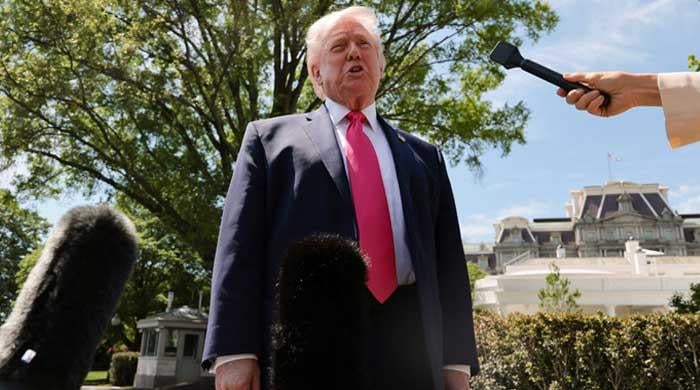
Speaking to reporters on the White House lawn as he prepared to depart for a trip to Nevada and Arizona, Trump indicated that the next round of in-person discussions between American and Iranian officials could occur as soon as this weekend.
He repeatedly praised Pakistan’s role in mediating the talks, singling out Prime Minister Shehbaz Sharif and Field Marshal Asim Munir, the country’s chief of defense forces and army chief, for their efforts. “If the deal is signed in Islamabad, I might go,” Trump said. “They want me.”
The comments came one day after White House press secretary Karoline Leavitt told reporters that a second round of talks was “very likely” to be held in Islamabad and described Pakistan as the “only mediator” in the ongoing negotiations between Washington and Tehran. Leavitt expressed appreciation for Islamabad’s diplomatic intervention, which has positioned Pakistan as a rare neutral ground for direct U.S.-Iranian engagement.
Pakistan hosted the first round of face-to-face discussions on April 11, following the announcement of a temporary truce that paused weeks of open warfare between Iran and a US-Israeli coalition. Those initial talks, held in Islamabad, made little headway on core disputes, including Iran’s nuclear program, the lifting of US sanctions and the future of the Strait of Hormuz — the vital waterway Tehran has blocked since the conflict erupted in late February.
Trump struck a notably hopeful tone Thursday, saying Iran had “agreed to almost everything” and was willing to make concessions it had previously resisted. He said without offering evidence that Tehran had agreed to surrender its stockpile of enriched uranium — material the United States maintains was buried during US-Israeli airstrikes last year and that could be used to build nuclear weapons. “They’ve agreed to give us back the nuclear dust,” Trump told reporters, using his colloquial term for the enriched uranium. “There’s a very good chance we’re going to make a deal.”
The president added that he could extend a US-Iran ceasefire scheduled to expire next week but suggested it might not be necessary. “If there was no deal, fighting would resume,” he said, “but I did not think the ceasefire would need to be extended as Iran was willing to do things it previously wasn’t.”
Trump’s remarks suggested the central role Pakistan has played in the diplomacy. Field Marshal Munir was in Tehran on Thursday continuing mediation efforts, while Sharif had spent the previous two days shuttling between regional capitals. On Wednesday he visited Saudi Arabia, and on Thursday he traveled to Qatar, both stops aimed at building support for a US-Iran agreement. Sharif reached Türkiye later Thursday to participate in the Antalya Diplomacy Forum, where he planned to meet with other regional leaders to discuss the rapidly evolving situation. “Pakistan has been great,” Trump said. “The field marshal has been great, the prime minister has been really great in Pakistan. So I might go.”
The developments mark a sharp pivot from the intense fighting that began in late February, when Israeli and US strikes targeted Iranian civilian and military sites. Iran responded by closing the Strait of Hormuz, a chokepoint for roughly one-fifth of global oil shipments, and launching retaliatory attacks. A temporary truce was reached after several weeks, but both sides have made clear that the pause is fragile.
During the April 11 talks in Islamabad, US and Iranian negotiators remained far apart on several key issues. Washington is demanding the complete dismantlement of Iran’s nuclear enrichment capability and the return of any fissile material that survived earlier strikes. Tehran has sought broad sanctions relief and guarantees that the Strait of Hormuz will reopen without further military pressure. Pakistani officials have described their role as purely facilitative, insisting they are not proposing specific terms but simply providing a venue where the two adversaries can meet directly — something that had not occurred in more than a decade.
Trump’s willingness to travel to Islamabad if a final agreement is reached there would represent a dramatic gesture. No American president has visited Pakistan since the early 2010s, and a trip tied to an Iran peace deal would carry significant symbolic weight, signaling US gratitude for Pakistani diplomacy while potentially lending presidential prestige to the signing ceremony.
trump did not specify whether he would attend the anticipated weekend talks themselves or only appear for a possible signing. When asked directly about the timing of the next round, he replied: “Probably, maybe over the weekend.” Trump also briefly addressed a separate but related Middle East development, expressing confidence that a ceasefire between Lebanon and Israel would take hold imminently and would encompass Hezbollah. “Today they’re going to be having a ceasefire, and that’ll include Hezbollah.”
He added that Lebanese and Israeli leaders could meet at the White House within the next week or two — the first such direct encounter in 44 years. “We’re going to have a meeting, first time in 44 years, and Lebanon will be meeting with Israel,” Trump said. “And they’re probably going to do it at the White House.” The convergence of the Iran and Lebanon-Israel tracks reflects the administration’s broader push to stabilize the region after months of cascading conflicts. Administration officials have privately described Pakistan’s mediation as unusually effective, in part because Islamabad maintains working relationships with both Washington and Tehran while also enjoying credibility in Arab capitals.
Copyright © 2021 Independent Pakistan | All rights reserved