By Staff Reporter
ISLAMABAD: Pakistani fighter jets and surveillance aircraft provided an extensive air escort last weekend to a high-level Iranian delegation returning from inconclusive peace talks with the United States, launching what officials described as a major operational mission after the Iranians expressed concerns that Israel might try to kill them, Reuters reported quoting three sources familiar with the matter.
The operation involved roughly two dozen Pakistani jets, including the air force’s top-of-the-line Chinese-made J-10 fighters, along with an Airborne Warning and Control System plane for aerial surveillance. The aircraft accompanied the Iranian delegation from Islamabad all the way to Iran, according to two Pakistani sources with direct knowledge of the mission. One of those sources said Pakistan would offer similar protection for any future round of talks if the Iranians requested it. Otherwise, the source added, “Pakistani aircraft would receive them in Pakistan airspace.”
The escort went well beyond normal diplomatic protocol and has not been previously reported. It showed the acute security anxieties that have persisted even after a fragile ceasefire took hold last week in the conflict that has pitted Israel against Iran and drawn in the United States. The talks in Islamabad represented the highest-level direct engagement between Tehran and Washington since the 1979 Iranian revolution.
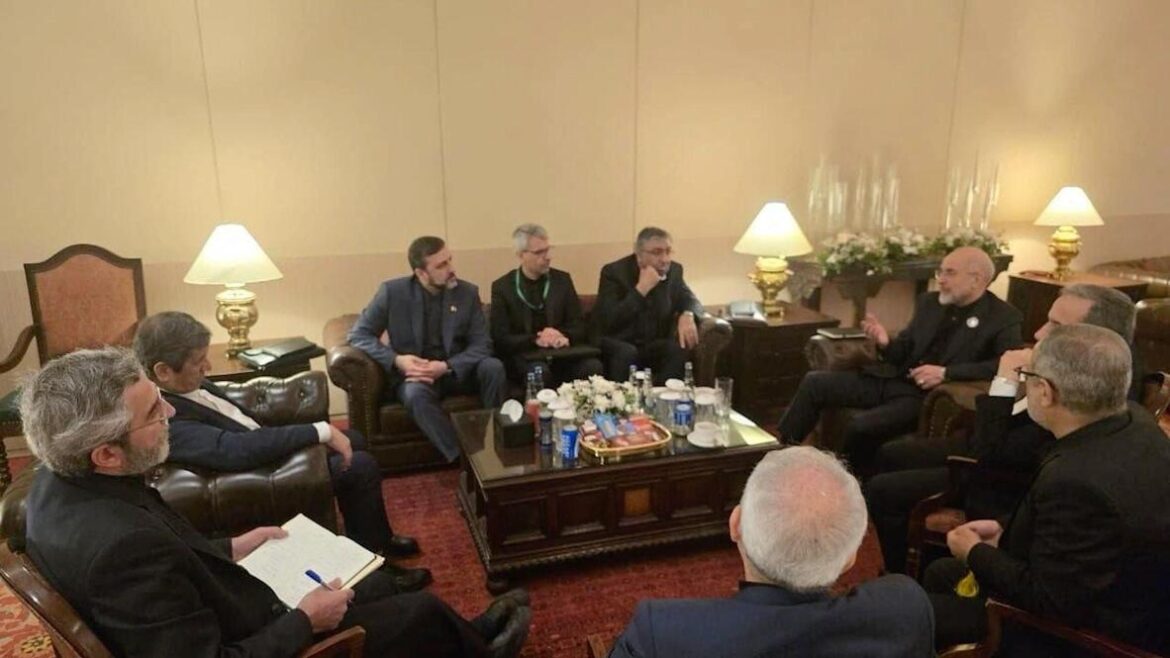
The Iranian delegation was led by Foreign Minister Abbas Araqchi and Parliament Speaker Mohammad Baqer Qalibaf, a former senior military officer and certified pilot. A third source involved in the negotiations confirmed that the escort was provided and said Pakistan had taken responsibility for the delegation’s safety even after the visitors left Pakistani territory. “We dropped them all the way to Tehran,” the source said. “Their security was our responsibility even beyond their time here.”
A regional diplomat briefed by Tehran offered a slightly different account, saying Pakistan had insisted on the escort after the Iranians raised what the diplomat described as the “hypothetical” possibility of a threat during their return journey. The Iranians did not make a formal request, the diplomat said, but they also did not rule out the possibility that Israel could even strike their aircraft. The diplomat added that the delegation did not land in Tehran itself and declined to specify exactly where the aircraft set down.
One security source familiar with the Iranian side’s thinking described the atmosphere immediately after the talks ended. “When the talks failed, the Iranians were wary that things had not gone right,” the source said. “It was their suspicion that they might be targeted.” The source characterized the mission as unusually demanding from an operational standpoint. “This was a massive operational mission if you look at it from a pilot’s point of view,” the source said. “You are taking responsibility for a delegation that is coming for talks, you are giving them air cover, you have potent fighters that counter any threat.”
Pakistan’s air force and military declined to comment on the operation. Iran’s permanent mission in Geneva and the US embassy in Islamabad did not respond to requests for comment. The office of Israeli Prime Minister Benjamin Netanyahu also did not respond.
The security concerns were not abstract. Since the war began, Israel has carried out a series of high-profile assassinations inside Iran, killing Supreme Leader Ayatollah Ali Khamenei, national security chief Ali Larijani, the commander of the paramilitary Basij force Gholamreza Soleimani, Intelligence Minister Esmail Khatib and other top military commanders. Last month Netanyahu told reporters, “I wouldn’t issue life insurance policies on any of the leaders of the terrorist organisation,” a reference to Iran. “I don’t intend to provide an exact report here about what we are planning or what we are going to do.”
Hours before the ceasefire was announced last week, President Donald Trump posted on social media a stark warning: “A whole civilisation will die tonight, never to be brought back again. I don’t want that to happen, but it probably will.” Despite the inconclusive outcome of last weekend’s talks, which were led on the American side by Vice President JD Vance, both sides have signaled that diplomatic channels remain open. Sources told Reuters shortly after the delegations departed that dialogue was still alive. On Thursday, Trump said the war “should be ending pretty soon” and indicated that another round of talks could take place in Islamabad as soon as this weekend.
A source involved in the negotiations said preparations for the next round were already underway. Pakistani officials have made clear they are prepared to continue hosting the discussions and to provide whatever security measures Tehran deems necessary, according to the sources. The episode highlights the extraordinary lengths to which Pakistan has gone to facilitate the negotiations while simultaneously assuming direct responsibility for the physical safety of one of the parties. Hosting the talks placed Islamabad in a delicate position between two longtime adversaries, yet Pakistani authorities moved decisively once the Iranians voiced their fears.
From a technical standpoint, the mission required precise coordination. The J-10s, Pakistan’s most capable fighters, flew alongside the Iranian aircraft for the duration of the journey, while the AWACS plane provided continuous radar coverage and early warning against any potential airborne threat. One official familiar with the operation described it as a significant commitment of resources for what was essentially a diplomatic protection detail. The Iranian delegation’s composition itself reflected the gravity of the moment. Araqchi, Tehran’s chief diplomat, and Qalibaf, a powerful conservative figure with deep roots in Iran’s security establishment, represented the highest echelon of the Islamic Republic’s political and military leadership. Their decision to seek enhanced protection — even if framed initially as hypothetical — spoke to the depth of mistrust that continues to shadow the ceasefire.
The regional diplomat who was briefed by Tehran said the Iranians had been unsettled by the atmosphere at the conclusion of the talks. The failure to reach any agreement appeared to heighten their sense of vulnerability, the diplomat said, prompting Pakistani officials to take the precautionary step of providing the full escort rather than risk any incident on the return leg.
Pakistani sources emphasized that the operation was not undertaken lightly. One described the pilots’ sense of responsibility as profound: they were not simply ferrying visitors across a border but guaranteeing the safety of senior officials who had come to Pakistan under the assumption that their hosts would protect them. Whether similar protection will be required for the expected next round of talks remains to be seen. One Pakistani source said the air force stood ready to repeat the mission if asked. Another source involved in the planning said arrangements were already in motion for talks that could resume in Islamabad within days. The broader context remains volatile. Trump’s public comments, both before and after the ceasefire, have alternated between apocalyptic warnings and expressions of hope that the conflict can be brought to a swift close. Netanyahu’s refusal to rule out further action against Iranian leaders has kept tensions high even as the guns have fallen silent.
Copyright © 2021 Independent Pakistan | All rights reserved