By Staff Reporter
KARACHI: The Sindh provincial government has terminated the construction contract for a crucial segment of the long-troubled Red Line Bus Rapid Transit project along University Road and will re-award the work on an emergency basis, Senior Minister Sharjeel Memon said on Wednesday.
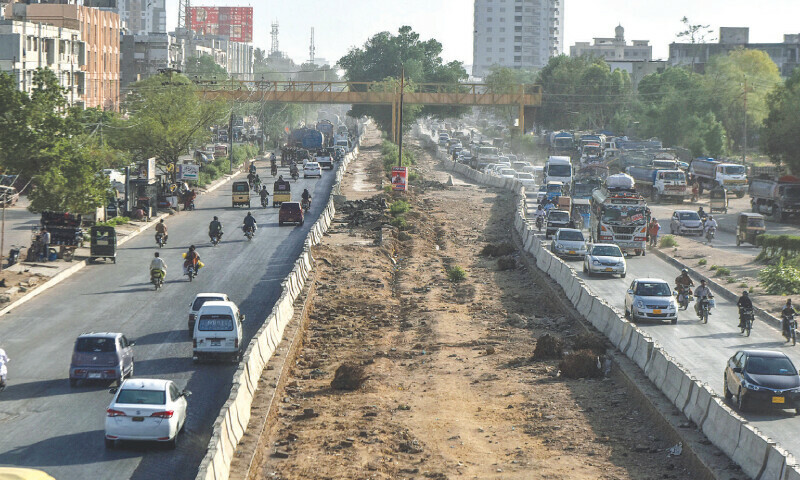
The cancellation covers the Mosamiyat–Numaish section of the 27-kilometer corridor, the latest in a string of setbacks that have left thousands of daily commuters on one of Karachi’s busiest arteries navigating incomplete construction, traffic chaos and prolonged uncertainty more than four years after work began.
Memon told reporters that the contractor had been issued repeated warnings to meet deadlines but failed to do so. The provincial government, he said, had gone to considerable lengths to keep the original firm on the job, including resolving disputes over rate escalations caused by inflation and currency depreciation. Yet the pace remained unacceptable to both the government and the Asian Development Bank, the project’s principal international lender, which has grown impatient with the slow progress. Environmental stakeholders have also voiced concerns about the impact of prolonged work on the corridor. “To ensure early completion, the remaining work will be split into smaller packages and awarded to more than one contractor,” Memon said.
Construction on the Red Line, which is intended to run from Malir Halt to Numaish via University Road, has been plagued by delays since it was announced in 2017 with an initial price tag of about 79 billion rupees (roughly $285 million at the time). The estimated cost has since ballooned to 103 billion rupees amid repeated extensions, design changes, land-acquisition fights, utility relocations and coordination failures among government agencies.
Work finally started in early 2022. The original target for completion was 2023. That slipped first to 2024 and then to the end of 2026. Even the latest deadline is widely viewed as unrealistic. In November, after Chief Minister Murad Ali Shah personally intervened to clear several bureaucratic bottlenecks, limited construction resumed on parts of the route. But large stretches remain untouched or only partially built, and no firm timeline for full opening has been offered.
Officials have cited a familiar litany of obstacles: heavy monsoon rains, disputes with contractors, safety stoppages, the rupee’s sharp depreciation that inflated imported material costs, difficulties acquiring land and shifting power lines, water mains and other utilities, and poor synchronization between the multiple agencies involved. In December, Shah toured the corridor from Malir Cantonment to Numaish and ordered accelerated work, only to be briefed that the same problems persisted. In September the Sindh High Court pressed all parties to resolve their differences so that construction could proceed without further interruption.
The project is financed in part by the Asian Development Bank and is meant to provide a modern, high-capacity transit spine for a city of more than 20 million people long starved for reliable public transport. Its repeated postponements have become a symbol of broader governance challenges in Sindh, where large infrastructure initiatives frequently fall years behind schedule and far over budget.
In a separate proceeding on Wednesday, the Sindh High Court heard a petition filed by the contractor challenging the government’s decision to seal its site office and construction yard. A two-member bench headed by Justice Mohammad Saleem Jessar directed the appointment of a court observer to visit the site and compile an inventory of all machinery present. The court, however, rejected the petitioner’s immediate request to have the office and site de-sealed.
Barrister Salahuddin Ahmed, representing the petitioner, told the court that the contract had been awarded to a joint venture of a Pakistani and a Chinese company. He argued that TransKarachi, the government entity overseeing the project, had delivered the detailed design only after two and a half years, contributing significantly to the delays. Ahmed also said a dispute-resolution board established to examine the impasse had found the government partly responsible and had approved an additional 3.7 billion rupees in payments to the contractor to cover escalated costs.
The lawyer contended that local officials — including the mukhtiarkar, police and the deputy commissioner of East district — had overstepped their authority the previous day when they sealed the contractor’s office. He noted that machinery “worth a billion rupees” remained on the site and was now at risk. The court issued formal notices to TransKarachi, the Sindh government, the mukhtiarkar, police officials and the deputy commissioner, and adjourned the case until April 29.
For residents of University Road and surrounding neighborhoods, the latest developments mean more months — perhaps years — of dust, detours and diesel fumes. Many say they have grown accustomed to broken promises on the Red Line, but the abrupt cancellation of a major contract and the promise of yet another re-tendering process have left them skeptical that relief is anywhere in sight.
Copyright © 2021 Independent Pakistan | All rights reserved