By Staff Reporter
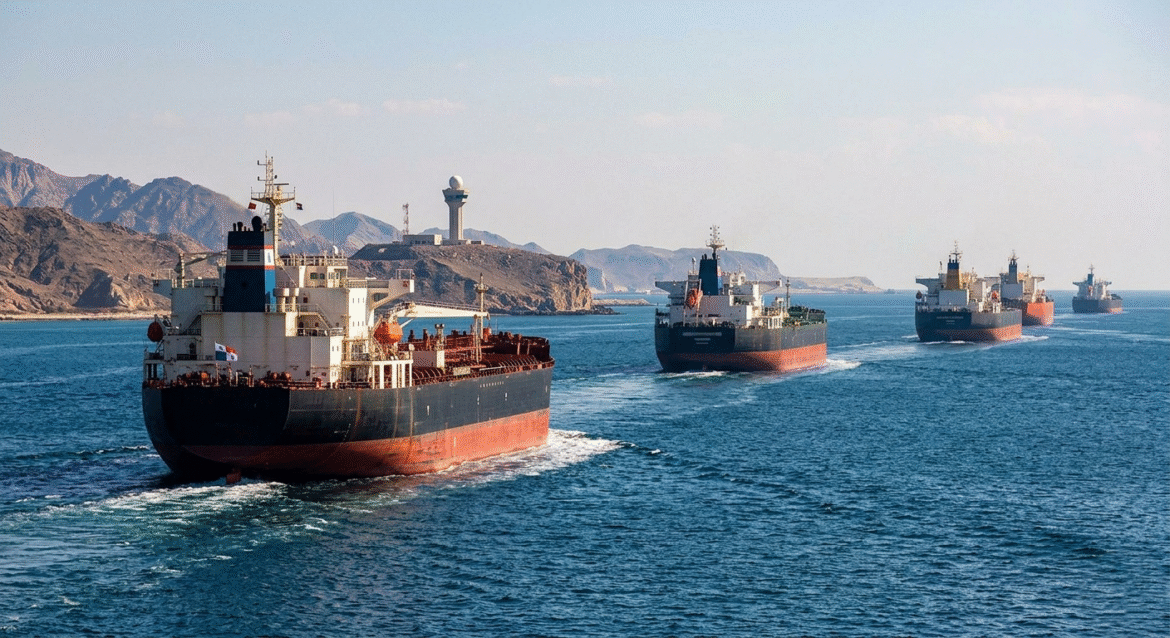
ISLAMABAD: President Donald Trump said on Sunday that the United States will begin an operation Monday to guide hundreds of commercial vessels and their crews out of the Strait of Hormuz, where they have been trapped for weeks by Iran’s effective closure of the vital waterway at the mouth of the Persian Gulf.
Trump cast the initiative, which he dubbed “Project Freedom,” as a humanitarian effort on behalf of neutral nations whose ships and roughly 20,000 seafarers have been caught in the crossfire of the US-Iran conflict. But he warned that any interference would “have to be dealt with forcefully,” and Iran immediately denounced the plan as a potential violation of the fragile ceasefire that has held since April 8.
The announcement came hours after Iranian state media reported that Tehran had received and was reviewing a US response to its latest 14-point peace proposal, delivered through Pakistani intermediaries. The Iranian plan calls for the United States to withdraw forces from the region, lift its naval blockade of Iranian ports, cease all hostilities — including Israeli operations in Lebanon — and reach a broader agreement within 30 days.
Iranian Foreign Ministry spokesman Esmail Baghaei told state-linked outlets that “at this stage, we do not have nuclear negotiations,” a point of sharp divergence with Washington, which has insisted that any deal must include curbs on Tehran’s nuclear program. Iran has long maintained that its nuclear activities are for peaceful purposes only, though it is the only non-nuclear-armed nation to have enriched uranium to near weapons-grade levels.
The developments underscored the precarious balance between diplomacy and confrontation more than three weeks after Pakistan brokered a ceasefire that halted direct US and Israeli strikes but failed to reopen the strait or resolve underlying disputes. The waterway, through which about one-fifth of the world’s oil and natural gas supplies normally pass, has been largely paralysed since Iran imposed restrictions shortly after the conflict began Feb. 28 with joint U.S.-Israeli airstrikes.
Trump, in a post on his Truth Social platform, said his representatives were engaged in “very positive discussions” with Iran that could lead to a broader breakthrough. “For the good of Iran, the Middle East, and the United States, we have told these Countries that we will guide their Ships safely out of these restricted Waterways, so that they can freely and ably get on with their business,” he wrote.
He provided few specifics about how the operation would work. U.S. Central Command indicated it would draw on guided-missile destroyers, more than 100 aircraft and 15,000 service members already in the region, but officials said the effort would not initially involve U.S. Navy warships escorting vessels through the strait. Instead, it appeared aimed at coordinating safe passage for neutral shipping.
Iranian officials reacted swiftly. A senior parliamentarian, Ebrahim Azizi, said on X that any U.S. interference in the strait would be viewed as a breach of the ceasefire. State-run IRNA described Trump’s announcement as part of his “delirium.” Earlier Sunday, the intelligence wing of Iran’s Islamic Revolutionary Guard Corps stated via state television that “Trump must choose between an impossible operation or a bad deal with the Islamic Republic of Iran.”
The maritime crisis has grown increasingly acute. More than 850 vessels — oil tankers, bulk carriers, container ships and others — remain stuck in the Persian Gulf, their crews reporting dwindling supplies of food and water amid the closure. Many sailors are from India and other South and Southeast Asian nations. Oil prices have surged above $120 a barrel at times, rattling global markets and complicating Trump’s planned trip to China on May 14. Beijing was Iran’s largest customer for oil before the war.
Trump’s move represented a sharp tonal shift from just 24 hours earlier, when he expressed deep scepticism about the Iranian proposal. In a Truth Social post Saturday, he wrote that he would review the plan “but can’t imagine that it would be acceptable in that they have not yet paid a big enough price for what they have done to Humanity, and the World, over the last 47 years.” Speaking to reporters in Palm Beach, Fla., he said he had been briefed on the “concept of the deal” and was awaiting the exact wording.
Asked about the possibility of renewed military strikes inside Iran, Trump told the BBC it was “a possibility” if Iran “misbehaves.” He also signalled that the United States was not prepared to withdraw entirely from the conflict. “We’re not leaving,” he said, adding that any resolution must ensure “nobody has to go back in two years or five years.”
The Iranian proposal, presented to the United States via Pakistan on Friday, was framed by Tehran’s state media as a comprehensive plan to end the war rather than merely extend the ceasefire. It demands an end to the US naval blockade imposed on April 13, the withdrawal of American forces from near Iran’s borders, compensation for war damage, sanctions relief and a halt to Israeli actions in Lebanon, where exchanges of fire with Hezbollah have continued despite the broader truce. On Sunday, Israel ordered evacuations in southern Lebanon, and Lebanese health authorities reported 20 killed and 46 wounded in Israeli strikes over the previous 24 hours.
Baghaei emphasised that the proposal focused on “ending the war” and set a 30-day timeline for implementation. Tehran’s 14-point document was a response to an earlier nine-point U.S. plan that had envisioned a two-month ceasefire.
The nuclear question remains a central sticking point. The United States has repeatedly stated that Iran can never be allowed to develop a nuclear weapon. Trump reiterated that position in public remarks on Friday. Iranian officials, however, insist the issue is not on the table in the current talks.
The impasse has fueled frustration in Congress, even among some Republicans. Sen. Josh Hawley (R-Mo.) called for the administration to begin redeploying forces and said congressional approval would be required for any continuation of hostilities. “I don’t really want to do that,” Hawley said. “I want to wind it down.”
Sen. Lisa Murkowski (R-Alaska), a frequent Trump critic, expressed scepticism about the operation’s prospects. “While the administration may point to ongoing negotiations, events on the ground and the rhetoric coming out of Tehran tell a different story,” she said. “But if the US steps back abruptly and prematurely, we almost certainly leave their critical capabilities intact. And those are not risks that I’m willing to take. But the answer is not a blank cheque for another endless war.”
Trump has sought to sidestep a looming congressional deadline under the War Powers Resolution. In a letter to lawmakers Friday — the 60th day since he notified Congress of the initial strikes — he argued that the ceasefire had “terminated” the conflict and that the ongoing blockade did not constitute active hostilities. The law requires congressional approval within 60 days or the cessation of military action.
The situation grew more tense on Sunday when the British military’s United Kingdom Maritime Trade Operations centre reported that a northbound bulk carrier had been attacked by multiple small craft off Iran’s coast near Bandar Sirik, at the eastern entrance to the strait. All crew members were safe. Iranian officials denied it was an attack, saying the vessel had been stopped for a routine documents check. It was the latest in at least two dozen such incidents since the war began.
Trump’s announcement also came against the backdrop of domestic political pressure. Rising fuel prices and the economic fallout from the disrupted oil trade pose risks ahead of congressional elections in November. At the same time, Trump has signalled a willingness to escalate tensions with allies, announcing the withdrawal of 5,000 US troops from Germany — and hinting at deeper cuts — despite objections from Republican leaders of the Senate and House armed services committees, who warned it could undermine deterrence against Russia.
The US military presence in the region remains substantial. Since the arrival of the USS George H.W. Bush on April 24, the United States has had three aircraft carriers in the Middle East for the first time since the 2003 Iraq war. Adm. Brad Cooper, head of U.S. Central Command, visited U.S. sailors and Marines aboard ships in the Arabian Sea on Saturday following a White House briefing on military options.
Copyright © 2021 Independent Pakistan | All rights reserved