By Staff Reporter
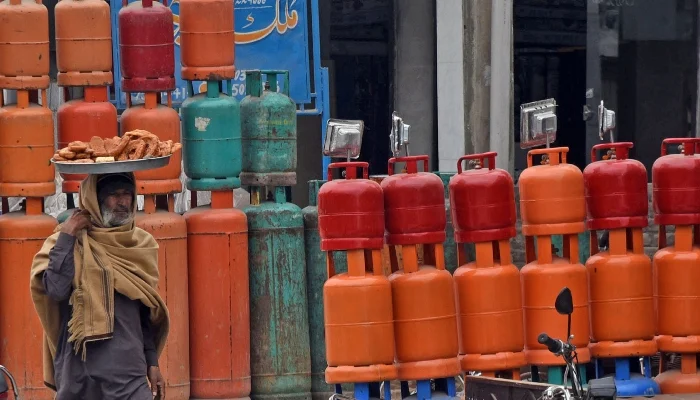
ISLAMABAD: Pakistan’s liquefied petroleum gas prices jumped by 100 rupees a kilogram over the weekend after the closure of a key border crossing with Iran, prompting industry executives to demand weekly or daily pricing and an end to the fuel’s link with Saudi Aramco’s benchmark.
Mohammad Ali Haider, vice chairman of the LPG Marketing Association, which represents more than 200 companies, said the increase followed the withdrawal of a trade exemption and that prices could climb further without immediate government intervention. The call for faster price adjustments comes ahead of winter, when LPG consumption typically rises, heightening the risk of hoarding, black-marketing and artificial price increases, particularly in remote and hilly areas.
Pakistan has suspended trade with Iran through the Taftan and Gabd-Rimdan crossings in Balochistan, with officials citing security concerns and the need to curb smuggling. On Friday, the Ministry of Commerce withdrew an October 3 order that had extended the electronic import form waiver for goods from Iran. The ministry’s October 16 memorandums also withdrew EIF exemptions for shipments to Central Asian republics and Azerbaijan that transit Iran. More than 4,500 tonnes of LPG are reportedly stranded on the Iranian side.
Hundreds of goods vehicles carrying LPG, rice, fresh fruit and other items are reportedly stuck on both sides of the border, and the Quetta Chamber of Commerce and Industry has told members to stop placing new orders with Iran until further notice. Iran’s Foreign Ministry spokesman, Esmaeil Baghaei, said the suspension was temporary, attributed it to technical issues and precautionary measures, and said authorities in both countries were in close contact to restore normal operations. Pakistan’s government hasn’t issued a public statement clarifying its position.
Pakistan consumes nearly 2 million tonnes of LPG a year, about 30% of it produced domestically. Of the roughly 1.2 million tonnes imported, about 250,000 tonnes arrive through Port Qasim and nearly 1 million tonnes through Iranian routes, including Taftan, Mand and Rahimdad-250. With Mand facing intermittent disruptions, the market has leaned increasingly on Rahimdad-250.
Haider said no imports are currently arriving at prices based on Saudi Aramco’s Contract Price, or CP, which the Oil and Gas Regulatory Authority uses as its benchmark. Before the war, Iranian LPG sold at auction reached the border at $100 to $150 a tonne below CP, he said. War-related insurance and freight premiums have since pushed costs to about $300 a tonne above it, leaving the regulator’s benchmark increasingly detached from reality, he said.
Pakistan sources most of its supply from Iran, Oman, the United Arab Emirates and Iraq rather than Saudi Arabia, stakeholders say, and some Iranian LPG is allegedly reaching the market through alternative sea routes. They say the LPG policy, unchanged for more than a decade, no longer reflects market conditions.
Haider said petroleum product prices moved to daily adjustments after the war began, while LPG remained tied to monthly prices notified in advance. As a result, major state-owned enterprises, including Sui Southern Gas Co., Sui Northern Gas Pipelines Ltd. and Pak-Arab Refinery Ltd., avoid importing at notified rates for fear of accountability investigations, leaving the market to private importers and land-route suppliers amid weak enforcement, according to stakeholders.
The border disruptions have also shifted pressure to Gwadar, where freight costs have risen to as much as $380 a tonne from $60 to $80, Haider said. He alleged that manipulated freight arrangements, questionable import declarations and the absence of digital tracking for tankers, transporters and distributors have enabled profiteering and tax evasion.
Haider also criticized a Petroleum Division directive requiring state companies to auction LPG against signature bonuses, saying the mechanism favors cash-rich bidders. Pakistan Petroleum Ltd. had previously allocated output through bidding, offering 25 tonnes a month to each successful bidder. A relatively obscure company reportedly offered a 220 million-rupee signature bonus for a five-tonne quota, prompting allegations of money laundering and consumer exploitation. Litigation has stalled the process.
He urged the government to review LPG policy with industry participants, revise the marketing margin of 35,000 rupees a tonne set in 2016, track imports and distribution digitally, and publish daily prices on the regulator’s website. He also questioned whether a petroleum levy of 4,690 rupees a tonne, introduced in 2016 to cushion consumers against price shocks, is serving its purpose.
Copyright © 2021 Independent Pakistan | All rights reserved