By Staff Reporter
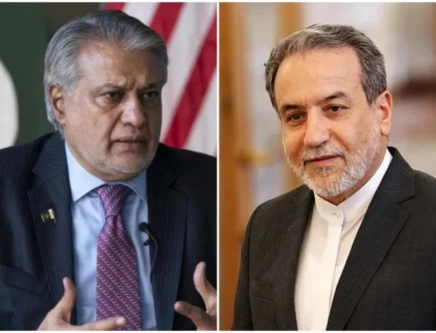
ISLAMABAD: Deputy prime minister and foreign minister, Ishaq Dar, held a late-night telephone call with Iranian Foreign Minister Abbas Araghchi on Sunday, reaffirming Islamabad’s determination to revive stalled peace talks between Washington and Tehran even as the economic fallout from the conflict continues to ripple across global energy markets.
The conversation, announced by the Foreign Office on Monday, focused on the broader regional situation and Pakistan’s persistent behind-the-scenes efforts to broker a lasting resolution. Araghchi thanked Pakistan for what he described as its “constructive role and sincere mediation efforts,” the Foreign Office said.
Dar responded by reiterating Islamabad’s commitment to “promoting constructive engagement,” adding that “dialogue and diplomacy remain the only viable path toward the peaceful resolution of issues and achieving lasting peace and stability in the region and beyond.”
The call came hours after Iranian officials disclosed that the United States had delivered a formal response to a new 14-point peace proposal Tehran had submitted through Pakistani channels. Iranian state media reported Sunday that Tehran was now reviewing Washington’s reply. President Donald Trump, speaking later that day, said his representatives were engaged in “very positive discussions” with Iran that could “lead to something very positive for all.”
The diplomatic activity underscores the fragile state of negotiations that have been largely frozen since April 8, when Pakistan helped broker a ceasefire that halted U.S.-Israeli strikes on Iranian targets. Only one round of direct talks between American and Iranian officials has taken place since then, in Islamabad. A second round has yet to be scheduled as both sides remain at odds over core demands.
Details of Iran’s proposal, first reported by the US news website Axios and Qatar-based Al Jazeera, citing sources familiar with the document, outline a structured, three-phase plan intended to convert the temporary ceasefire into a permanent end to the war within 30 days.
The first phase calls for the gradual reopening of the Strait of Hormuz — the narrow chokepoint through which roughly one-fifth of the world’s oil passes — alongside the lifting of the U.S. naval blockade of Iranian ports. Under the plan, Iranian authorities would assume responsibility for clearing sea mines laid during the fighting. The proposal also envisions an immediate pledge of nonaggression that would include Israel, aimed at preventing any resumption of hostilities across the Middle East.
In the second phase, Iran would be permitted to resume limited uranium enrichment at 3.6 percent purity under a “zero-storage principle,” while the United States and Israel would commit to refraining from attacks on Iran or its regional allies in exchange for Tehran halting its own strikes. The document explicitly rejects any demand that Iran dismantle its nuclear infrastructure or destroy existing facilities. Sanctions relief would begin with the gradual release of frozen Iranian funds held abroad.
The third phase envisions a broader strategic dialogue between Tehran and its Arab neighbours, culminating in the creation of a new regional security architecture covering the entire Middle East. The proposal’s one-month negotiating deadline reflects Tehran’s urgency to resolve the economic paralysis caused by the dual blockades. Iran’s closure of the Strait of Hormuz in response to the initial U.S.-Israeli attacks has severely restricted shipments of oil, liquefied natural gas and fertiliser, driving up global prices and threatening food security in import-dependent nations. The United States responded with its own blockade of Iranian ports, further isolating Tehran’s economy.
Pakistan has emerged as the unlikely but increasingly central intermediary in the crisis. High-level U.S.-Iranian contacts occurred in Islamabad last month, and Pakistani officials have repeatedly positioned themselves as honest brokers capable of shuttling messages between the two adversaries when direct communication proved impossible.
Foreign Office officials declined to provide additional details about Sunday’s call or the precise content of the US response now under review in Tehran. But Dar’s emphasis on diplomacy echoed language Pakistani leaders have used since the earliest days of the conflict, when Islamabad quietly began facilitating back-channel contacts.
Copyright © 2021 Independent Pakistan | All rights reserved