By Staff Reporter
ISLAMABAD: Iran’s military warned Monday that it would target and attack any US forces attempting to enter the Strait of Hormuz, sharply escalating tensions hours after President Donald Trump announced the start of a US-led operation to guide hundreds of stranded commercial vessels and their crews out of the blocked Persian Gulf waterway.
The Iranian military’s central command described the American initiative, dubbed “Project Freedom,” as unacceptable and said safe passage through the strait must be coordinated exclusively with Iranian forces “under all circumstances.” Maj. Gen. Ali Abdollahi, head of the Khatam al-Anbiya central headquarters, issued the statement via state broadcaster IRIB.
“We warn that any foreign armed force — especially the aggressive US military — if they intend to approach or enter the Strait of Hormuz, will be targeted and attacked,” Abdollahi said. He added that commercial ships and oil tankers must refrain from any movement without prior coordination with Iran’s armed forces “so as not to jeopardise their security.”
The warning came as U.S. Central Command confirmed it would support the operation with guided-missile destroyers, more than 100 land- and sea-based aircraft, multi-domain unmanned platforms and 15,000 service members already in the region. Adm. Brad Cooper, the CENTCOM commander, described the mission as “essential to regional security and the global economy” while the U.S. naval blockade of Iranian ports remains in place.
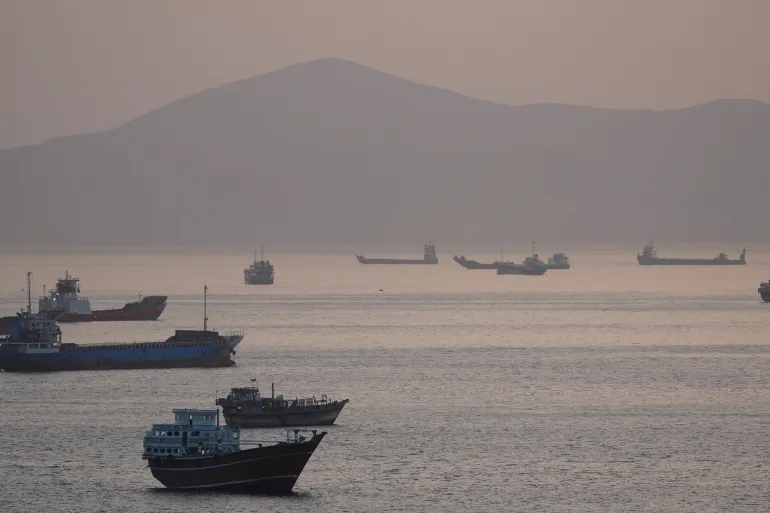
Trump cast the effort as a humanitarian gesture for the crews of more than 900 commercial vessels — many running low on food, water and other supplies — that have been trapped in the Persian Gulf since Iran effectively closed the strait shortly after the U.S.-Israeli military campaign began Feb. 28. In a Truth Social post Sunday, he said operations would begin Monday morning.
“We will use best efforts to get their Ships and Crews safely out of the Strait,” Trump wrote. “In all cases, they said they will not be returning until the area becomes safe for navigation.” He added that any interference “will, unfortunately, have to be dealt with forcefully.”
The president made no direct reference to Iran’s 14-point peace proposal, delivered last week through Pakistani intermediaries, which Tehran has described as a comprehensive plan to end the war within 30 days. According to reporting by Axios, citing sources briefed on the document, the proposal included a one-month deadline for negotiations to reopen the strait, lift the U.S. naval blockade and formally conclude the conflict.
Negotiations between Washington and Tehran have remained deadlocked since the Pakistani-brokered ceasefire took effect April 8. Iran has maintained its stranglehold on the strait — through which roughly one-fifth of global oil and natural gas supplies normally flow — while the United States has enforced a counter-blockade on Iranian ports since April 13. The dual restrictions have sent oil prices soaring to about 50 percent above pre-conflict levels and driven U.S. gasoline prices to an average of $4.44 per gallon, up from less than $3 before the war.
Treasury Secretary Scott Bessent described the American economic pressure as part of a broader strategy. “We are suffocating the regime, and they are not able to pay their soldiers,” he told Fox News on Sunday. “This is a real economic blockade, and it is in all parts of government.”
Iranian officials have framed the strait as a changed reality after the war, insisting that Tehran now exercises control over the waterway and that nothing will revert to pre-conflict conditions. “The Iranians are quite clear,” Al Jazeera correspondent reported from Tehran. “They are saying they’re going to respond and engage militarily. And in such a case, that will be the end of the ceasefire.”
The Revolutionary Guard’s intelligence wing had already signalled defiance Sunday, stating that Trump must choose between “an impossible operation or a bad deal with the Islamic Republic of Iran.”
Analysts said the Iranian government views the standoff as existential and is prepared to use every available tool — including swarms of drones and small, nimble patrol boats — to disrupt the American plan.
“This could lead to a dangerous escalation,” said Harlan Ullman, a former US naval officer and chairman of the Killowen Group. “Iran has huge amounts of drones and small craft that could make this very, very difficult. I would hate to see a confrontation where an American warship is hit, because then the Americans will have no other option except to retaliate.”
Trump spent the weekend at his Mar-a-Lago resort in Florida and, in public remarks on Sunday, declined to specify what might trigger renewed US military strikes. He has repeatedly described the American blockade as more effective than bombing and has signalled that he is comfortable with the current pressure campaign even as he pushes the new maritime operation.
European allies, increasingly alarmed by the economic fallout, urged de-escalation. German Foreign Minister Johann Wadephul, in a call with Iranian counterpart Abbas Araghchi, demanded that Iran “completely and verifiably renounce nuclear weapons and immediately open the Strait of Hormuz.” French President Emmanuel Macron called for “a coordinated reopening by the United States and Iran,” describing it as “the only solution.”
The latest flare-up comes amid growing congressional unease in Washington. Some Republican senators have pressed the administration to wind down the conflict, while lawmakers from both parties have questioned the open-ended nature of the military and economic campaign.
As of early Monday, it remained unclear whether U.S. forces would directly escort commercial vessels or limit their role to coordination and overwatch. Iranian officials have insisted that any vessel seeking to transit the strait must now operate under what they term a “new maritime regime” established by the war.
The stakes are enormous. An estimated 20,000 seafarers, many from India and South and Southeast Asia, remain aboard the stranded tankers, bulk carriers and container ships. The continued closure has already disrupted global supplies of oil, gas, fertiliser, and petrochemicals, with ripple effects felt from European factories to American gas pumps.
Copyright © 2021 Independent Pakistan | All rights reserved