By Staff Reporter
RAWALPINDI: Pakistan’s senior military command on Tuesday linked regional peace to “collective restraint, responsibility and respect for sovereignty,” issuing the call as a fragile ceasefire in the Middle East continued to hold following US-Israeli strikes on Iran in late February that escalated into a broader crisis.
The statement, released by the Inter-Services Public Relations after the 275th Corps Commanders’ Conference at General Headquarters in Rawalpindi, came as the military also reviewed its ongoing offensive against militants it says are sheltered in Afghanistan and marked the first anniversary of last year’s border clashes with India.
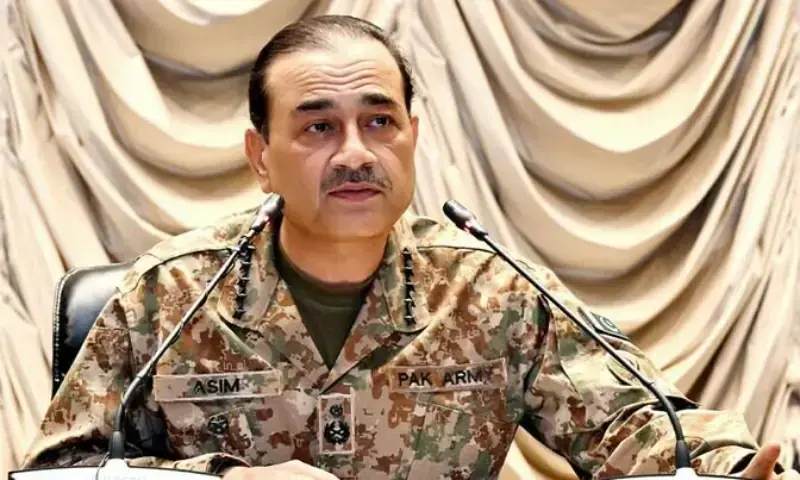
Field Marshal Asim Munir, who serves as both chief of army staff and chief of defense forces, presided over the meeting. The gathering offered a comprehensive assessment of internal and external security threats, according to the ISPR statement. “Emerging geopolitical developments carry significant implications for regional stability,” the statement said, noting the broader Middle East conflict that began with strikes on Iran and expanded to include disruptions in shipping lanes and attacks on Gulf states.
The military leadership emphasised “the importance of restraint and avoidance of escalation” and “acknowledged Pakistan’s continued responsible role in advocating stability and supporting efforts aimed at preventing further deterioration of the situation.” The conference reiterated that “peace and stability in the region are intrinsically linked to collective restraint, responsibility and respect for sovereignty.”
Munir expressed satisfaction with the “high standards of operational preparedness, professionalism, and combat readiness” of Pakistan’s armed forces and commended commanders for their “unwavering commitment, vigilance, and success” in counterterrorism operations. The commanders resolved to sustain the current operational tempo “to decisively dismantle terrorist networks, disrupt their support infrastructure, and deny them any operational space within Pakistan.” They noted the “continued degradation of terrorists and their support infrastructure” through Operation Ghazab lil-Haq, launched on the night of Feb. 26 after cross-border firing by the Afghan Taliban. The operation has targeted terrorist hideouts.
The statement sharply criticized what it described as the Afghan Taliban regime’s “irrational and perverted policy” of providing safe havens to the Tehreek-i-Taliban Pakistan — referred to as Khawarij — and other terrorist groups, saying the approach “is increasingly backfiring and stands fully exposed” and shows “total disregard to the interests of the Afghan people.”
The commanders also rejected a “propaganda campaign” by the Afghan Taliban aimed at portraying Pakistani strikes as attacks on civilians inside Afghanistan. Such claims, the statement said, form “a coordinated disinformation strategy by the regime to distract attention from their internal failures and play the victim card.” “The forum categorically rejected these frivolous allegations and reaffirmed that Pakistan’s defensive actions remain focused, precise, and directed solely against infiltrators, terrorist hideouts and support infrastructures,” the ISPR said.
The meeting coincided with the first anniversary of Marka-i-Haq, the military’s term for the May 2025 conflict with India that began with an attack on tourists in Pahalgam in Indian-occupied Kashmir on April 22 and ended with a ceasefire on May 10 after Pakistan’s Operation Bunyanum Marsoos. The commanders congratulated the nation and the armed forces, describing the commemoration as “a defining moment reflecting national unity, collective resolve, and an unyielding commitment to safeguard Pakistan’s sovereignty at all costs.”
The gathering underscored that the anniversary “serves as a clear message to the Indian hubristic political mindset that the Pakistani nation stands united, resilient, and fully prepared.” It highlighted what it called the “unshakeable harmony between the people, government and armed forces of Pakistan, which stand together as ‘Bunyanum Marsoos’ against all internal and external challenges.”
The commanders “strongly condemned ongoing atrocities, extrajudicial killings, and demographic changes” in Indian-occupied Kashmir and reaffirmed Pakistan’s “unwavering diplomatic, political, and moral support for the just struggle of the Kashmiri people.” In a final tribute, the forum offered prayers for the martyrs of the armed forces, law enforcement agencies and innocent civilians killed in defense of the country. “Paying profound tribute to their unmatched sacrifices,” the statement said, “the forum reaffirmed that the enduring legacy of the martyrs continues to serve as the bedrock of Pakistan’s national security, unity, and resilience.”
Copyright © 2021 Independent Pakistan | All rights reserved