By Staff Reporter
ISLAMABAD: US military leaders insisted on Tuesday that a fragile ceasefire with Iran remained intact a day after Tehran was blamed for fresh attacks in the Strait of Hormuz and on the United Arab Emirates, even as the key American ally reported yet another wave of Iranian drones and missiles.
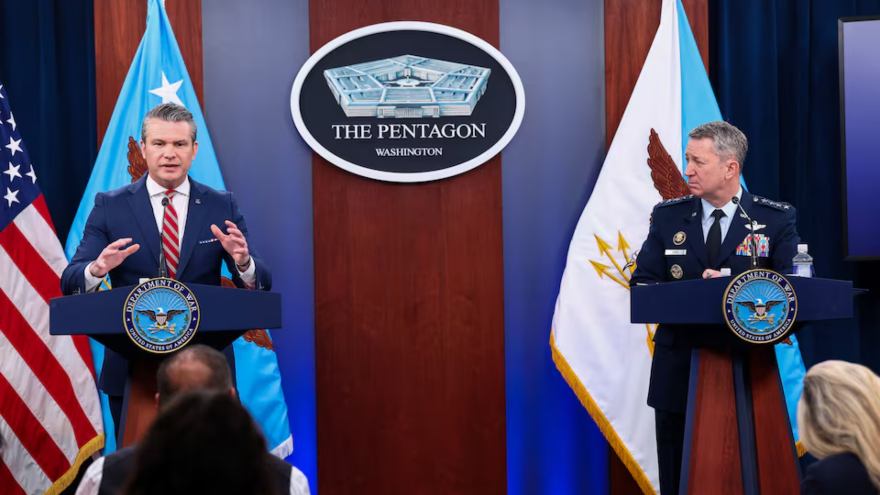
US Defence Secretary Pete Hegseth and Gen. Dan Caine, chairman of the Joint Chiefs of Staff, told reporters at the Pentagon that the latest flare-up had not crossed what Caine described as the threshold for “major combat operations.” He called Tuesday a “quieter” day in the vital waterway. “The ceasefire is not over,” Hegseth said flatly, before the UAE announced it was responding to a second consecutive day of Iranian strikes.
The assessment came as the Trump administration pressed forward with a risky naval operation to reopen the Strait of Hormuz, through which roughly one-fifth of the world’s oil and liquefied natural gas flowed before the conflict erupted. The effort, dubbed “Project Freedom,” is Washington’s most direct challenge yet to Iran’s month-long effective blockade of the narrow chokepoint, a move that has sent global fuel prices soaring and rattled energy markets from Europe to Asia.
On Monday, US forces said they opened a new southbound shipping lane hugging Omani territorial waters and sank six small Iranian boats that had menaced commercial traffic. More than 100 American military aircraft were patrolling the skies overhead, officials said. Yet only two US-flagged merchant ships — including a Maersk-operated vehicle carrier that received direct military assistance — are known to have transited the new route. Hundreds more remained bottled up in the Persian Gulf, their crews and owners wary of venturing forward.
Shipping giants signaled continued caution. Hapag-Lloyd, one of the world’s largest container lines, said its risk assessment was unchanged: “Transits through the Strait of Hormuz are for the moment not possible for our ships.” Torbjorn Soltvedt, principal Middle East analyst at the risk intelligence firm Verisk Maplecroft, was blunt. “This initiative alone isn’t something that looks like it’s going to open the Strait of Hormuz,” he said. “For shipping companies and for insurance companies, they still have to wait and see how this plays out.”
Iran immediately denounced the American move as a violation of the April 8 ceasefire. Mohammad Bagher Qalibaf, speaker of Iran’s parliament and its chief nuclear negotiator, posted on X that the status quo was “intolerable for America” while adding, pointedly, “we have not even begun yet.” His statement made no reference to the indirect US-Iran talks now being conducted through Pakistan.
Tehran offered its own account of Monday’s skirmish. An Iranian military commander told state television that US forces had struck two small civilian cargo boats, killing five civilians. US officials did not immediately address the claim. The violence extended beyond the waterway. On Monday, Emirati air defenses intercepted 15 Iranian missiles and four drones, authorities said. One drone struck a key oil facility in the eastern emirate of Fujairah — a critical export terminal that has handled about 1.7 million barrels per day during the conflict, roughly half the UAE’s export capacity by routing shipments around the strait via the Gulf of Oman. Three Indian nationals were wounded. The British military reported two cargo vessels ablaze off the UAE coast. On Tuesday, the UAE Defense Ministry said it was again responding to Iranian drones and missiles; results were not immediately clear. During the five weeks of open fighting before the April 8 truce, the UAE absorbed more than 2,800 Iranian missiles and drones — more than any other Gulf state or Israel.
Pakistan and Saudi Arabia issued condemnations. Iran’s foreign minister, Abbas Araghchi, posted on X that Washington and Abu Dhabi “should be wary of being dragged back into quagmire.” The broader conflict began Feb. 28 with joint US-Israeli strikes on Iran, which Washington and Jerusalem code-named “Epic Fury.” Iran retaliated by seizing control of the strait, attacking or threatening vessels that refused to use its own northern corridor along the Iranian coast, where Revolutionary Guard forces vet traffic and, in some cases, demand payment. The US responded April 13 with a naval blockade of Iranian ports, choking off Tehran’s oil revenue and its ability to import critical goods.
Hegseth told reporters the blockade was “like a piece of steel” and that Iran no longer controlled the strait. “We know the Iranians are embarrassed by this fact,” he said. “They said they control the strait. They do not.” Caine added that, since the ceasefire took effect, Iran had fired at commercial vessels nine times, seized two container ships and attacked US forces more than 10 times — actions he described as falling below the level that would restart full-scale fighting.
The Trump administration has cited the ceasefire to argue that it does not need to provide Congress with a formal 60-day War Powers Resolution notification on the hostilities. Officials stressed that Project Freedom is a limited, temporary operation separate from the wider campaign against Iran and that US forces have not entered Iranian waters or airspace. “We’re not looking for a fight,” Hegseth said.
President Donald Trump, speaking to reporters in the Oval Office on Tuesday, dismissed Iran’s remaining military capacity as reduced to “peashooters” and said Tehran privately wants a deal despite its public defiance. “They play games, but let me just tell you, they want to make a deal,” Trump said. “And who wouldn’t, when your military is totally gone?” He praised the blockade and said he alone would decide if Iranian actions crossed into a ceasefire violation. “You’ll find out, because I’ll let you know,” he added. “They know what not to do.”
The stakes remain enormous. Reopening the strait would strip Iran of its primary remaining leverage as the Trump administration demands a sweeping rollback of Tehran’s nuclear program. But reopening it safely is no small feat. The waterway narrows to just 21 miles at its tightest point. Iran can strike anywhere in it with cruise missiles, longer-range ballistic missiles, drones, fast-attack craft and mines. Former US officers who have patrolled the strait described the operation as inherently dangerous even with military escorts — which Washington is not currently providing to commercial traffic.
Ship tracking data Tuesday showed at least one Panamanian-flagged crude oil tanker moving toward the strait’s center after leaving a Persian Gulf anchorage, though its intentions were unclear. For now, the vast majority of the world’s energy traffic remains stalled, the global economic shock from the closure unabated.
Copyright © 2021 Independent Pakistan | All rights reserved