By Staff Repotrter
QUETTA: Balochistan Chief Minister Sarfraz Bugti said on Monday that the intelligence agencies had thwarted a plot to force a girl into carrying out a suicide bombing in the capital, Islamabad, an operation he described as a particularly egregious case of terrorists exploiting Baloch women and girls through blackmail and threats.
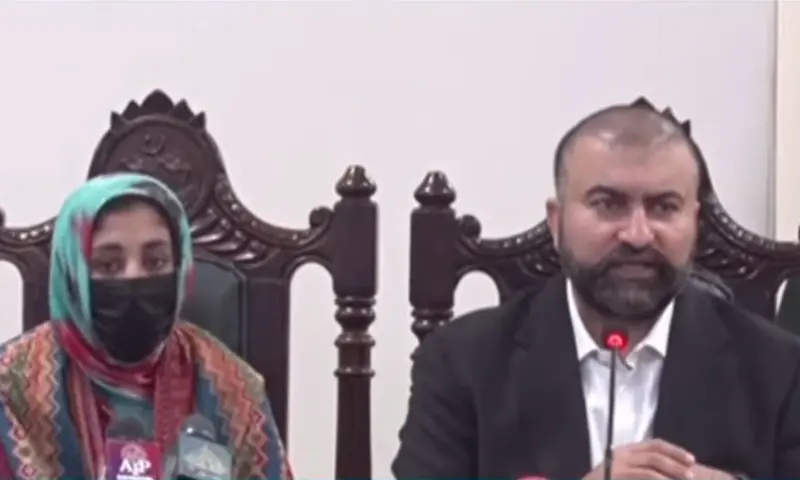
The girl, whose identity was not disclosed, was arrested before she could execute the attack and will be released to her father under supervision rather than face trial, Bugti said at a news conference in Quetta where she appeared alongside him. He said the decision reflected both her status as a minor and clear evidence that she had been coerced.
Bugti, a veteran Baloch politician, used the occasion to deliver an impassioned denunciation of those behind the plot, insisting that such tactics had nothing to do with Baloch history or culture. “We are faithful to our tradition,” he said. “These people have no connection to Balochiyat, and the way they are using our women in this war is shameful. I am so ashamed that I cannot even tell the media the details.”
According to Bugti, the girl’s name had first surfaced on social media in a missing-person notice. Intelligence agencies later determined she had been drawn into a terrorist training camp. The method of recruitment, he said, followed a pattern of “honeytrapping” vulnerable women and then blackmailing them. In this instance, the girl was threatened with the killing of her father if she refused to comply.
“The plan was to perform a suicide attack in Islamabad,” Bugti said. He alleged that the operation was orchestrated by agents of India’s Research and Analysis Wing, or RAW, with the aim of undermining Pakistan’s improving international standing at a moment when the country’s security situation has shown measurable progress. Bugti suggested the girl may not have known the intended target until the final moments and praised the intelligence agencies for intervening in time. “So much destruction was going to happen; that was a given,” he said. “But in Pakistan, if a woman carries out a suicide bombing … you can imagine its impact on Pakistan at this time, on an international level.”
The chief minister spoke with visible emotion about the human cost. “I always say we should be opening doors to Oxford and Harvard for these girls, and they want to exploit them and put them in suicide jackets,” he said. He accused the perpetrators of betraying their own families for the sake of foreign patrons. “They would exploit their own Baloch girls? Their own daughters, their own sisters … and to please international masters? Can you conceive of it?”
Turning to Baloch tradition, Bugti contrasted the militants’ actions with what he described as the historic role of women in Baloch society. “Historically, Baloch women have never been a part of war,” he said. “Historically, Baloch women have been a part of peace — when tribes fight, if a woman comes in between them, the fight ends.” He added that the exploitation of girls for propaganda videos posted on social media, presented as “heroism,” represented a profound perversion of those values.
Bugti said the episode had caused him personal anguish. “This is what they are doing to our Baloch daughters? To our Baloch sisters? They should be ashamed.” He announced that the girl would be returned to her father — described as a poor man — with political and tribal guarantees and ongoing state oversight. “We have decided that we are returning this girl to her father respectfully,” he said. “We have requested that he keep an eye on his daughter and, of course, our oversight will be present somewhere; we will watch them.”
The announcement comes as Pakistan recorded its second consecutive month of improved security metrics. According to a report released by the Pakistan Institute for Conflict and Security Studies, militant attacks and related casualties declined markedly nationwide in April 2026. In Balochistan, the number of attacks fell from 59 in March to 18 in April, a 69 percent reduction.
The case is not isolated. In March, Bugti himself reported the arrest of another would-be female suicide bomber in Khuzdar, crediting human intelligence and insisting she would be questioned only in the presence of female police personnel to ensure she suffered “no physical harm, moral harm or harassment.” In December, authorities in Karachi detained a teenage girl from Balochistan in what Sindh officials described as the disruption of another major terror plot.
Bugti framed Monday’s events as evidence of a larger distinction between the Pakistani state and its adversaries. “The girl’s story had caused me great pain and was a cause for shame,” he said, adding that it illustrated “the difference between the state and the terrorists.” He expressed confidence in the intelligence services’ performance. “The capacity and capability” of the agencies, he said, had spared Pakistan significant embarrassment on the world stage.
Copyright © 2021 Independent Pakistan | All rights reserved