By Staff Reporter
ISLAMABAD: Pakistan’s interior minister arrived in Tehran on Saturday for a two-day official visit aimed at restarting direct negotiations between Iran and the United States, Iranian state media reported, as a fragile ceasefire that halted more than a month of US-Israeli airstrikes on Iran shows signs of unraveling.
The visit by Mohsin Naqvi comes as both sides have traded public recriminations over the future of the Strait of Hormuz, a chokepoint for roughly one-fifth of the world’s oil and liquefied natural gas shipments, which Iran has largely closed since the fighting erupted on Feb. 28. Iranian officials have signaled openness to continued diplomacy while insisting on sovereignty over the waterway, even as President Donald Trump has expressed growing impatience and threatened to resume military action if no agreement is reached.
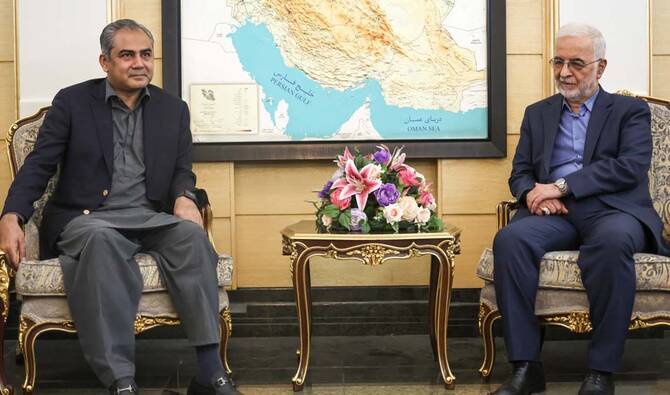
Iranian Interior Minister Eskandar Momeni received Naqvi at the start of the trip, according to Iranian media accounts. Momeni praised the mediation efforts of Pakistan’s top military commander, Field Marshal Asim Munir, who visited Tehran in April alongside Naqvi and a broader Pakistani delegation. The two ministers discussed bilateral ties, regional stability and possible next steps to revive the talks, the reports said.
Pakistan has emerged as the most active intermediary between Washington and Tehran, hosting unprecedented direct talks between Iranian and US delegations in Islamabad on April 11 and 12 — the first such face-to-face meetings since the 1979 Iranian revolution. The ceasefire, announced April 9 after weeks of intense bombardment, has held only tenuously, with both sides accusing the other of bad faith.
The April talks in Islamabad included senior Iranian figures who later met with Naqvi and Munir in Tehran, among them Foreign Minister Abbas Araghchi, Parliament Speaker Mohammad Bagher Ghalibaf and President Masoud Pezeshkian. Munir, who also serves as chief of the army staff, met separately with Iran’s top military leadership, including Maj. Gen. Ali Abdollahi, commander of the Khatam al-Anbiya Central Headquarters.
In their Saturday meeting, Momeni and Naqvi “exchanged views on matters of mutual interest, including regional peace and the evolving situation in the wider region,” according to Iranian media. The Pakistani push has drawn public appreciation from Washington. Rep. Jack Bergman (R-Mich.), co-chair of the Congressional Pakistan Caucus, sent a letter to Prime Minister Shehbaz Sharif and Munir expressing gratitude for their “indispensable” role. “Pakistan’s willingness to leverage its unique position to bring these parties to the table is a demonstration of true statesmanship,” Bergman wrote, according to Pakistan’s state-run PTV. He added that Trump, the White House and Congress have all recognized Pakistan’s contribution.
Trump himself has repeatedly praised Sharif and Munir, describing the Pakistani leaders as “great people” in a recent Fox News interview and referring to Munir as his “favorite field marshal.” The rapport dates in part to last year’s short but intense conflict between Pakistan and India, which the United States helped defuse. Yet the diplomatic track has stalled.
Araghchi told reporters Friday that Tehran had received messages from the Trump administration indicating willingness to continue negotiations. But Ghalibaf, who led the Iranian side in the Islamabad talks, posted on social media on Tuesday that Washington must accept Iran’s 14-point proposal or face repeated failure. “There is no alternative but to accept the rights of the Iranian people as laid out in the 14-point proposal,” he wrote. “Any other approach will be completely inconclusive; nothing but one failure after another.”
A central impasse remains the Strait of Hormuz. Iran has blocked most commercial traffic since the war began, imposing tolls on vessels it allows through and recently permitting passage for dozens of ships, including from China, Japan and Pakistan, after agreements on its management protocols. Iranian state television reported on Saturday that European countries had begun negotiations with the Revolutionary Guard navy for transit rights.
Ebrahim Azizi, chairman of the Iranian parliament’s national security commission, said Tehran has prepared a “professional mechanism” to manage traffic along a designated route that will be unveiled soon. “In this process, only commercial vessels and parties cooperating with Iran will benefit from it,” he said. “The necessary fees will be collected for specialized services.” He added that the route would remain closed to operators of the US-led “freedom project,” Washington’s temporary naval effort to escort stranded ships.
The economic fallout has been severe on both sides. In Iran, food inflation reached 115 percent in the first Persian calendar month after the war began, with prices for staples such as cooking oil, rice and chicken tripling. The rial traded Saturday at about 1.8 million to the dollar on the open market in Tehran, near its all-time low. In the United States, the closure has contributed to higher energy costs and inflation, with benchmark 10-year Treasury yields hitting a one-year high on Friday and traders anticipating possible Federal Reserve rate increases.
Araghchi used social media to highlight the pain for ordinary Americans, posting an image of rising US Treasury yields alongside a warning that “real pain begins when US debt and mortgage rates start to jump.” Ghalibaf, in a more pointed Thursday post, mocked the cost of funding US Defense Secretary Pete Hegseth’s operations in the region, warning of a potential new global financial crisis.
Iranian officials have also signaled readiness to resume fighting if diplomacy collapses. Araghchi said Tehran remains prepared for direct military conflict and has welcomed potential mediation from China after Trump’s recent meetings with President Xi Jinping in Beijing. Trump, speaking aboard Air Force One on his return on Friday, said he was considering lifting sanctions on Chinese firms buying Iranian oil but made no claim of a firm Chinese commitment to press Tehran on reopening the strait.
Domestically, Iranian authorities have maintained a hardline. State television has broadcast nightly calls to arms, including segments showing hosts and an IRGC commander demonstrating how to load AK-47 variants and firing weapons on air. Major squares remain dotted with armored vehicles and checkpoints. The judiciary has executed 39 people since the war began for alleged collaboration with US or Israeli intelligence or involvement in “terror” or armed unrest, according to the official Mizan news agency, while sentencing 36 others to long prison terms. An internet shutdown has lasted 78 days, with authorities promoting a limited state-run access plan.
As of Saturday, the US military said it had redirected 78 commercial ships and disabled four others to enforce its own blockade of Iranian ports. Trump has said the United States wants the strait open and does not want Iran to acquire a nuclear weapon, while Iran has denied any intention of building one and has refused to relinquish its stockpile of enriched uranium.
Copyright © 2021 Independent Pakistan | All rights reserved