By Staff Reporter
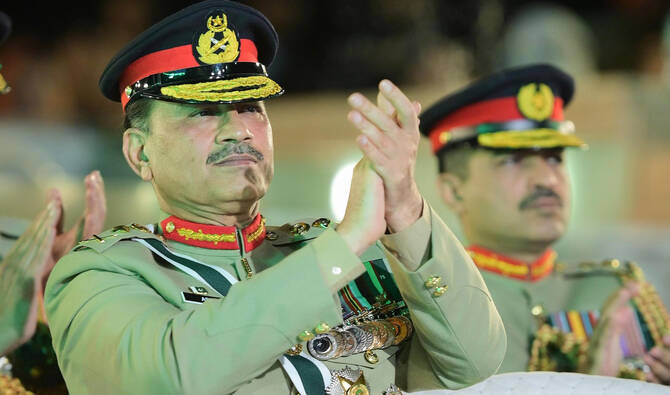
ISLAMABAD: Pakistan’s top military commander flew to Tehran on Friday in what officials and mediators described as a final push to secure a framework agreement that would formally end the war between the United States and Iran and open a 30-day window for negotiations on a more sweeping accord, including a resolution of the Iranian nuclear standoff.
Army Chief, Field Marshal Asim Munir, has served as the lead mediator between Washington and Tehran since the conflict began in late February, following American and Israeli strikes on Iranian territory. His personal visit to the Iranian capital, after several days of lower-level consultations, was seen by those familiar with the talks as a signal that Pakistan believed the outlines of a deal were finally within reach — and that the moment required the weight of his direct engagement.
“There’s been some slight progress,” Secretary of State Marco Rubio said on Friday on the sidelines of a NATO foreign ministers’ gathering in Helsingborg, Sweden. “I don’t want to exaggerate it, but there’s been a little bit of movement, and that’s good.”
His words were carefully calibrated. In recent weeks, statements from multiple capitals have hinted at breakthroughs that never materialised, and Rubio declined to predict that this time would be different. But he was unambiguous about what any agreement must include. “Iran can never have a nuclear weapon,” he said. “It just cannot.”
Rubio said a final deal would need to address Iran’s stockpile of highly enriched uranium, its enrichment policy going forward, and what he described as Tehran’s efforts to impose a “tolling system” on vessels transiting the Strait of Hormuz — a chokehold on global energy markets that the United States and its allies have refused to accept. “I don’t know of a country in the world that’s in favor of it except Iran,” he said, “but there’s no country in the world that should accept it.”
A Draft Framework Takes Shape
The Arabic-language news network Al Arabiya reported on Friday, citing sources it did not identify, that a draft agreement was nearing completion and could be announced within hours. The network said the framework, mediated by Pakistan, would include an immediate and unconditional ceasefire across all fronts — land, sea and air — as well as a mutual commitment to refrain from attacking military, civilian or economic infrastructure.
The draft, as described, would also include guarantees of freedom of navigation in the Arabian Gulf, the Strait of Hormuz and the Gulf of Oman; a joint monitoring mechanism to oversee compliance; and a commitment by both sides to begin negotiations on unresolved issues within seven days of signing. The gradual lifting of American sanctions in exchange for Iranian adherence to the agreement’s terms was also included, the network reported.
Iran’s position, as articulated on Friday by its Foreign Ministry spokesman, Esmaeil Baghaei, was that it was not asking for favors. “We do not want any concessions from the United States,” Baghaei said, according to Iran’s state-affiliated Tasnim news agency. “We are only seeking our rights.”
He called for an end to the American naval blockade of Iranian ports, the release of frozen Iranian assets abroad and the lifting of decades of sanctions that, he said, had been imposed under a series of shifting pretexts, with the nuclear issue among the most prominent. “For the past five decades, we have been subjected to what they themselves call ‘crippling sanctions,'” Baghaei said.
He categorically rejected the notion that Iran posed a nuclear threat. “There has been no nuclear threat from Iran against any actor in the region or the world,” he said. On the Strait of Hormuz, he described the American naval blockade as “completely contrary to international law.” A senior Iranian official told Reuters on Thursday that no agreement had been signed, but that gaps between the two sides had been narrowed. Iran’s uranium enrichment program and its assertion of authority over the Strait of Hormuz remained the principal sticking points.
Qatar Re-Enters the Fray
In a further sign of accelerating diplomatic activity, a Qatari negotiating team arrived in Tehran on Friday, traveling, a source told Reuters, in coordination with Washington. Qatar had largely distanced itself from the mediation effort earlier in the conflict — a measured calculation given that Iran had struck Qatari territory with hundreds of missiles and drones, targeting civilian infrastructure and the Ras Laffan liquefied natural gas facility, the linchpin of the country’s economy. Those attacks destroyed roughly 17 percent of Qatar’s LNG export capacity. The country had already suspended LNG production on March 2 following Iranian strikes.
Qatar’s decision to re-engage nonetheless reflected both its longstanding role as an interlocutor between Washington and Tehran and the acute pressure the conflict has placed on Doha’s economic lifeline. Before the war, approximately 20 percent of global LNG trade transited the Strait of Hormuz, the bulk of it from Qatar. Iran’s effective closure of the waterway has severed virtually all of that trade.
Rubio, asked about the Qatari team’s presence in Tehran, described Pakistan as “the primary country we’ve been working with on all of this,” and credited Islamabad’s diplomats with doing an “admirable job.” But he acknowledged the broader coalition of interests at play. “Gulf countries that are in the middle of all this — they have their own situation going,” he said.
The Qatari Foreign Ministry did not respond to requests for comment.
Pakistan’s Foreign Ministry said Friday that Interior Minister Mohsin Naqvi had traveled to Tehran twice earlier in the week for meetings with senior Iranian officials. Spokesman Tahir Andrabi said Prime Minister Shehbaz Sharif would discuss the country’s mediation role when he travels to Beijing this weekend for a four-day state visit, underscoring how thoroughly the Iran file has become entangled with Pakistan’s broader diplomatic calendar.
A War That Has Reshaped a Region
The conflict, now in its third month, began on February 28, when American and Israeli forces launched coordinated strikes against Iran. Tehran retaliated with strikes against Israel and American allies across the Persian Gulf, while simultaneously closing the Strait of Hormuz. A ceasefire brokered by Pakistan took effect on April 8, but talks in Islamabad subsequently broke down. President Trump extended the truce indefinitely while maintaining the naval blockade of Iranian ports.
Since mid-April, the United States Central Command said on Friday, American naval forces have redirected 94 commercial vessels away from Iranian ports and disabled four others.
New details emerged on Friday about the scope of the military response to the conflict. Two regional officials and a Western diplomat told The Associated Press that Saudi Arabia and the United Arab Emirates had each independently launched multiple strikes against Iranian territory and against Iranian-backed Shiite militias operating in Iraq during the course of the war. An Israeli military officer with knowledge of the situation confirmed that the UAE had proactively struck Iran at least once. All of them spoke on the condition of anonymity, citing the sensitivity of the disclosures.
The regional officials said the Saudi strikes targeted military infrastructure — missile and drone launchers — as well as hideouts belonging to Kataib Hezbollah, an Iranian-backed Iraqi militia, after Riyadh concluded that most drone attacks on Saudi territory had been launched from Iraqi soil. Saudi Arabia had repeatedly briefed the government in Baghdad about those attacks before deciding to act, one official said.
The UAE Foreign Ministry, in a statement dated May 16, said all actions taken by Abu Dhabi had been “within the framework of defensive actions aimed at protecting its sovereignty, civilians, and vital infrastructure.” Saudi Arabia did not respond to a request for comment. Iran has not publicly acknowledged being struck by either country.
Trump’s Shifting Calculus
In Washington, Trump’s management of the crisis has grown increasingly unpredictable, even by the standards of his previous terms. He has set deadlines for Tehran and walked them back. He has indicated a willingness to let negotiations proceed — only to then authorise military strikes, as he did at the war’s outset in late February.
Earlier this week, he said he had called off a planned strike on Iran at the explicit request of allied leaders in the region, including the heads of state of Qatar, Saudi Arabia and the United Arab Emirates — the very countries whose territory Iranian forces had targeted. But his decision to pursue a negotiated settlement brought him into open friction with Israeli Prime Minister Benjamin Netanyahu, who has taken a harder line against any agreement with Tehran.
An official who spoke on the condition of anonymity because they were not authorized to discuss internal deliberations said Trump and Netanyahu had a “dramatic” phone call on Tuesday over the direction of the talks, and that Israel was furious with the American push for a deal.
Trump, asked about the tension, told reporters that Netanyahu “will do whatever I want him to do” — an unusually blunt public assertion of leverage over America’s closest Middle Eastern ally, and one that offered a rare glimpse of the strains the Iran negotiations have placed on one of Washington’s most consequential relationships.
Copyright © 2021 Independent Pakistan | All rights reserved