By Staff Reporter
ISLAMABAD: Pakistani forces killed several Afghan Taliban personnel and destroyed a base camp in a fresh clash on the Afghan border on Saturday, security sources said, as the head of Pakistan’s National Strategic Command warned that any miscalculation in the region would meet a response beyond the adversary’s imagination.
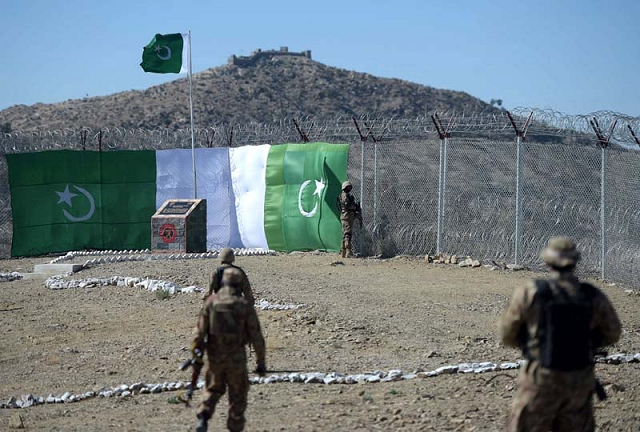
Officials, speaking on condition of anonymity, said Taliban forces opened fire in the Taida sector of Upper Kurram and at Ghozgarhi, in the northwestern province of Khyber Pakhtunkhwa, to help foreign militants cross into Pakistan.
The Pakistan Army responded with heavy weapons, the sources said, shelling the Topsar border post and the Shipola base camp. They claimed the camp was “destroyed completely” and that Taliban personnel abandoned a border post, while firing continued in the area. State-run PTV News and the Associated Press of Pakistan carried the reports. The Afghan Taliban regime had not commented by Sunday.
Hours later, General Syed Aamer Raza, Commander National Strategic Command, told a passing-out parade at the Pakistan Military Academy in Kakul that Pakistan would not tolerate cross-border aggression or any violation of its sovereignty.
“There is no space for conflict or war in a nuclearised environment, and any miscalculation will be met with a response far beyond the imagination or calculation of the initiator,” he said.
“Let no adversary mistake our commitment to peace as weakness nor misinterpret our restraint as a lack of resolve,” he added. He said the armed forces stood prepared to “defend every inch of sacred motherland at all costs”.
General Raza maintained that any fresh activity from across the border would be met with a strike bigger than the last one. He said that for those harbouring hostile designs across the country’s borders, the stance of the armed forces was “resolute and unambiguous”.
He also said that in the “post-truth era” Pakistan’s adversaries were trying to drive a wedge between the armed forces and the public through disinformation and narrative warfare. “Hostile elements actively attempt to exploit internal vulnerabilities across Pakistan to cultivate proxy instruments against our national unity,” he said.
The general said the rapid spread of disruptive technology had altered the character of modern warfare and undermined traditional doctrines, and that the armed forces had begun a swift multidomain transformation in response. He added that recent geopolitical shifts, set against the conflict in the Middle East, had underscored Pakistan’s strategic importance.
General Raza reviewed the parade and presented awards. Cadets from the 154th Long Course, the 39th Technical Graduate Course, the 73rd Integrated Course and the 28th Lady Cadet Course graduated, alongside cadets from Bangladesh, Iraq, the Maldives, Palestine, Qatar, Sri Lanka, Tajikistan and Yemen. The Sword of Honour went to Academy Senior Under Officer Muhammad Junaid Jabbar, and the President’s Gold Medal to Battalion Senior Under Officer Syed Hassan Abbas. Riyad Mahmood Khan of Bangladesh took the Chief of Defence Forces Overseas Gold Medal.
Saturday’s fighting is the latest in a series of confrontations on the roughly 2,600km frontier, which Afghanistan has never recognised as a legal border. The two sides have clashed sporadically since major fighting last October, and Pakistan has carried out airstrikes inside Afghanistan, saying it targets militant hideouts. Each side accuses the other of starting the hostilities.
Pakistan’s military said last Sunday that 12 members of the Afghan Taliban and the Pakistani Taliban, along with a Pakistani soldier, were killed in a clash in Kurram district, while the Afghan Taliban said Pakistani forces opened fire first.
Islamabad has repeatedly accused the Taliban government of letting the Tehreek-e-Taliban Pakistan (TTP) operate from Afghan territory and launch attacks across the border. Kabul denies the allegations and says Pakistan’s security problems are an internal matter.
Earlier this week, Pakistan’s information ministry rejected remarks by Taliban spokesman Zabihullah Mujahid, who had accused Pakistani officials of blaming Afghanistan for their own failures. It called for “concrete action rather than denial”. Pakistan said in September that mediation by Qatar, Turkey and China had failed to produce a breakthrough.
The fighting comes with militant violence surging in Khyber Pakhtunkhwa and Balochistan. Pakistan recorded its highest monthly number of militant attacks in 12 years in September, according to the Press Trust of India.
On Friday, the Counter Terrorism Department said it had killed Zahid Gul, a commander of the Gul Bahadur group, whom authorities identified as the mastermind of a September attack on a police compound in Kohat. The assault killed 17 police personnel and six civilians, and eight attackers also died, making it one of the deadliest attacks on Pakistani security forces in recent months.
Pakistan has stepped up counterterrorism operations in response, while pressing Kabul to stop militant groups using Afghan territory to stage attacks.
Copyright © 2021 Independent Pakistan | All rights reserved