By Staff Reporter
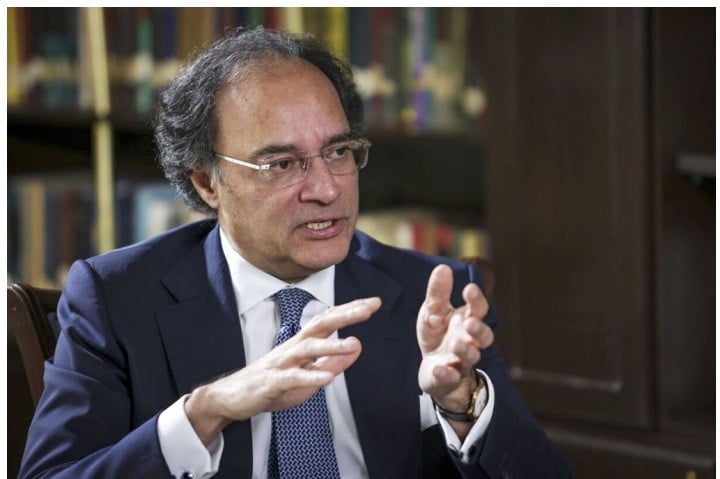
ISLAMABAD: Pakistan has so far withstood the energy-price shock from the Iran war, though attacks on Gulf energy infrastructure threaten to prolong the damage, Finance Minister Muhammad Aurangzeb said.
The warning comes as oil climbs back toward levels last seen in the spring. Brent crude settled at $109.86 a barrel on Friday, up 3.7% on the day and 4.8% on the week, after briefly touching $110 for the first time since May. Traders have been weighing attacks on shipping near the Strait of Hormuz and a run of Houthi strikes on Saudi Arabia.
Aurangzeb, speaking to AFP on the sidelines of the IMF-World Bank annual meetings in Bangkok, said the South Asian nation has secured enough energy supplies to last through November and is now planning for winter, when household demand typically peaks.
“The first-order impact has been negotiated well by Pakistan,” he said. “We’ve had no shortage, no queues at the gas stations, and no law and order situation, which at times we have seen in some of the countries.”
Unless the government sees “an absolute dire need,” it won’t buy spot cargoes of liquefied natural gas, which tend to cost far more than previously contracted shipments, he said.
The war began in February, when the US and Israel struck Iran. Tehran’s retaliation, which has targeted Washington’s Gulf allies and curtailed oil and gas supplies, has pushed global energy prices sharply higher. About one-fifth of the world’s oil and LNG shipments passed through the Strait of Hormuz before the conflict.
Yemen’s civil war has also flared again, and the Houthis have repeatedly attacked Saudi infrastructure, including energy facilities and airports, in recent days. Aurangzeb said damage to such sites would push back any return to economic normalcy.
“What is now (the) worrying part of it is when the energy infrastructure starts getting hit,” he said. “I, to be very honest, I don’t know where that would go. But one thing is very clear: that if the infrastructure continues to get hit, the return to normalcy, even if things subside, will take longer.”
IMF Backdrop
Pakistan is in its 25th program with the International Monetary Fund since independence in 1947, at least 11 of which were outright bailouts. The current arrangement totals about $7 billion over three years. IMF staff reached an agreement on Oct. 8 on the latest reviews, which would open access to about $1.2 billion, including roughly $1 billion under the Extended Fund Facility and about $210 million under the Resilience and Sustainability Facility. The deal still needs approval from the IMF’s executive board. If approved, total disbursements under the two arrangements would reach about $5.7 billion.
The IMF team, led by Iva Petrova, said Pakistani authorities had navigated the impact of the Middle East conflict and preserved macroeconomic stability. Foreign-exchange reserves rose to about $21.5 billion by the end of September, according to the IMF’s assessment.
The fund used this year’s annual meetings to urge all economies, including those most exposed to the war’s fallout, to pursue fiscal consolidation and avoid a debt crisis.
“Fortunately for us, we have been on this fiscal consolidation path for a while,” Aurangzeb said.
Tax revenue has risen significantly in recent years, he said. The government is now targeting businesses that collect sales tax from consumers but never pass it on to the state, a practice he said costs billions of dollars. He added that there is “room for improvement” in income-tax collection.
The reform agenda has met resistance from industry, lobbying groups and vested interests, he said. “Every reform, everything that you try to do when you try to change the status quo, there is pushback.”
Privatising state-owned assets is a core pillar of the IMF program. In Pakistan, the military runs a sprawling business empire spanning real estate to fertiliser. Asked about those companies, Aurangzeb denied they receive state funding.
“As far as we are concerned, whichever commercial enterprises (the military) are running, they are running on a standalone basis and profitable on their own basis,” he said. “So, I can confirm to you, we are not providing any funds from the exchequer.”
The military has ruled Pakistan directly for about two-fifths of its history. Under army chief Field Marshal Asim Munir, it has tightened its hold on key levers of power, even as a civilian government nominally runs the state.
Gulf Bank Meetings
Aurangzeb also held talks on Saturday with several Gulf lenders in Bangkok, the Finance Division said. He met delegations from Abu Dhabi Commercial Bank, Ajman Bank and Sharjah Islamic Bank, as well as JPMorgan Chase & Co.
Across the meetings, he stressed replacing costly short-term borrowing with longer-dated debt, extending maturities and reducing repayment concentrations without raising overall external debt, according to the ministry. Topics included prospective sukuk, rupee-denominated but dollar-settled instruments, further Panda bond issuance and a possible tokenisation of Eurobonds.
With Abu Dhabi Commercial Bank, the talks covered restored credit limits for Pakistan, participation in financing from the International Islamic Trade Finance Corp., and transactions backed by the World Bank’s Multilateral Investment Guarantee Agency and the International Finance Corp. The latter includes a diversified payment rights deal. Aurangzeb pointed to investment openings in refinery upgrades, privatisation, airport outsourcing, electricity transmission and the ML-1 railway. The two sides also discussed data-centre financing and the need for competitive power prices and an effective regulatory framework. Follow-up will run through the Debt Management Office at the Finance Ministry.
Ajman Bank’s delegation discussed prospective sukuk and the broader diversification of funding sources. The ministry said discussions also covered targeted fuel subsidies consistent with fiscal discipline, as well as Pakistan’s de-escalation efforts and fertiliser availability that helped safeguard food security.
Sharjah Islamic Bank’s meeting touched on capital-market benchmarks through financial-institution issuance and more lending to businesses, small and medium-sized enterprises and agriculture. Aurangzeb cited improved fiscal and external indicators, stronger reserves and credit-rating upgrades.
JPMorgan discussed Pakistan’s ambition to move into the BB rating category and offered analytical support on the key indicators and institutional changes involved, the ministry said. Aurangzeb thanked the bank for its advice on an opportunistic approach to issuance given global interest-rate risks, and for investor outreach and private-placement underwriting support. Other topics included remittance flows, regional risks, potential debt swaps, credit enhancement and secured financing.
Pakistan has been rebuilding its external buffers through a return to international capital markets. It raised $750 million from a Eurobond in April, its first dollar bond sale in about five years. In May it sold its debut Panda bond, 1.75 billion yuan ($250 million) of three-year notes priced at a 2.5% coupon, drawing orders of more than five times the amount offered. The government has also said it issued more than 2 trillion rupees ($7 billion) of sukuk last year.
Copyright © 2021 Independent Pakistan | All rights reserved