By Staff Reporter
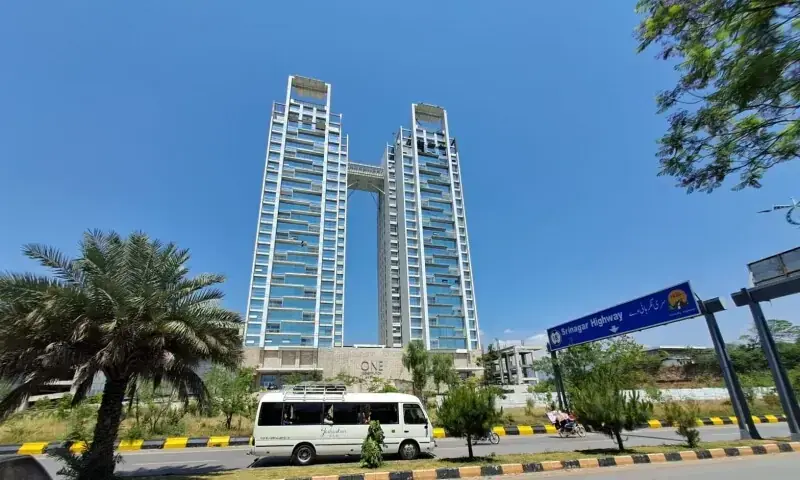
ISLAMABAD: The Islamabad High Court on Monday barred the Capital Development Authority from evicting residents of One Constitution Avenue, a luxury residential and commercial tower in the heart of Pakistan’s capital, issuing a stay on intra-court appeals until the full case can be heard.
A two-judge bench comprising Justice Muhammad Azam Khan and Justice Raja Inaam Ameen Minhas directed the authority not to take any coercive action against the occupants pending the next hearing. The ruling came after lawyers for the residents argued that the Capital Development Authority had long been aware of their presence in the building and had even collected lease-related payments from them.
“We want the CDA board to hear us and give us an opportunity to prove our innocence,” said Sardar Taimur Aslam, one of the residents’ lawyers. The dispute centers on a 2005 lease agreement between the Capital Development Authority and BNP (Pvt.) Ltd. for the development of a five-star hotel on prime land in Islamabad’s high-security Red Zone, an area that houses key government offices and diplomatic missions. The developer later converted the project into One Constitution Avenue, a high-end residential and commercial complex.
The authority terminated the lease in 2016. The Supreme Court restored it in 2019, but only on the condition that the developer pay 17.5 billion rupees in structured installments backed by bank guarantees. The lease could be canceled only in the event of default and after a 30-day notice.
Last month, the Islamabad High Court upheld the authority’s decision to cancel the lease after BNP defaulted on payments, particularly the 2022 installment. A single-bench ruling by Chief Justice Sardar Muhammad Sarfraz Dogar dismissed petitions filed by the developer and investors, declaring that third-party buyers would “sink or sail” with the original lessee. The judgment added that sub-lessees claiming to be bona fide purchasers could not seek relief under Article 199 of the Constitution without further evidence and would have to pursue claims against BNP in a court of competent jurisdiction.
The decision triggered an uproar. Residents complained that authority officials, accompanied by police, had broken down doors to serve eviction notices. On May 1, Prime Minister Shehbaz Sharif ordered a halt to further action and formed a high-level committee to review the evictions. The Bank of Punjab and several flat owners then filed intra-court appeals challenging the single-bench verdict.
During Monday’s hearing, the bench pressed both sides on key procedural and factual questions. Justice Khan asked whether sub-leasing had been formally documented or handled informally. Ali Raza, another lawyer for the residents, contended that the Capital Development Authority had originally leased the land, that subleases had been executed while the primary lease remained intact, and that partial payments received by the authority were sufficient to cover the space occupied by the residential towers.
Appearing for the authority, Kashif Ali Malik reminded the court that the Capital Development Authority is the custodian of the land and that the Supreme Court’s 2019 order requiring the 17.5 billion-rupee payment was a matter of public record. “Why did people invest in risky properties?” he asked. Justice Minhas observed that the authority had sent letters to the builder and was fully aware that residents occupied the building. Justice Khan inquired whether a completion certificate had ever been issued for the project. Malik replied that none had been issued to date and that residents possessed no documents from the Capital Development Authority.
The judges also drew a parallel to an earlier case involving the National Police Foundation housing scheme, which was declared illegal in its entirety yet whose residents were not dispossessed. Justice Minhas noted that the court would first examine the request for a stay before turning to the merits of the appeals. He questioned when the authority had appointed an administrator for the building; Raza said it was March 12, 2023.
Aslam told the court that the Capital Development Authority itself should not object to the current arrangement, noting that a residents’ committee had been managing the property. He added that the prime minister’s committee was still reviewing the matter and that its recommendations would eventually require approval by the federal cabinet and the Capital Development Authority board. Raza further pointed out that the authority had previously recognized the apartment owners’ rights and had collected 15 to 18 percent lease charges from them.
Court records also revealed new details about the project’s troubled history. A 2012 interim arbitration award, issued by then-incumbent Defence Minister Khawaja Muhammad Asif and Mian Hamid Javed, former president of the Faisalabad Chamber of Commerce and Industry, had attempted to resolve disputes between the project’s main partners, Abdul Hafeez Sheikh of BNP and Nadeem Zia Pirzada of Paragon.
Documents placed before the court showed that 240 flats had been sold to a striking roster of Pakistan’s political and judicial elite. The buyers included a former acting president who served two non-consecutive terms, a former chairman of the Senate, a former prime minister, two former chief justices of Pakistan, a former chief justice of the Lahore High Court, and a former defence minister, among other prominent ex-officeholders.
Copyright © 2021 Independent Pakistan | All rights reserved