By Staff Reporter
KARACHI: A liquefied natural gas tanker slipped out of the Strait of Hormuz on Monday bound for Pakistan, while a supertanker carrying Iraqi crude for China finally cleared the Middle East Gulf on Saturday after nearly three months stuck inside, shipping data showed.
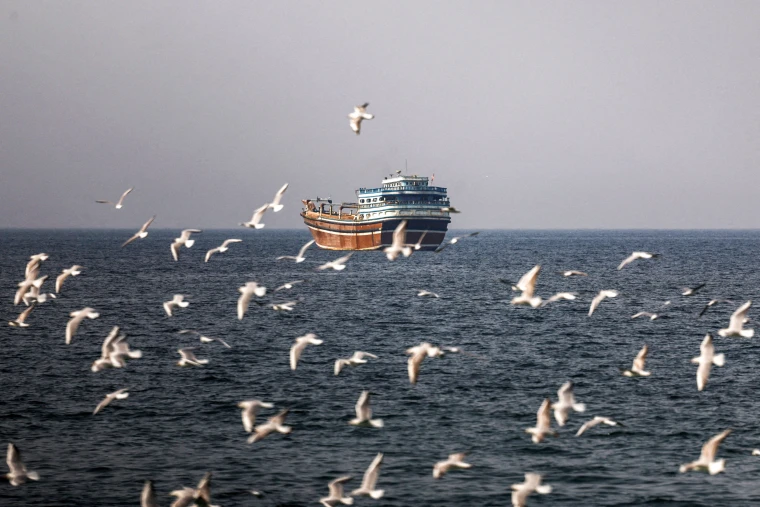
The two vessels are the latest in a small group of supertankers to exit the Persian Gulf this month, using a transit route ordered by Iran as the US-Israeli war that began Feb. 28 has sharply reduced traffic through the narrow chokepoint. The strait normally carries about one-fifth of the world’s oil and LNG supply.
The Bahamas-flagged LNG carrier Fuwairit was crossing the strait on Monday and is scheduled to discharge its cargo in Pakistan on Tuesday, according to data compiled by LSEG and Kpler. The vessel loaded at Qatar’s Ras Laffan terminal around March 28. It is owned by Japan’s Mitsui O.S.K. Lines Ltd. A representative for the company could not be reached for comment outside regular business hours.
Separately, the Singapore-flagged very large crude carrier Eagle Verona left the Gulf on Saturday and is expected to arrive at Ningbo, in eastern China, on June 12 to unload, the data show. Chartered by Unipec, the trading arm of China’s Sinopec Ltd., Asia’s biggest refiner, the ship loaded nearly 2 million barrels of Basrah crude on or around Feb. 26. Representatives for Sinopec and the vessel’s owner, Malaysia’s state-controlled shipper MISC Bhd., could not be reached outside office hours.
Last week alone, three other VLCCs carrying a combined 6 million barrels of crude sailed from the Gulf to China and South Korea. Before the conflict erupted, shipping traffic through the Strait of Hormuz averaged 125 to 140 passages a day. The war has dramatically curtailed those flows, leaving an estimated 20,000 seafarers stranded aboard hundreds of vessels still inside the Gulf.
The resumption of even limited tanker movements highlights the persistent commercial pressure to keep energy supplies moving from the world’s most important hydrocarbon export region, even as geopolitical tensions remain high. Iran has directed vessels to follow a specific transit corridor in recent weeks, according to people familiar with the instructions, a measure aimed at managing risk in the congested waterway.
The Fuwairit and Eagle Verona departures come more than three months after the outbreak of hostilities, which quickly disrupted the normal rhythm of oil and gas exports that underpin economies from Asia to Europe. While the volume remains a fraction of pre-war levels, the successful transits suggest that some operators are finding ways to thread the needle through the strait under the new constraints.
Copyright © 2021 Independent Pakistan | All rights reserved