By Staff Reporter
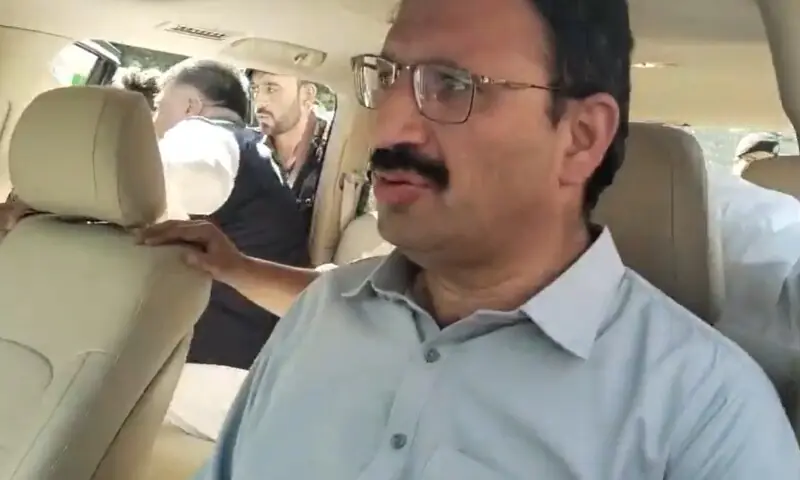
Gilgit: Police in Gilgit-Baltistan detained and later expelled Junaid Akbar, president of the opposition Pakistan Tehreek-e-Insaf’s Khyber Pakhtunkhwa chapter and a member of the National Assembly, along with six other party figures on Friday as the region’s political parties intensified campaigning for legislative elections set for June 7.
The detentions, which authorities described as enforcement of the election code of conduct, immediately drew sharp condemnation from PTI leaders, who called the action political revenge and an assault on democracy. The episode unfolded amid longstanding questions about fairness in the vote for the region’s fourth Legislative Assembly, a body whose limited autonomy stems from a 2009 presidential order.
GB police officials said they took Akbar and his associates into custody after he addressed a rally in the Jaglot area and held a public gathering in Gilgit without securing a required no-objection certificate. Among those detained were Syed Mehboob Shah, Salimur Rehman, Dr. Amjad Ali Khan, Muhammad Naeem Khan, Ziauddin, and Arshad Meer. Authorities said the group was apprehended in the Hanzel area.
Sajid Ali Baig, the Gilgit-Baltistan home minister, told reporters that the action was taken because the PTI leaders had violated clear rules governing campaign activities. “Indiscriminate action will be taken against the violation of the election code of conduct,” he said.
The PTI party officials, including in posts on X, said Akbar and the others were stopped at a check post while returning from the Ghizer district, where they had gone to hold a rally. The group was then taken to Gilgit, the party said. Akbar himself posted that authorities first blocked their travel to Ghizer for lack of a “permit,” then ordered him to leave Gilgit and later stopped the group again at a check post. “Isn’t Gilgit-Baltistan a part of Pakistan? Why does a Pakistani need a no-objection certificate to travel within their own country?” Akbar wrote. In another post he added, “I was told to leave Gilgit as I don’t have an NOC, and now I have been stopped at the checkpost again. Is Gilgit-Baltistan not a part of Pakistan?”
The party later announced that Akbar and his companions had been expelled. PTI Chairman Barrister Gohar Ali Khan issued a statement condemning the arrests, saying that denying political space even in Gilgit-Baltistan would harm democracy across the country. “Preventing political workers from running election campaign ahead of polls is tantamount to rigging,” he said.
Sheikh Waqas Akram, a PTI information secretary, said that others from Swat and surrounding areas had also been removed from the region. He contrasted their treatment with that of candidates from other parties, who he said were campaigning with helicopters and government protocol. “The government was not allowing a level-playing field ahead of the election,” he said.
The PTI described the episode as “political revenge, pre-poll rigging and an attack on democracy” and demanded fair and transparent polling with equal opportunities for all parties. The party has accused the federal government of broader interference, including snatching its election symbol and providing VIP treatment to PML-N leaders while blocking PTI activities.
Khyber Pakhtunkhwa Chief Minister Sohail Afridi warned that if the parliamentarians were not released, he would travel to Gilgit-Baltistan himself “to question the puppet GB government.” He added that such actions were “harming Pakistan,” “increasing hatred,” and “creating divisions,” and accused authorities of destroying the democratic system by sidelining Imran Khan’s party. Afridi said the Gilgit-Baltistan chief minister had not responded to his calls and said, “We will not let GB turn into a no-go area.” The people of the region, he said, would “avenge this dishonour of their guests through their votes.”
The June 7 election will choose members of the 24-constituency Legislative Assembly in a region that gained a measure of self-governance through the 2009 Gilgit-Baltistan (Empowerment and Self-Governance) Order signed by then-President Asif Ali Zardari. Yet the vote is taking place against a backdrop of demographic shifts that have not been fully reflected in electoral boundaries.
Officials report 963,034 registered voters — 506,097 men and 456,937 women — a 29 percent increase since 2020. The gender gap in registration has narrowed to 4 percent from 8 percent. Despite the visible population growth, there has been no fresh delimitation of constituencies since 1994; an Election Commission source cited the confidential nature of the region’s census as the reason.
The field of candidates also highlights persistent patterns. Of nearly 400 aspirants across the 24 seats, only eight are women, and just three are running on party tickets — one each for the Pakistan Peoples Party, the IPP, and the Pakistan Nazriyati Party. That low participation mirrors previous elections: four female candidates in 2009, three in 2015, and four in 2020.
Among major parties, the PPP has nominated 23 candidates, the PML-N 22, and the IPP 15. The Nazaryati Party fielded 10, Islami Tehreek Pakistan 10, JUI-F nine, Majlis Wahdat-ul-Muslimeen seven, Jamaat-e-Islami six, and MQM six. The PTI, through a seat adjustment with MWM on four constituencies, is contesting 23 of the 24 seats.
Copyright © 2021 Independent Pakistan | All rights reserved