By Staff Reporter
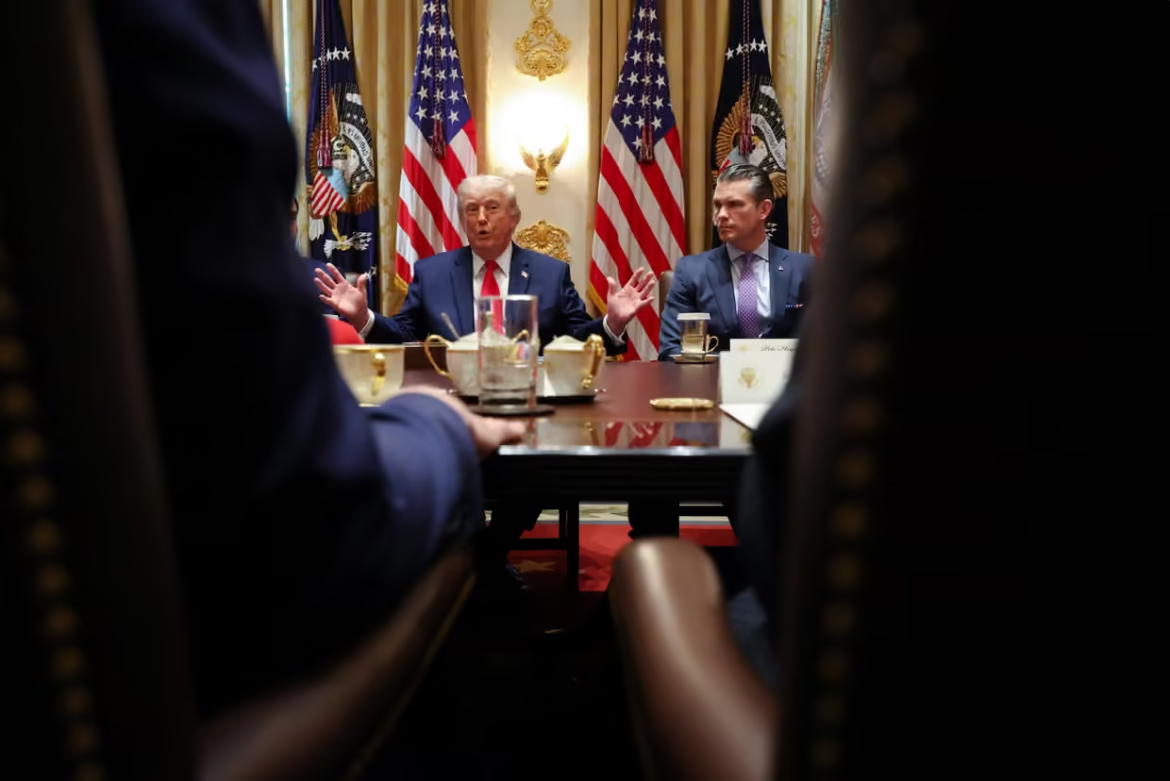
There is a particular kind of political theatre that only Donald Trump can produce — one where spectacle and genuine crisis become so thoroughly entangled that it grows almost impossible to distinguish posturing from policy. This week’s cabinet meeting at the White House offered yet another masterclass. Asked whether he would accept a short-term arrangement allowing Iran and Oman to jointly oversee passage through the Strait of Hormuz, the President of the United States responded with characteristic economy of thought. “Oman will behave just like everybody else,” he said, “or we’ll have to blow them up.”
Not Iran. Oman.
A country of 5.3 million people. A state with which the United States has maintained diplomatic relations for more than two centuries. A nation that was, until approximately forty-eight hours before those remarks, regarded as one of America’s most indispensable back-channel interlocutors in the entire Middle East. The kind of ally that, in any conventional diplomatic context, you treat with extreme care — precisely because you need it.
Trump’s threat, later amplified and confirmed by the State Department on social media, sent shockwaves through a Gulf region already living on its nerves. Senior Omani diplomats were, according to multiple reports, “shocked and furious.” Omani newspapers did not report the comment at all — a silence that speaks its own diplomatic language. In London, Samir Puri, a visiting lecturer in war studies at King’s College, called it “really surprising,” warning that it would “send shockwaves across the region.” He added, pointedly, that he could not see “how bombing Oman would necessarily change Iran’s calculus” on Hormuz. It would not, of course. It would detonate what remains of America’s already battered standing in the Gulf while handing Tehran the narrative gift of a lifetime.
But Trump’s Oman threat is not just another entry in his long catalogue of diplomatic recklessness. It is, in a very real sense, a symptom of the deeper bind his administration has constructed around itself over the past three months — a bind in which every pressure point available has already been squeezed, every threat has already been issued, and every red line has already been either crossed or quietly abandoned. The result is a diplomatic impasse dressed up as momentum, a ceasefire that both sides simultaneously claim is holding and violating, and a peace process that appears to move in frantic circles without advancing an inch toward resolution.
The money problem that neither side can solve
At the heart of the current deadlock lies something almost mundanely transactional: $12 billion. Iran is demanding access to a portion of the roughly $24 billion in its assets frozen in foreign banks — money it regards not as a concession but as the return of what is already its own. Tehran has been unequivocal: meaningful negotiations cannot begin without the funds’ release. A senior US administration official was equally unequivocal in the opposite direction, telling reporters that Iran would need to commit to surrendering its highly enriched uranium first. “No dust, no dollars,” the official said, borrowing Trump’s term — “nuclear dust” — for enriched uranium.
And then there is Trump himself, who at Wednesday’s cabinet meeting framed the frozen funds with characteristic bluntness. “We have control of money that they claim is theirs,” he said. “When they behave properly, and when they do what’s right, we’ll let them have their money.”
The awkwardness in that word “claim” should not pass unnoticed. Under international law, much of this money is, in fact, Iran’s. It is not American leverage to be dispensed as reward for good behaviour. But the political reality within which Trump must operate is corrosive. He has spent years savaging Barack Obama’s 2015 nuclear deal, and in particular the $1.7 billion — the first $400 million of it in stacked foreign currency flown into Tehran — that was paid to settle a decades-old financial dispute as part of the deal’s implementation. That episode, mockingly christened “Pallets of Cash” by Republican critics, haunts the current negotiations like an unwanted ghost. Trump posted images of the Obama-era pallet of cash alongside a US warship firing at aircraft just days ago, lest anyone misunderstand where he stands.
And yet — this is the inescapable irony — the deal he is reportedly circulating among allies including Israel is not dramatically different from what Obama’s diplomats laboured to construct. Under the draft framework, Washington’s naval blockade of Iranian ports would be lifted, Iran would gain access to as much as $12 billion in frozen assets, and the Strait of Hormuz would be reopened to commercial shipping within thirty days. A sixty-day negotiating window would then open on the future of Iran’s nuclear programme, including discussions about its stockpile of highly enriched uranium and a time-limited suspension of further enrichment under IAEA supervision. Iran would renounce nuclear weapons.
For a man who made the JCPOA’s destruction a signature promise of his political career, this is a remarkable destination — though one he will undoubtedly insist is entirely different in kind. The optics of writing a cheque to Tehran, whatever the formal mechanism, will not be easy. Miad Maleki, a senior fellow at the Foundation for Defense of Democracies who oversaw sanctions campaigns at the Treasury’s Office of Foreign Assets Control, has suggested a workaround: the administration could release the funds directly to exporters rather than depositing them in Iranian government accounts, bypassing formal sanctions relief. He calls it a “light lift.” It may well be the ladder Trump uses to climb down.
But the structural problem runs deeper than optics. Unlocking the frozen assets at this initial stage of talks, before Iran has made any firm nuclear commitments, contradicts the entire logic of the maximum pressure campaign. As Alex Zerden, who worked on sanctions compliance and Iran-related financial intelligence in multiple government roles, has pointed out, it doesn’t align with what the US has been doing economically. More remarkably, he observes that what was “unthinkable as a precondition during the first Trump administration” is now openly on the table. The goal posts have not merely shifted; they have been dismantled and moved to a different field.
A strait, a toll, and the architecture of humiliation
The Strait of Hormuz is not simply a geographic feature. It is, at this moment, the single most concentrated expression of the war’s unresolved political questions. A fifth of the world’s seaborne oil trade and a fifth of global liquefied natural gas normally pass through it. Iran closed it in response to the US-Israeli strikes of 28 February and has since asserted a degree of sovereignty over it that has no basis in international maritime law — but which the IRGC is enforcing with warning shots, intercepted tankers, and mandatory permission requests for passage.
Washington has countered by imposing sanctions on Iran’s newly formed “Persian Gulf Strait Authority” — the IRGC’s administrative vehicle for monetising control of the waterway — and by enforcing a naval blockade of Iranian ports. The US Treasury has described the scheme as “a new attempt by Iran’s Islamic Revolutionary Guard Corps to monetise its campaign of state-sponsored terror.” The IRGC, for its part, issued a statement this week asserting that “seeking permission is mandatory and passage through other routes will be considered as disruption.” Both positions are, functionally, correct about only one thing: no deal has been struck.
The Iran-Oman talks that so infuriated Trump were an attempt to find a way through this impasse — specifically, by dressing Iranian control as a jointly administered technical service, with fees framed as “navigational service charges” rather than tolls. Under international maritime law, the distinction matters enormously. Countries bordering natural straits cannot charge passage fees. They can, however, charge for services. It is the legal equivalent of the difference between a toll road and a valet service — and everyone involved knows exactly what it is.
Trump, to his credit, understands what Oman’s involvement would mean strategically. Muhanad Seloom, a non-resident senior fellow at the Middle East Council on Global Affairs, laid it out with clarity: joint Iran-Oman control would “turn Iran’s grip on the chokepoint into a permanent post-war fact rather than a temporary act of war,” set a precedent for littoral states to “metre and monetise” an international waterway, and “hand Tehran a strategic win that outlasts any ceasefire.” The White House is therefore right to resist it. What it is not right to do — what no coherent diplomatic strategy could endorse — is threaten to bomb the mediating ally whose territorial waters form half the strait in question, whose goodwill is essential to any durable resolution, and whose quiet diplomacy has been keeping back-channel lines open since long before this war began.
Raed Jarrar, advocacy director at the rights group DAWN, captured the wider stakes precisely. Trump’s threat, he argued, is “the same lawless logic that produced this war in February, and it is the clearest possible signal that any ceasefire this administration brokers will hold only until the next time the president loses his temper at a cabinet meeting.” The UN Charter, as Jarrar noted, prohibits the threat of force against any state. The United States is not exempt.
A ceasefire that limps, and the diplomacy that props it up
The ceasefire of 8 April — now seven weeks old, which is itself a minor miracle given the week both sides have just had — is technically still in place. But “technically” is doing a great deal of work in that sentence. Iranian forces have struck a US air base, with a ballistic missile intercepted over Kuwait. US Central Command has described this as “an egregious ceasefire violation.” Washington has hit what it calls a “ground control site” in Bandar Abbas. Tehran has called this aggression that “will not go unanswered.” Both sides have, meanwhile, continued insisting that the ceasefire has not collapsed.
It is a curious war, this one. Both parties behave simultaneously as combatants and negotiators, launching strikes while simultaneously dispatching envoys to Islamabad and Doha. Pakistan’s foreign minister is flying to Washington this week. Qatar, where some of Iran’s frozen assets are held, is continuing to mediate. China is pressing for UN Security Council ratification of any final agreement. The diplomatic machinery is, if not exactly humming, at least still moving.
What it has conspicuously failed to produce is the memorandum of understanding that was supposed to be imminent last week, and the week before that. The Iranian state media report of a fourteen-point draft MOU — including the lifting of the naval blockade, the withdrawal of US forces from Iran’s “vicinity,” and Iran-Oman joint management of the strait — was called “a complete fabrication” by the White House. The mutual incompatibility of what each side claims is in the draft is itself diagnostic. These are not parties who have agreed on the broad shape of a settlement and are haggling over details. These are parties who remain fundamentally apart on the central questions, and who are — in Tehran’s case at least — engaged in a parallel effort to shape international perceptions of the negotiating landscape.
Robert Malley, the Middle East programme director at the International Crisis Group, who helped negotiate the Obama-era Iran nuclear deal, has been pointed in his assessment: Tehran’s new post-war leadership appears to believe it won this confrontation with a superpower, even with its economy in ruins and its citizens facing “dire conditions.” That belief — accurate or not — fundamentally complicates the prospect of any deal that Washington would find acceptable. CNN’s senior diplomatic analyst offered the same cautionary note: any Iranian promise not to pursue nuclear weapons “would be greeted with great reservations in Washington,” and Iran’s record suggests it “would love to drag the United States into a prolonged period of inconclusive diplomacy that lasts months or years.”
The dealmaker exposed
Perhaps the most consequential damage from this conflict is not military but political — and not international but domestic. Trump built his entire political persona around the proposition that he alone could close deals that lesser men could not. The Iran conflict has subjected that proposition to a stress test it has not survived.
His approval rating among Republican voters has dropped to 80 percent — a new low. Among non-MAGA Republicans, it sits at 54 percent. Gas prices are rising. Gulf allies who have absorbed Iranian retaliatory strikes — including severe damage to the UAE’s Habshan refinery, which will not be fully repaired until 2027 — are unnerved rather than reassured by American military power. NATO allies who were asked to join the campaign declined. His condemnation of Britain for non-participation was followed by administration briefings about reviewing UK sovereignty over the Falklands. His dismissal of German Chancellor Merz as someone who “didn’t know what he was talking about” produced precisely nothing in terms of changed behaviour from Berlin.
The most revealing aspect of Trump’s conduct, however, is his continued refusal to call the conflict what it is. He openly admitted he avoided the word “war” because congressional approval would be required. He called it a “military operation” while simultaneously, on other occasions, calling it a war. This linguistic gymnastics does not deceive anyone; it merely broadcasts the scale of his accountability problem. As Amnesty International has documented, more than 6,000 people have been arrested inside Iran since the offensive began — protesters, journalists, lawyers, human rights defenders. The costs of this conflict are human and irreversible, regardless of what label a president chooses to attach to them.
Trump, turning to his defence secretary at the cabinet meeting, said: “If they won’t, the man on my left is going to finish them off.” It was a line built for television. But wars require something beyond television lines. They require clarity of objective, alliance cohesion, diplomatic patience, and a willingness to absorb political costs without telegraphing your impatience to the adversary. On all four counts, this administration has been found wanting.
The narrow path forward
None of this means a deal is impossible. The ceasefire is holding, however barely. Negotiators on both sides have agreed a framework — subject to leadership approval from Washington and Tehran — for a sixty-day extension. Pakistan’s mediation has kept communication alive through repeated military flare-ups. Iran’s supreme leader, Mojtaba Khamenei, has asked officials not to “turn differences into divisions” — a sign, however faint, that Tehran’s internal debate about the wisdom of continued conflict is not entirely resolved in favour of the hardliners.
The narrow path to a deal runs through a sequencing agreement on the frozen assets and the strait — something that addresses Iran’s need for tangible economic relief without handing it what would amount to a formal endorsement of IRGC control over an international waterway. It requires the US to accept that Iran will not surrender its enriched uranium stockpile before a deal is reached, only that it will place it under negotiation. It requires Trump to find a way to call this a victory, whatever the underlying substance.
That is not nothing. Trump has demonstrated before that he can reframe a concession as a triumph when the political winds demand it. The question is whether the hardliners on both sides — Netanyahu in Jerusalem, the IRGC’s maximalists in Tehran — will allow the space for that reframing to occur.
What is not in doubt is that the present course is unsustainable. A ceasefire that both sides violate while pretending to observe is not a ceasefire; it is a slow-motion collapse. An ally you threaten to “blow up” at a cabinet meeting will not remain an ally indefinitely. A dealmaker who cannot close a deal — not for lack of effort, but because his methods have consistently undermined his objectives — is something else entirely.
The frozen assets will eventually be released. The Strait of Hormuz will eventually reopen. The nuclear question will eventually be addressed, in whatever unsatisfying, temporary, face-saving form diplomacy can manage. The more urgent question is what permanent damage has been done to American credibility, to its alliances in the Gulf and beyond, to the principle that threats from the world’s most powerful democracy are calibrated to strategic purpose rather than cabinet-meeting mood. That is the question this conflict will leave behind long after the uranium stockpiles and the frozen dollar amounts have been forgotten. And on that question, the answer is already becoming clear — and it is not a comfortable one.
Copyright © 2021 Independent Pakistan | All rights reserved